
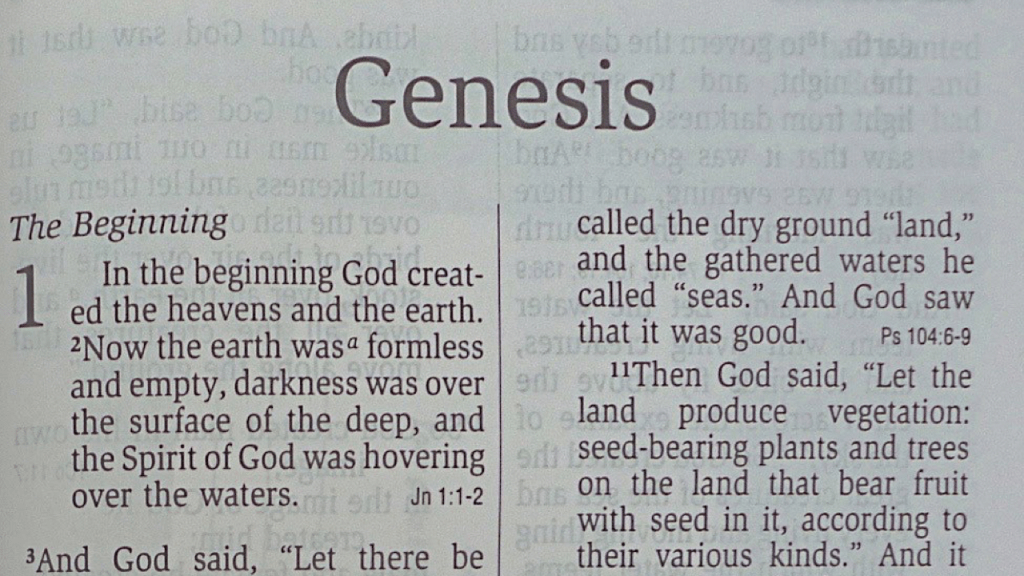
“In the beginning, God created the heavens and the earth.” (Genesis 1:1 (ESV)
The basis for the propositional truth for the worldview of Biblical Theism, and its consequential implications including being accountable to the God of the Bible, stems from the very first verse from the first chapter of the first book of the Bible: Genesis 1:1. This verse is not an archaic, ancient or outdated text having no application to our lives today. Instead, the text establishes the foundation, source and starting point for all the biblical theist believes, and consequentially does, in knowing and living for God the Creator.
First, we observe the event of creation. “In the beginning” (Genesis 1:1, ESV). The phrase is one word in the Hebrew (רֵאשִׁית / rēʾšît). It refers to the point in time which is the beginning. It is the beginning of time at the point of the initiation of life that God created. The word appears fifty times in nearly all parts of the Old Testament. The primary meaning is “first” or “beginning” of a series.
This word may refer to the initiation of a series of historical events (Gen 10:10; Jeremiah 26:1) but it also refers to a foundational or necessary condition as the reverence or fear of God (Ps 111:10; Proverbs 1:7) and the initiation, as opposed to the results, of a life (Job 8:7; 42:12).
It is also used frequently in the special sense of the choicest or best of a group or class of things, particularly in reference to items to be set aside for God’s service or sacrifice. The “first fruits” (Lev 2:12; 23:10; Neh 12:44) and “choicest” (Num 18:12) fruits are so distinguished. Difficult uses of the term occur in several passages. In Deuteronomy 33:21 the King James Version reads “first part.” While in Daniel 11:41, the text reads “chief of the children of Ammon.”
The most important use of rē˒šı̂t in the Old Testament occurs in Genesis 1:1. There has been a great deal of debate over this use of rē˒šı̂t. Many commentators, both ancient and modern, have tried to read the phrase as “when” rather than “in the beginning” as do several modern English translations. John 1:1 correctly translates the Hebrew and follows the Greek Old Testament Translation precisely in its reading of Genesis 1:1.
“In the beginning was the Word, and the Word was with God, and the Word was God. 2 He was in the beginning with God. 3 All things were made through him, and without him was not anything made that was made.” (John 1:1–3 (ESV)
The use of this root word leaves no doubt that Genesis 1:1 opens with the very first and initial act of the creation of the cosmos. To the contrary, naturalists like Carl Sagan believe that the cosmos is all there ever was, all there ever is and all there ever will be. The Bible sets forth the propositional truth that the universe is a result from the creative act of the One, True Eternal God revealed in Scripture.
One commentator writes, “Genesis 1:1 tells us God made everything out of nothing. In the beginning, the verse tells us, there was nothing else besides the Almighty Himself. We read nothing of angels, human beings, or any physical material. Even time itself did not exist before the Creator acted to bring something out of nothing. Moses can only speak of a “beginning” in Genesis 1:1 because of God’s intervention to get things started. Prior to His work of creation, the Lord alone was, and He was from all eternity. As Hebrews 11:3 tells us, “The universe was created by the word of God, so that what is seen was not made out of things that are visible.”
Second, we observe the person responsible for creation: God. The word for God is אֱלֹהִים / ʾělohîm. This refers to the One, True God. We should note that though the form is a grammatical plural, the meaning is singular and many sources believe this implies a plurality of majesty or stateliness.
The true God ĕlōhı̂m functions as the subject of all divine activity revealed to man and as the object of all true reverence and fear from men. Often ˒ĕlōhı̂m is accompanied by the personal name of God, Yahweh (Genesis 2:4–5; Exodus 34:23; Psalm 68:18).
There are several descriptive words attached to the noun ˒ĕlōhı̂m. These serve as titles by which God reveals himself to his people. Several examples are as follows:
- hā˒ēl bêt-˒ēl “the El (God) of Bethel” (Genesis 31:13; 35:7).
- ˒ēl sal˒ı̂ “El (God) my rock” (Psalm 42:9).
- ˒ēl yĕšû˓ātı̂ “El (God) my Savior” (Isaiah 12:2).
- ˒ēl ḥayyāy “El (God) of my life” (Psalm 42:8).
- ˒ēl gōmēr ˓ālāy “El (God) the performer on me” (Psalm 57:3).
- me’˒ēl “The El (God) of … ” (Genesis 49:25).
- ˒ēlı̂ “My El” (God) (Psalm 89:26; 102:24; 118:28).
- hā˒ēl mā˓ûzzı̂ “El (God) my fortress” (2 Samuel 22:33).
- hā˒ēl ham˒azĕrēnı̂ ḥāyil “El (God) the girder of me with strength” (Psalm 18:32).
- hā˒ēl hannōtēn nĕqāmôt lı̂ “The El (God) giving me vengeance” (Psalm 18:47; 2 Samuel 22:48).
The title may also refer to God’s work in creation (Genesis 1:1; Isaiah 45:18; Jonah 1:9). It also focuses on His sovereignty, which is evident in Isaiah 54:5, (“God of All the Earth”); I Kings 20:28, (“God of the Hills”); and Jeremiah 32:27, (“God of All Flesh”).
Additional phrases emphasizing God’s sovereign rule include “The God of All the Kingdoms of the Earth” (Isaiah 37:16); “God of Heaven” (Nehemiah 2:4, 20); “Yahweh God of the Heaven” (Genesis 24:7; 2 Chronicles 36:23); “God in the Heaven” (2 Chronicles 20:6); “The Lord God of the Heaven and God of the Earth” (Genesis 24:3; Deuteronomy 4:39; Joshua 2:11); and “God of gods and Lord of Lords, the Great, the Mighty, and the Terrible Who Does Not Regard Favorites and Does Not Take Bribes” (Deuteronomy 10:17). An all-inclusive title is “God Most High” (Psalm 57:2).
The Creator-creature distinction is fundamental to biblical theology. Every act of sin arises when we forget that we are not the Creator and then attempt to live by our own rules thereby living in disobedience to the Creator.
Soli deo Gloria!
 His Word Today