
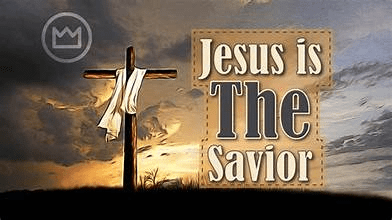
15 “The saying is trustworthy and deserving of full acceptance, that Christ Jesus came into the world to save sinners, of whom I am the foremost. 16 But I received mercy for this reason, that in me, as the foremost, Jesus Christ might display his perfect patience as an example to those who were to believe in him for eternal life. 17 To the King of the ages, immortal, invisible, the only God, be honor and glory forever and ever. Amen.” (1 Timothy 1:15–17 (ESV)
The following message is by Pastor Derek Thomas of First Presbyterian Church, Jackson, MS. Dr. Thomas preached it on Sunday, July 11, 2004. It is entitled The Savior of Sinners. The biblical text is I Timothy 1:15-17.
This morning, I want us to see three things and two applications. Three points of doctrine, if you like, and two applications.
- The Gospel is True.
The first point that Paul wants us to see here is that the gospel is true. The gospel is true. “Here is a trustworthy statement…” “Here is a trustworthy statement…” Now Paul has already warned us in this chapter, in verses three and four, of those who teach false doctrines; of those who propagate myths; and, those who take themselves to endless genealogies. And in contrast to all of that, this, Paul says, is a trustworthy statement.
He’s already warned us in verse six of some who have wandered away and turned to what he calls “meaningless talk”, but here is something entirely different.
Here are words, here are truths, that are entirely trustworthy. You can stake
your life on these words. They have all of the truth of God behind them.
Jesus, who said, “I am the Truth”; who in His high priestly prayer said “Thy
word is truth”; and again, “…the Scriptures cannot be broken.”
For Jesus, if it was written in the Scriptures, it was sufficient for Him. You remember on three occasions, before the devil, He would say “It is written….” And Paul seems to be saying, ‘Yes, that’s true of all of Scripture, because “…all Scripture is given by inspiration of God, and is profitable for doctrine and reproof and correction, and instruction in the way of righteousness, that the man of God might be thoroughly furnished unto every good work…”’–but pay heed to these words, because these words are utterly trustworthy.
II. The Gospel is for all sorts and conditions of men.
The second thing I want us to see here is that the gospel is for all sorts and conditions of men. Here is “a trustworthy statement deserving full acceptance.” Now, without getting too technical, the grammar of what Paul is saying could be pointing backwards, as though Paul were saying that these words are worthy of being accepted because they are true; or,
as I think Paul is saying, pointing forward, that these words are true, and,
therefore, everybody should accept them. No matter who you are, no matter what
your background may be; no matter what your nationality; no matter what age you
are; no matter what educational distinctions may differentiate you from someone
else, here are words deserving of full acceptance. There is no reason…there
is no valid reason… why you shouldn’t accept these words–these words that
Paul is about to tell you.
Imagine for a moment a world in which these words were not given. Imagine a world without the Bible. Imagine you woke up one morning and there was no Bible. Not just that you’d lost your own personal copy of the Bible, but there was no Bible. Imagine a world in which all of the influence of the Bible had dissipated, and you’d be confronted by a world in
which the great literature would be well-nigh unintelligible.
Shakespeare would be unreadable, Newton would make no sense, everyday speech would be stammering, and halting and faltering; a change would come over the whole temper and tone of the nation. Life would become hectic and hurried, and vulgar. All restraints would suddenly be thrown off, leaving us to instinct and appetite.
Values would be blurred. Life would become meaningless, tragic, tedious, and
make no sense…and have no goal and no direction. And here is Paul saying
‘this is what gives life purpose, and this is what gives life meaning, and this
is what gives life a foundation. Here are words that are worthy of all
acceptation.’
III. The Gospel is about Jesus Christ.
And the third thing that I want us to see is that the gospel is about Jesus Christ. The gospel is about Jesus Christ. This is what Paul says is worthy of all acceptation. This is what Paul says is true: that Christ Jesus came into the world to save sinners. You understand that all theology is contained–well, almost all of theology is contained–in that one little sentence.
You know, do yourself a favor this afternoon. When you’ve had your roast beef and Yorkshire pudding, and you’ve had your little nap, take these words and mull them over in your mind. See how much theology, how much truth, you can draw just from these words. “Christ — Jesus–came–into the world–to save–sinners.” You understand, there’s a seven- or eight-point sermon in there somewhere…I don’t have time for that this morning.
Let’s take a little of it. His statement that’s worthy of all acceptation is about Christ Jesus. It’s about the Messiah of the Old Testament Scriptures, the seed of the woman who would crush the head of Satan, God’s gospel remedy for sinners. It’s about Jesus. It’s about King Jesus. It’s about Jesus, who is sitting at the right hand of God: that He came into this world, He became incarnate. The Christmas story… I know we’re in July, but this is the Christmas story. “He who thought it not robbery to be equal with God made Himself of no reputation…” that He humbled Himself; that He became obedient as a servant in fashion as a man. “The Lord of glory was,” in Wesley’s words, “contracted to a span.”1
At least one of you has held a little grandson in your arms in the last couple of weeks, and I’m sure you’ve rocked that little grandson back and fore and sung sweet nothings into his ear. And imagine that the Lord of glory became an infant. He became a human being. He came into this world, He came into this fallen world. He came to Bethlehem. He came and lived in Nazareth, where people said “no good thing comes out of that place.”
Not into a palace, not into the White House, but into a lowly stable in Bethlehem. He came into this world. He wasn’t in this world, He was outside of this world. He was the Son of God, He was at the right hand of the Father, but He became flesh and blood.
He was tempted in every point like as we are, yet without sin. He knows what it is to be thirsty; He knows what it is to be hungry. He knows what it is to be tired. He knows what it is to be tempted by the devil. He knows what it is to be let down; He knows what it is that your own family doesn’t understand you; He knows what it is to desire another path than the one that is laid before you, and to pray a prayer, “Father, if it be possible, let this cup pass from Me.” He came into the world, and He came into the world to save sinners.
Men took Him and they crucified Him. They nailed Him to a tree; they killed Him. And why? Because, as the Bible tells us from Genesis to Revelation, over and over and over, He died for sinners like you and me. The just for the unjust. That “by His stripes we are healed”; that “all we like sheep have gone astray, and the Lord has laid on Him the iniquity of us all.” That Jesus died in our stead. He took the punishment that our sins deserved, and took it upon Himself.
He took the wrath that our guilt deserves, and He took it upon Himself. And on that cross, He cried in dereliction, as the darkness of the wrath of God covered His face, “My God, My God, why have You forsaken Me?” And He did it for sinners. He did it for sinners like you and me. He was without sin. He was the just and holy one.
“Which of you convinces me of sin?” He would say. But He came into this world to save sinners, not just to die for sinners, but to rise again for sinners; to go to the right hand of God for sinners; to intercede for sinners; to call sinners like you and me out of darkness and into His most marvelous light. He died to give us new hearts. He died so that the Holy Spirit might come and indwell our hearts. He died so that He might witness with our spirits that we are the children of God, and if
children then heirs, heirs of God and joint heirs with Jesus Christ. He died to
rescue us.
He died to deliver us from the darkness and into the light, so that this morning, my friends, this is the true statement. This is the statement that is worthy of all acceptation. This is the statement that every single one of you should believe in, that Jesus came for sinners like you and me. It doesn’t matter who you are this morning, doesn’t matter where you are. It doesn’t matter what sins you’ve committed, what dark sins, what black sins, what secret sins, what sins that you’d be ashamed to speak about–doesn’t matter. Christ Jesus came into the world to save sinners like that, to rescue sinners like that.
Paul draws two conclusions and two points of application. We will examine both categories when next we meet. Until then, may we praise and honor the Lord.
Soli deo Gloria!
 His Word Today