
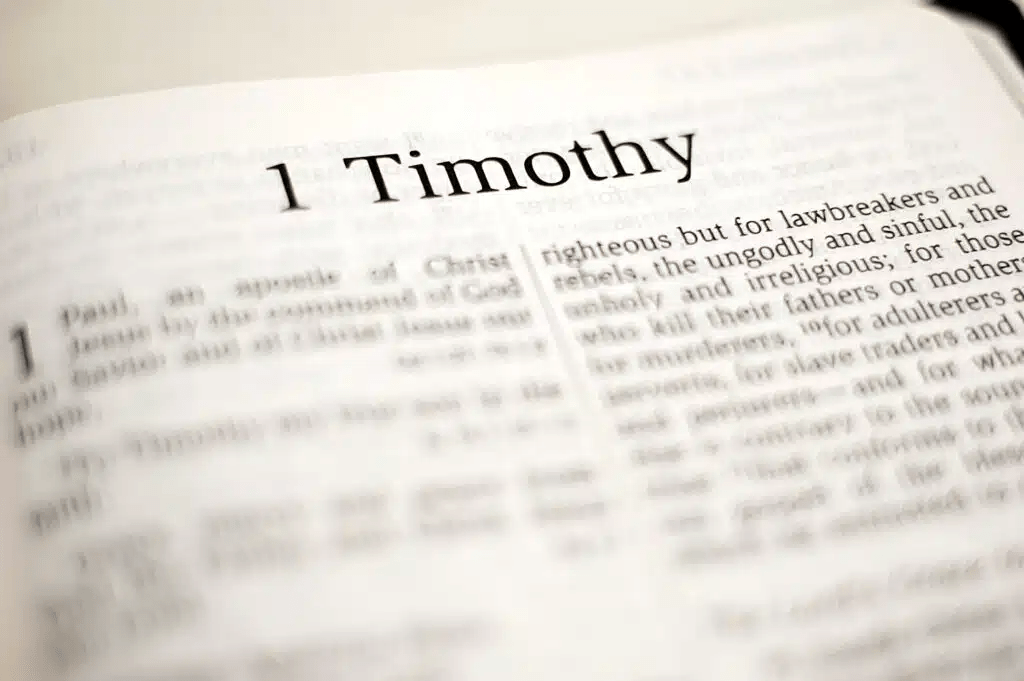
Our next study will focus on the New Testament Pastoral Epistles of I Timothy, 2 Timothy and Titus. They are referred to as Paul’s Pastoral Epistles because Timothy and Titus were respectively pastors in the Roman city of Ephesus and on the Island of Crete, which is located in the eastern portion of the Mediterranean Sea. We begin with an introduction of I Timothy.
I Timothy is the first of two inspired (2 Tim. 3:16-17; 2 Peter 1:20-21) epistles Paul wrote to his beloved son in the faith. Timothy means “one who honors God,” or “honoring God.”
“This is a very personal letter. From elsewhere in the New Testament we know that Paul was very fond of Timothy; he speaks of his love for the younger man and of his conviction that he was faithful (1 Cor. 4:17). Paul says further that Timothy could remind the Corinthians of Paul’s way of life, which indicates a certain intimacy and shows that Paul trusted him. It accords with this that he likens Timothy’s relationship to him to that of a son to his father (Phil. 2:22), and with a cheerful disregard for consistency speaks of him as a brother (and fellow worker, 1 Thess. 3:2). He links Timothy with himself in the opening greetings in some of his epistles (2 Cor. 1:1; Phil. 1:1; Col. 1:1; 1 Thess. 1:1; 2 Thess. 1:1), which argues that he was a trusted colleague. Paul asks the Corinthians to ensure that Timothy “has nothing to fear” if he should visit them (1 Cor. 16:10), which seems to indicate a certain diffidence about the young man. He sent him to the Thessalonians, he assures them, “to strengthen and encourage you in your faith” (1 Thess. 3:2), and he plans to send him to the Philippians, explaining, “I have no one else like him, who takes a genuine interest in your welfare” (Phil. 2:20),” explains D. A. Carson & Douglas J. Moo – An Introduction to the New Testament.
“All this gives point to Paul’s greeting, “To Timothy my true son in the faith” (1 Tim.1:2). The letter is written to a younger man for whom the apostle had a deep affection and whom he had for years entrusted with important missions. What Paul now says brings out the truth that Christians are linked in the service of the Lord and that there is significant help they can and should give to one another.”
After Rome released Paul from his first Roman imprisonment (cf. Acts 28:30), he revisited several of the cities in which he had planted and ministered, including Ephesus. Paul left Timothy behind in Ephesus to deal with problems that had arisen in the church, such as false doctrine (1 Tim. 1:3–7; 4:1–3; 6:3–5), disorder in worship (2:1–15), the need for qualified leaders (3:1–14), and materialism (6:6–19), Paul then traveled to Macedonia, from where he wrote Timothy this first letter to help him fulfill his pastoral and leadership duties (cf. 3:14–15).
First Timothy is a practical letter containing pastoral instruction (cf. 3:14–15). Since Timothy knew well Paul’s theology, the apostle did not need to give him extensive doctrinal instruction. However, I Timothy expresses many important theological truths. These include the proper function of the Mosaic Law (1:5–11), salvation (1:14–16; 2:4–6); the attributes of God (1:17); the fall (2:13–14); the person of Christ (3:16; 6:15–16); election (6:12); and the second coming of Christ (6:14–15).
What are some of the interpretative challenges in I Timothy? Here is a top ten list.
First, who are the false teachers (1:3) and the genealogies (1:4) involved in their teaching?
Second, what is meant to be “handed over to Satan” (1:20)?
Third, the letter fosters debate over the extent of the atonement (2:4–6; 4:10).
Fourth, the teaching on the role of women (2:9–15). What, if any leadership role is there for women in the church?
Fifth, what is meant be women being saved by bearing children (2:15)?
Sixth, what does it mean when an elder must be “the husband of one wife?” Does this exclude divorced or unmarried men from eldership (3:1)?
Seventh, does Paul refer to deacons’ wives or deaconesses (3:11)?
Eighth, can Christians lose their salvation (4:1)?
Ninth, who are the widows in 5:3–16—are they needy women ministered to by the church, or an order of older women ministering to the church?
Tenth, Does “double honor” accorded to elders who rule well (5:17–18) refer to respect or money?
I encourage you to begin reading I Timothy. May the Lord’s truth and grace be found here. Have a blessed day in the Lord.
Soli deo Gloria!
 His Word Today