
13 But we ought always to give thanks to God for you, brothers beloved by the Lord, because God chose you as the first fruits to be saved, through sanctification by the Spirit and belief in the truth. 14 To this he called you through our gospel, so that you may obtain the glory of our Lord Jesus Christ. 15 So then, brothers, stand firm and hold to the traditions that you were taught by us, either by our spoken word or by our letter.” (2 Thessalonians 2:13–15 (ESV)
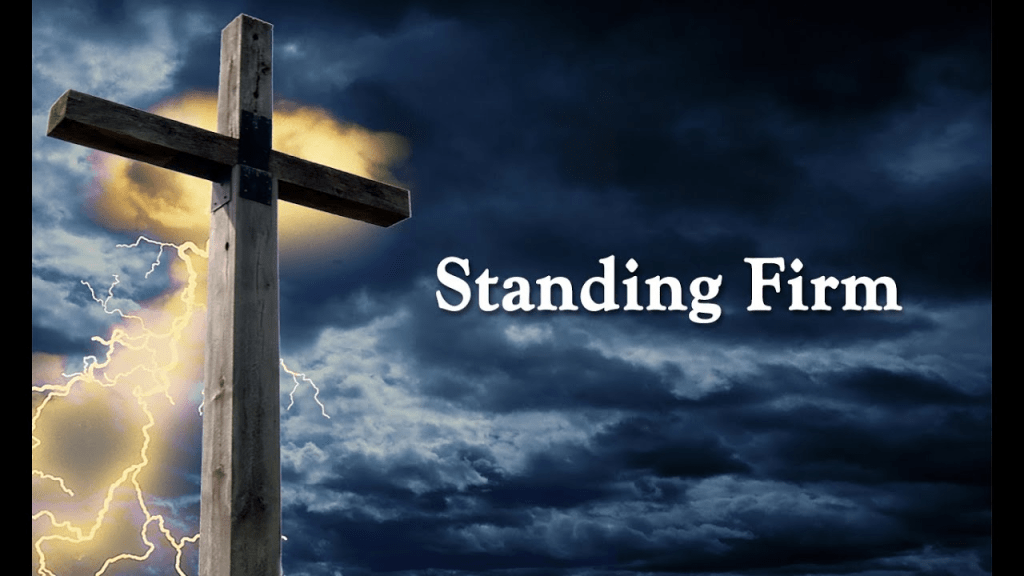
On the basis of God’s unconditional election of sinners unto salvation, which the Apostle Paul stated in vs. 13-14, what is to be the believer’s response? Paul sets for the purpose and response for the believer in vs. 15 of today’s text. Believers in Christ are to stand firm in biblical doctrine. Our trust in, commitment to, dependence upon and worship of the Lord must be grounded in biblical truth (Psalm 1; 19; 119; 2 Timothy 3:16-17; 2 Peter 1:20-21).
“Regrettably, many believers today regard Christian doctrine as merely theoretical, having no practical value. For Paul and the other Apostles, however, theology was immensely practical. Just consider 2 Thessalonians 2:1–12. Why does Paul remind us of various doctrines regarding what must happen before Christ returns? Because he does not want us to be “shaken in mind or alarmed” (v. 2). He teaches doctrine so that readers will enjoy the practical benefits of emotional stability and confidence in Christ,” explains Dr. R. C. Sproul.
So then, brothers (οὖν ἄρα; oun ara) can be translated “therefore.” This phrase indicates a conclusion, consequence or result. In other words, what is the consequential or resulting behavior of God’s people to His unconditional election of sinners unto salvation by grace alone, through faith alone, in Christ alone? The word brothers (ἀδελφοί; adelphoi) in the context refers to fellow believers in Christ or the church. (2 Thess. 1:1).
Believers in Christ are to stand firm and hold. To stand firm (στήκετε; stekete) is a present, active, imperative, plural verb. To stand firm is to be done presently, actively, obediently and collectively by the believing community. It means to have determination and steadfastness. To hold (κρατεῖτε; krateite) is also a present, active, imperative, plural verb. It means to seize and take possession. In what is the church to stand firm and hold?
To the traditions you were taught by us. Traditions (παραδόσεις; paradoseis) refers to doctrine or teachings handed down from one generation to the next generation. In this context, the traditions were the doctrines Paul, Silas and Timothy taught (ἐδιδάχθητε; edidachthete) and instructed the Thessalonian believers. This was done either by their spoken word (Acts 17:1-9) or by their first and second letter (I Thess. 1:1; 2 Thess. 1:1).
John Calvin writes, “Some restrict this to precepts of external polity; but this does not please me, for he points out the manner of standing firm. Now, to be furnished with invincible strength is a much higher thing than external discipline. Hence, in my opinion, he includes all doctrine under this term, as though he had said that they have ground on which they may stand firm, provided they persevere in sound doctrine, according as they had been instructed by him.”
“I do not deny that the term παραδόσεις is fitly applied to the ordinances which are appointed by the Churches, with a view to the promoting of peace and the maintaining of order, and I admit that it is taken in this sense when human traditions are treated of, (Matthew 15:6.) Paul, however, will be found in the next chapter making use of the term tradition, as meaning the rule that he had laid down, and the very signification of the term is general. The context, however, as I have said, requires that it be taken here to mean the whole of that doctrine in which they had been instructed. For the matter treated of is the most important of all — that their faith may remain secure in the midst of a dreadful agitation of the Church.”
“In context, the traditions to which Paul refers are found in 2 Thessalonians 2:1–12, where Paul reminds his readers that what he says in writing is what he had told them face-to-face (v. 5). In other words, Paul did not tell the Thessalonians by mouth anything other than the traditions he puts into writing. There is no body of teaching that the Apostles wanted the church to have that can be found outside the Scriptures,” concludes Dr. Sproul. (See 2 Tim. 3:16–17).
Scripture reveals what sinners must believe in order to be saved and how then they must live to please God. May the Lord’s truth and grace be found here. Have a God-honoring day in the Lord.
Soli deo Gloria!
 His Word Today