
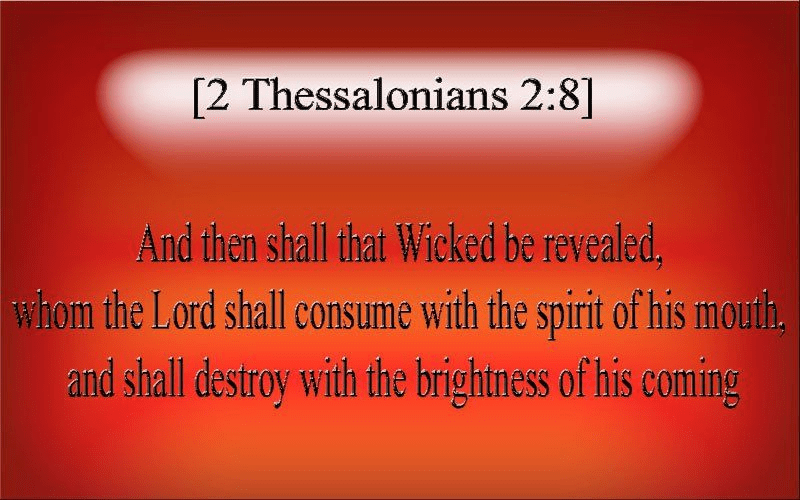
7 For the mystery of lawlessness is already at work. Only he who now restrains it will do so until he is out of the way. 8 And then the lawless one will be revealed, whom the Lord Jesus will kill with the breath of his mouth and bring to nothing by the appearance of his coming.” (2 Thessalonians 2:7–8 (ESV)
Not only have people asked me who the Antichrist is, they also inquire as to when he will appear or reveal himself. Today’s text, specifically vs. 8, answers the question. This involves the biblical doctrine of eschatology or the doctrine of the end times. However, biblical eschatology involves the now and the not yet. The New Testament church, since the Day of Pentecost (Acts 2), has lived in the last days or the period of time immediately prior to the Lord’s return (I Tim. 4:1; 2 Tim. 3:1).
“Biblical eschatology—the teaching of Scripture regarding the end times—is frequently thought to concern things that have not yet happened. When God’s Word addresses eschatological topics, many people suppose, it is speaking only of things that, from our perspective, are still to come. However, while biblical eschatology certainly involves things that lie ahead, we must not forget that according to the New Testament, the last days began during the ministry of Jesus and His death and resurrection,” explains Dr. R. C. Sproul.
“Peter’s sermon in Acts 2 makes this point, but we also see it in 2 Thessalonians 2:7. Paul notes that at the time of his writing, “the mystery of lawlessness” was “already at work.” Before Christ’s return, this mystery must reach its apex in the revelation of the man of lawlessness, one who embodies the spirit of antichrist most fully. But the presence of this mystery in the first century—and its continuing presence today—demonstrates that we are living in the final era of redemptive history. As 1 John 4:3 confirms, “the spirit of the antichrist . . . now is in the world already.”
At the divine decreed moment, the Lord will remove the restraint. This will allow the full fury of the satanic influenced individual to be revealed. Revealed (ἀποκαλυφθήσεται; apokalyphthesetai) means to disclose and to make fully known. It also means to uncover and to take out of hiding.
However, the divine reveal will coincide with the Lord Jesus Christ’s judgment upon the Antichrist. The text says the Lord Jesus will kill this individual. To kill (ἀνελεῖ; anelei) means to execute or destroy. The Lord will also bring to nothing all of this adversary’s plans.
“There will not be a long-drawn-out conflict, with victory now apparently with the lawless one, then with the Christ, this “round” going to Satan, that to the Christ. The issue will be settled in a moment. The Lord Jesus (see on 1 Thess. 1:1) will very summarily and decisively put an end to antichrist and his program. The entire description is symbolical. The two clauses are parallel, though this does not necessarily mean that they are completely identical in meaning. The first clause stresses what will happen to the lawless one himself: he will be slain (which in this connection has been interpreted to mean that he will be punished with everlasting death, but the idea that he will first be put to death physically must not be excluded). The Lord will merely blow upon him, so swift will be his destruction,” explains Dr. William Hendriksen.[1]
“The second clause also indicates what will happen to him, perhaps with the added idea: in relation to his program of activities. Also, in this respect he will be “abolished,” “utterly defeated,” “put out of commission,” “rendered useless,” “made inoperative or inactive” (καταργέω; a verb very frequently used by Paul and almost confined to him in the New Testament; for the particular shade of meaning in the present connection see especially such passages as Rom. 3:31; 4:14; 1 Cor. 1:28; Gal. 3:17; Eph. 2:15; 2 Tim. 1:10)” [2]
The phase breath of His mouth (πνεύματι στόματος; pneumati stomatos) refers to the spirit of the Lord’s speech. How fitting. The Lord spoke the universe into being (Gen. 1-2; Psalm 33:6-7) and He speaks forth the utter and total destruction of this evil opponent.
“Paul tells us in 2 Thessalonians 2:8 that at the Parousia of Christ—His final advent or second coming—this man of lawlessness will be killed with the breath of Jesus’ mouth and be brought to nothing. Paul here leans on Isaiah 11:4, a text that prophesies the righteous rule of the Messiah, particularly His just judgment. The Apostle is telling us that when Jesus returns in judgment, His decree of guilt for the man of lawlessness and all who support him will bring an end to his wickedness. Christ’s final judgment is sure and true, and when He speaks His judgment over His creatures, they will be consigned infallibly to everlasting punishment if they have not sought refuge in Him by faith alone,” concludes Dr. Sproul.
8 Let all the earth fear the LORD; let all the inhabitants of the world stand in awe of him! For he spoke, and it came to be; he commanded, and it stood firm. 10 The Lord brings the counsel of the nations to nothing; he frustrates the plans of the peoples. 11 The counsel of the Lord stands forever, the plans of his heart to all generations. 12 Blessed is the nation whose God is the Lord, the people whom he has chosen as his heritage! (Psalm 33:8–12 (ESV)
May the Lord’s truth and grace be found here. Have a blessed day in the Lord.
Soli deo Gloria!
[1] William Hendriksen and Simon J. Kistemaker, Exposition of I-II Thessalonians, vol. 3, New Testament Commentary (Grand Rapids: Baker Book House, 1953–2001), 183.
[2] Ibid.
 His Word Today