
“Luke the beloved physician greets you, as does Demas.” (Colossians 4:14 (ESV)
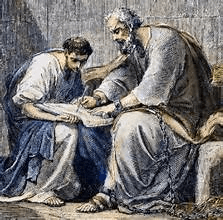
At the end of the Apostle Paul’s New Testament Epistles, he often included final greetings. These remarks usually mentioned fellow servants of Christ who ministered to him and alongside him. They may be identified as superstar-less servants. For the next several weeks, we’ll discover some insights from Paul about his many companions. Today, it is Luke and Demas.
Regarding leadership, it is often said it does not matter as much how you begin but rather how you finish.
“My legacy doesn’t matter. It isn’t important that I be remembered. It’s important that when I stand before the Lord, he says, ‘Well done, good and faithful servant.’ I want to finish strong.” — Dr. James Dobson, Focus on the Family
“You have to expect things of yourself before you can do them.” — Michael Jordan
“Success is not final; failure is not fatal. It is the courage to continue that counts.” – Winston Churchill
The Scriptures contain many examples of individuals who finished strong and others who did not. In today’s brief biblical text, the Apostle Paul mentioned Luke and Demas. They provide a striking contrast illustrating the difference between how you begin vs. how you finish.
Paul referred to Luke as the beloved physician. Paul had a deep affection of the will towards this individual he identified as a healer and doctor. Luke was Paul’s missionary companion, author of the third Gospel and the Acts of the Apostles.
“Luke and Paul had much in common. Both were educated men, men of culture. Both were big-hearted, broad-minded, sympathetic. Both were believers and missionaries,” explains Dr. William Hendriksen.
There is much we can learn about Luke from his two-volume work. The preface to the Gospel indicates that Luke was not an eyewitness or immediate disciple of the Lord. Luke states that he had carried out extensive research and had written an orderly account about Jesus (Luke 1:1-4). The exceptional feature of Luke’s work is the Acts of the Apostles which serves as a sequel to his Gospel.
The two volumes, Luke and Acts, display the fulfillment of Isaiah’s prophecies about the incarnation of the Lord Jesus Christ and the proclamation of the gospel to the ends of the earth. Scholars refer to the inclusion of the Gentiles as Luke’s salvific concern for all humanity (Luke 2:14; 24:47).
“The Gospel of Luke displays a keen interest in individuals, social outcasts, women, children, and social relationships, especially situations involving poverty or wealth. This Gospel has a special stress on prayer and the Holy Spirit, which results in a striking note of joyfulness and praise. These features tell us something about Luke as a person and his understanding of Christianity,” explains Dr. Walter Elwell in the Tyndale Bible Dictionary.
“If Luke is accepted as the companion of Paul, then the “we” passages of Acts disclose that Luke was in Philippi (possibly his hometown) when he first joined Paul (Acts 16:10–17). Then he later rejoined Paul when the latter returned to Philippi (20:5–15). Luke then journeyed with Paul on his way to Jerusalem and stayed with Philip at Caesarea (21:1–18). Then, after Paul’s two-year imprisonment in Caesarea, Luke sailed with him to Rome (27:1–28:16).”
Other references about Luke in the epistles of Paul (Col 4:14; 2 Tm 4:11; Phlm 1:24) provide valuable information. Colossians 4:11 and 14 seem to indicate that Luke was a Gentile and a physician. The latter is supported, but not proved, by the interest shown by Luke in medical matters (Luke 4:38; 5:12; 8:43). Early tradition says Luke was a physician in Antioch and wrote his Gospel in Achaia dying at the age of 84.
Today’s text confirms Luke was at Rome with Paul, was a doctor and a person of good-natured personality. beloved by his Lord, by other believers, and by Paul. It is probable Luke knew Mark, the author the Gospel bearing his name.
“Note that he and Mark, who wrote the second Gospel, were together in Rome. It is not at all surprising but gratifying that in spite of lengthy arguments to the contrary, thoroughly conservative scholarship is more and more arriving at the conclusion that in composing his own Gospel Luke made use of Mark’s as one of his sources,” explains Dr. Hendriksen.
“And it is from Rome during this, Paul’s first, Roman imprisonment, that he is sending his greetings to the Colossians and also to Philemon. Later, the apostle, experiencing his second and final Roman imprisonment, would write these touching words, “Luke is the only one with me” (2 Tim. 4:11a). This would be followed by, “Pick up Mark and bring him with you.…”
Demas offers a sobering contrast to Luke. Demas was also a fellow-worker (Philem. 24). Paul wanted Demas to be remembered by the church in Colossae and to Philemon.
“Paul does not yet know that one day this man will be a deep disappointment to him, and that with reference to this assistant in the gospel-ministry he will, during his second Roman imprisonment, write these plaintive words, ‘Demas has deserted me, because he fell in love with the present world, and has gone to Thessalonica’ (2 Tim. 4:10). And with that tragic statement Demas will disappear from sacred history,” states Dr. Hendriksen.
When do begin to follow Christ as your Savior and Lord? How is the journey going for you? Are you resolved to finish strong striving to be more like Luke rather than Demas? May the LORD provide us the strength in the holy pursuance of fighting the good fight, finishing the race, and keeping the faith (2 Tim. 4:7).
May the Lord’ truth and grace be found here. Have a blessed day in the Lord.
Soli deo Gloria!
 His Word Today