
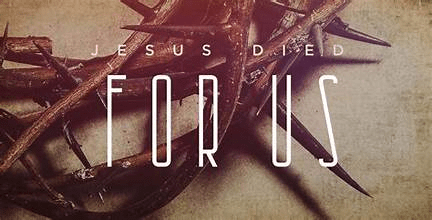
9 For God has not destined us for wrath, but to obtain salvation through our Lord Jesus Christ, 10 who died for us so that whether we are awake or asleep we might live with him. 11 Therefore encourage one another and build one another up, just as you are doing.” (1 Thessalonians 5:9–11 (ESV)
The Apostle Paul declared to the Thessalonian believers the Lord was a God of wrath and judgment on account of sin. However, the apostle also shared there is salvation from God the Father’s wrath through the Lord Jesus Christ. Why is this the case? Isn’t it enough to just acknowledge the existence of God? Why is belief, trust, commitment and worship in Christ so necessary?
Paul provided the answer in four succinct words referring to the person and work of Jesus Christ. They are “Who died for us.” Jesus died for sinners like Paul, Silas, Timothy, the Thessalonians and us. Paul alluded to the doctrine of substitutionary atonement. This was not a question by the apostle, but rather a declarative statement.
The word died (ἀποθανόντος; apothanontos) refers to a physical death, though in the case of Christ, it involved significant spiritual implications. The grammar denotes a onetime death. The phrase “for us” (περὶ ἡμῶν; peri hemon) means “on behalf of sinners”. Clearly, Paul is teaching a substitutionary atoning death by Christ on behalf of sinners.
The doctrine of substitutionary atonement by Jesus Christ on the cross is central, or the crux, of biblical Christianity. Martin Luther called biblical Christianity a theology of the cross.
“The figure of a cross is the universal symbol of Christianity. The concept of atonement reaches back to the Old Testament where God set up a system by which the people of Israel could make atonement for their sins. To atone is to make amends, to set things right,” explains Dr. R. C. Sproul.
Why was there a need for Christ to die for us? It is because all humankind are sinners (Rom. 3:10-20, 23). All sin is committed against the one, true holy God. Therefore, an atonement must be made in order for sinners to have fellowship with God and to not suffer the wrath and judgment of God because of our sin. God views sin as a crime (Isaiah 53:5-6; Rom.4:24-25; Gal.1:3-4; Col. 1:13), a debt (Matt. 6:12; Col. 1:140, and an enmity (Rom. 5:10-11; Col. 1:21-22). Therefore, sinners are guilty of their crimes against God, spiritual debtors who cannot pay their debt to God, and enemies unable to reconcile themselves before God.
Consequently, sinners either bear the wrath of God themselves, or trust and rely upon a substitute who receives God the Father’s wrath in their place. Jesus Christ bore the wrath and punishment of God the Father “on behalf of” sinful human beings, like you and me.
The Old Testament covenant pronounced a curse upon any person who broke the law of God (Ezekiel 18:4, 20). On the cross, Jesus took not only took the curse upon Himself, but He also became “a curse for us” (Gal. 3:10-14). He was forsaken by the Father and experienced the full measure of hell on the cross (Rom. 3:21-26; Heb. 2:14-18; I John 2:1-2; 4:7-11). Therefore, believers in Christ do not face the wrath of God the Father because Jesus received the Father’s wrath on our behalf.
“A key phrase in the Bible regarding the Atonement is the phrase “on behalf of.” Jesus did not die for Himself, but for us. His suffering was vicarious. He was our substitute. He took our place in fulfilling the role of the Lamb of God who takes away the sin of the world (John 1:29; 2 Cor. 5:21),” states Dr. Sproul.
“Who died for us so that whether we are awake or asleep we might live with him.” This substitutionary atonement is efficient for elect believers in Christ; alive or dead. Physical death cannot render null and void eternal life in Christ, based upon His substitutionary death and bodily resurrection.
“When the apostle mentions the Lord Jesus Christ as the cause of our salvation, he immediately thinks of the Savior’s death for us, inasmuch as that is basic. This death concerns us. Literally we read, “… who died with reference to (περί) us (though there is also some textual support for another preposition, ὑπέρ, for the meaning of which see John 10:11. The Good Shepherd gave his life for the benefit of the sheep),” explains Dr. William Hendriksen.
The salvation, or deliverance, is in Christ alone. Christ alone provides justification in place of punishment, redemption in place of spiritual indebtedness, and reconciliation in place of enmity.
“Paul says “for us.” In this us he includes all believers, whether they be readers or writers or anyone else who can lay claim to the name believer. Specifically, he is thinking here of the same two groups which he has mentioned before (see on 4:13–18): the survivors and the departed ones. The purpose (or the result, it makes little difference in this connection) of Christ’s death for his own is that whether at his coming we be waking or sleeping the sleep of death (καθεύδωμεν cf. Mark 5:39), we may together live in fellowship with him,” states Dr. Hendriksen.
Has God brought you to the place in your mind, emotions and will (i.e. your soul) to receive Jesus Christ as your Savior and Lord because of His person and work on behalf of sinners like you? Will you repent of your sins and receive Christ today (John 1:12-13)?
May the Lord’s truth and grace be found here. Have a blessed day in the Lord.
Soli deo Gloria!
 His Word Today