
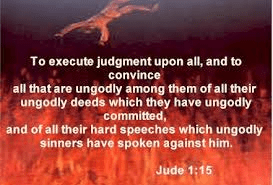
14 It was also about these that Enoch, the seventh from Adam, prophesied, saying, “Behold, the Lord comes with ten thousands of his holy ones, 15 to execute judgment on all and to convict all the ungodly of all their deeds of ungodliness that they have committed in such an ungodly way, and of all the harsh things that ungodly sinners have spoken against him.” (Jude 14–15 (ESV)
What will the Lord Jesus Christ do when He comes again with ten thousand of His holy ones? What does this have to do with the present problem of apostates and the ancient prophecy of Enoch? Jude immediately provided the answer in vs. 15 of his epistle.
The Lord Jesus will execute judgment (ποιῆσαι κρίσιν; poiesai krisin). This means the Lord Christ will carry out, or accomplish, his verdict of condemnation upon all apostates and false teachers. Jesus came to save, and not judge, the lost at His first coming (John 3:17-21). Jesus will come to judge, and not save, the lost at His second coming (2 Peter 3:1-10; Rev. 19:1-2, 20-21; 20:1-15).
The Lord will also convict (ἐλέγξαι; elenxai) and actively expose and rebuke all the ungodly (ἀσεβεῖς; asebeis). The ungodly are the wicked who have no regard for the Lord God (Rom.1:18-32). Jude used the word ungodly three times: as an adjective, verb and noun. He did so for emphasis.
John Newton poetically described the Lord’s return, and the plight of the ungodly, in the following manner.
At His call the dead awaken, Rise to life from earth and sea; All the powers of nature, shaken By His looks, prepare to flee. Careless sinner, What will then become of thee?
Jude states the Lord will judge the ungodly apostates because of their deeds and their words. Their wickedness is at the core of their being. Their behavior and words give evidence of who they truly are. In other words, apostates behave and speak the way they do because of who they are internally (Eph.2:1-3). They do not become false teachers because of their behavior and speech. Their behavior and speech display they are false teachers.
“As Jude develops his letter, he explains his earlier comment about God’s condemnation of godless men (v. 4). Thus, he discloses that these men live immorally, spurn authority, and “slander celestial beings” (vv. 8, 10). He reveals that they find fault, boast, brag, and flatter (v. 16); they scoff at divine revelation and willfully “follow their own ungodly desires” (v. 18). Applying the prophecy of Enoch, Jude indicates that these men will be convicted because of the evil acts they have committed and the harsh words they have spoken against the Lord,” states Dr. Simon J. Kistemaker.
“All ungodly persons will be judged and all their ungodly deeds and all their hard words will be held as evidence against them in a court of law (see Mal. 3:13; Matt. 12:36). The writer’s emphasis on the terms all and ungodly is designed to call the attention of these godless men to the seriousness of their sin. They deliberately taunt God, dishonor him, and scorn his Word. In the Greek Jude placed the two words ungodly sinners last in the sentence for special emphasis. A literal translation of these words reveals the climax of the sentence: “sinners, godless persons.”
“Enoch’s prophecy pointed to the glorious return of Christ to the earth with thousands upon thousands of His angels (holy ones) (Matt. 24:30; 2 Thes. 1:10), when His purpose will be to judge everyone (2 Thes. 1:7–10) and to convict all the ungodly with unanswerable evidence that their actions, manners, and words have been ungodly (asebeis, “irreverent”; cf. Jude 4). Jude’s fourfold use of this word ungodly reinforces his description of their nature. Rather than being true spiritual leaders, they had spoken harsh words (cf. “speak abusively” in v. 10) against Jesus Christ whom they denied,” explains Dr. Edward C. Pentecost.
My hope is built on nothing less
Than Jesus’ blood and righteousness
I dare not trust the sweetest frame
But wholly lean on Jesus’ name.
When darkness veils His lovely face
I’ll rest on His unchanging grace
In every high and stormy day
My anchor holds within the veil.
His oath, His covenant, His blood
Support me in the whelming flood
When all around my soul gives way
He then is all my hope and stay.
When He shall come with trumpet sound
Oh, may I then in Him be found
Dressed in His righteousness alone
Faultless to stand before the throne.
On Christ the solid rock I stand
All other ground is sinking sand
All other ground is sinking sand.
May the Lord’s truth and grace be found here. Have a blessed day in the Lord.
Soli deo Gloria!
 His Word Today