
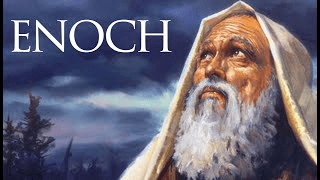
“It was also about these that Enoch, the seventh from Adam, prophesied, saying, “Behold, the Lord comes with ten thousands of his holy ones,” (Jude 14 (ESV)
What do the Scriptures tell us about the Old Testament character known as Enoch? Who was this individual and why did Jude refer to him when writing about the danger of apostates and apostasy?
Following the genealogy of Gen. 5:1–14; 1 Chron. 1:1–3; Luke 3:37; Heb. 11:5, Enoch was the seventh in the line of Adam. Because Enoch “walked with God,” he was taken directly to heaven without dying (cf. Gen. 5:24; Heb. 11:5). The Bible mentions only one other individual who enjoyed such an intimate relationship with the LORD described as walking with God; Noah (Gen. 6:9). The Scriptures also mention only one other individual being taken to heaven alive like Enoch; Elijah (2 Kings 2:1-12). Enoch was the father of Methuselah and the great grandfather of Noah (Gen. 5:21-31). Jude wrote that Enoch prophesied the Lord Jesus would come with ten thousand of his holy ones.
“Enoch, before the flood, prophesied about Christ’s second coming in judgment (cf. 1 Thess. 3:13). “Holy ones” can refer to either angels or believers. Since both angels (Matt. 24:31; 25:31; Mark 8:38; 2 Thess. 1:7) and believers (Col. 3:4; 1 Thess. 3:13; Rev. 19:14) will accompany Christ, it may refer to both (cf. Zech. 14:5), but the focus on judgment in Jude 15 seems to favor angels, who are often seen in judgment action. While believers will have a role of judging during the Lord’s earthly kingdom (see note on 1 Cor. 6:2) and will return when Christ comes to judge (Rev. 19:14), angels are the executioners of God at the second coming of Christ (see Matt. 13:39–41, 49–50; 24:29–31; 25:31; 2 Thess. 1:7–10),” explains Dr. John MacArthur.
Jude’s reference to Enoch’s prophesy presents one of the interpretative challenges in properly understanding this epistle. It also resulted in Jude being one the New Testament books disputed for its inclusion into the biblical canon. The question centered upon authenticity.
The period of time between the Old and New Testaments, known as the 400 silent years, contained a great amount of international upheaval. The Judean Maccabean revolt (around 164 BC) concluded with the overthrow of Antiochus IV’s tyranny and defilement of the temple in Jerusalem. Israel subsequently enjoyed a century of independence from foreign rule. This continued until 63 BC when the Roman general Pompey made Israel a part of the Roman empire.
“Though prophets were silent during the intertestamental period, the Jews continued to produce many religious works. These works came to be known as the deuterocanonical books, and many of them, such as 1 and 2 Maccabees, are included in the canon of the Roman Catholic Church. However, many other works were produced at this time and were never recognized as inspired, even though they may have been used as devotional aids by some Jews,” explains Dr. R. C. Sproul.
“One of these is known as the Testament of Moses and is the likely source for Jude’s description of the fight over Moses’ body in verse 9 of his epistle. Jude’s reliance on an uninspired source immediately raises concerns for us. These concerns are only compounded by today’s passage. In verses 14–15, Jude quotes 1 Enoch, a pseudepigraphal (falsely attributed) work written between the third and first centuries BC. This book is based on the enigmatic “Enoch” of Genesis 5:18–24, and was a favorite of the Dead Sea sect.”
Did Jude consider the aforementioned works inspired? Many in the early church rejected Jude as canonical because of his use of these sources.
“The majority of those who questioned Jude did so on the basis of its reference to the Pseudepigraphal Book of Enoch (vv.14-15; cf. Enoch 1:9), and probably also to the Assumption of Moses (vs.9).” explains Dr. Norman Geisler.
“However, the explanation that has most commended it is that Jude’s citation of Enoch does not demand approval of the work as a whole, but extends only to those portions that he (Jude) utilizes for his purpose. This situation is not materially different from Paul’s references to pagan poets (Acts 17:28; I Cor. 15:33; Titus 1:12).”
“Because there are no doctrinal issues discussed, the challenges of this letter have to do with interpretation in the normal process of discerning the meaning of the text. Jude does quote from non-canonical, pseudepigraphal (i.e., the actual author was not the one named in its title) sources such as 1 Enoch (v. 14) and the Assumption of Moses (v. 9) to support his points. Was this acceptable? Since Jude was writing under the inspiration of the Holy Spirit (2 Tim. 3:16; 2 Pet. 1:20–21) and included material that was accurate and true in its affirmations, he did no differently than Paul (cf. Acts 17:28; 1 Cor. 15:33; Titus 1:12),” states Dr. MacArthur.
All truth is God’s truth. Believers in Christ can be certain the Holy Spirit inspired Jude’s epistle (2 Tim. 3:16-17; 2 Peter 1:20-21).
Soli deo Gloria!
 His Word Today