
“The heart of man plans his way, but the Lord establishes his steps.” (Proverbs 16:9 ESV)
“Here then is a sure resting place for the heart. Our lives are neither the product of blind fate nor the result of capricious chance, but every detail of them was ordained from all eternity; and is now ordered by the living and reigning God. Not a hair of our heads can be touched without His permission. “A man’s heart deviseth his way; but the LORD directeth his steps” (Prov. 16:9). What assurance, what strength, what comfort this should give the real Christian! “My times are in Thy hand” (Ps. 31:15). Then let me “Rest in the LORD, and wait patiently for Him” (Ps. 37:7).” – A.W. Pink, The Attributes of God
Louis Berkhoff (1873-1957) was a Dutch-American Reformed theologian. He graduated from Princeton Theological Seminary (1904), studying under professors B. B. Warfield and Geerhardus Vos. In addition to pastoring churches in West Michigan, he also taught biblical studies and systematic theology at Calvin Theological Seminary for four decades. He became president of the seminary in 1931 until he retired in 1944.
One biographer explains, “Professor Berkhoff was not known for being original or speculative but for being very good at organizing and explaining basic theological ideas following in the tradition of John Calvin, Abraham Kuyper and Herman Bavinck.”
One of Professor Berknoff’s students was Cornelius Van Til (1895-1987) who served as professor of apologetics and epistemology at Westminster Theological Seminary, Philadelphia, PA.
Theologian Dr. Wayne Grudem has called Berkhof’s Systematic Theology “a great treasure-house of information and analysis […] probably the most useful one-volume systematic theology available from any theological perspective.”
The following excerpt on God’s providence is taken from Professor Berkhof’s book A Summary of Christian Doctrine. It is available at monergism.com. These meditations are contained in the section entitled The Doctrine of God and Creation.
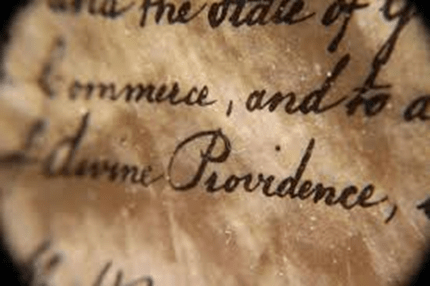
“Since God not only created the world but also upholds it, we naturally pass from the doctrine of creation to that of divine providence. This may be defined as that work of God in which He preserves all His creatures, is active in all that happens in the world, and directs all things to their appointed end. It includes three elements, of which the first pertains primarily to the being, the second to the activity, and the third to the purpose of all things.”
1. The Elements of Divine Providence. We distinguish three elements:
a. Divine preservation. This is that continuous work of God by which He upholds all things. While the world has a distinct existence and is not a part of God, it nevertheless has the ground of its continued existence in God and not in itself. It endures through a continued exercise of divine power by which all things are maintained in being and action. This doctrine is taught in the following passages: Ps. 136:25; 145:15; Neh. 9:6; Acts 17:28; Col. 1:17; Heb. 1:3.
b. Divine concurrence. This may be defined as that work of God by which He co-operates with all His creatures and causes them to act precisely as they do. It implies that there are real secondary causes in the world, such as the powers of nature and the will of man, and asserts that these do not work independently of God. God works in every act of His creatures, not only in their good but also in their evil acts. He stimulates them to action, accompanies their action at every moment, and makes this action effective. However, we should never think of God and man as equal causes; the former is the primary, and the latter only a secondary cause. Neither should we conceive of them as each doing a part of the work like a team of horses. The same deed is in its entirety both a deed of God and a deed of man. Moreover, we should guard against the idea that this co-operation makes God responsible for man’s sinful deeds. This doctrine is based on Scripture, Deut. 8:18; Ps. 104:20, 21, 30; Amos 3:6; Matt. 6:45; 10:29; Acts 14:17; Phil. 2:13.
c. Divine government. This is the continued activity of God whereby He rules all things so that they answer to the purpose of their existence. God is represented as King of the universe both in the Old and in the New Testament. He adapts His rule to the nature of the creatures which He governs; His government of the physical world differs from that of the spiritual world. It is universal, Ps. 103:19; Dan, 4:34, 35, includes the most insignificant things, Matt. 10:29-31, and that which is seemingly accidental, Prov. 16:33, and bears on both the good and the evil deeds of man, Phil. 2:18; Gen. 50:20; Acts 14:16.
2. Misconceptions of Divine Providence. In the doctrine of providence, we should guard against two misconceptions:
a. The Deistic conception. This is to the effect that God’s concern with the world is of the most general nature. He created the world, established its laws, set it in motion, and then withdrew from it. He wound it up like a clock, and now lets it run off. It is only when something goes wrong that He interferes with its regular operation. God, is only a God afar off.
b. The Pantheistic conception. Pantheism does not recognize the distinction between God and the world. It identifies the two, and therefore leaves no room for providence in the proper sense of the word. There are, strictly speaking, no such things as secondary causes. God is the direct author of all that transpires in the world. Even the acts which we ascribe to man as really acts of God. God is only a God that is near, and not a God afar off.
3. Extraordinary Providences or Miracles.
We distinguish between general and special providences, and among the latter the miracles occupy an important place. A miracle is a supernatural work of God, that is a work which is accomplished without the mediation of secondary causes. If God sometimes apparently uses secondary causes in the production of miracles, He employs them in an unusual way, so that the work Is after all supernatural.
Some regard miracles as impossible, because they involve a violation of the laws of nature. But this is a mistake. The so-called laws of nature merely represent God’s usual method of working. And the fact that God generally works according to a definite order does not mean that He cannot depart from this order, and cannot without violating or disturbing it bring about unusual results. Even man can lift up his hand and throw a ball into the air in spite of the law of gravitation and without in any way disturbing its operation. Surely, this is not impossible for the omnipotent God. The miracles of the Bible are means of revelation. Num. 16:28; Jer. 32:20; John 2:11; 5:36.
For Further Study:
a. Name some examples of special providences. Cf. Deut. 2:7; I Kings 17:6, 16; II Kings 4:6; Matt. 14:20.
b. How should belief in divine providence affect our cares? Isa. 41:10; Matt. 6:32; Luke 12:7; Phil. 4:6, 7; I Pet. 5:7.
c. Name some of the blessings of providence. Cf. Isa. 25:4; Ps. 121:4; Luke 12:7; Deut. 33:28; Ps. 37:28; II Tim. 4:18.
Soli deo Gloria!
 His Word Today