
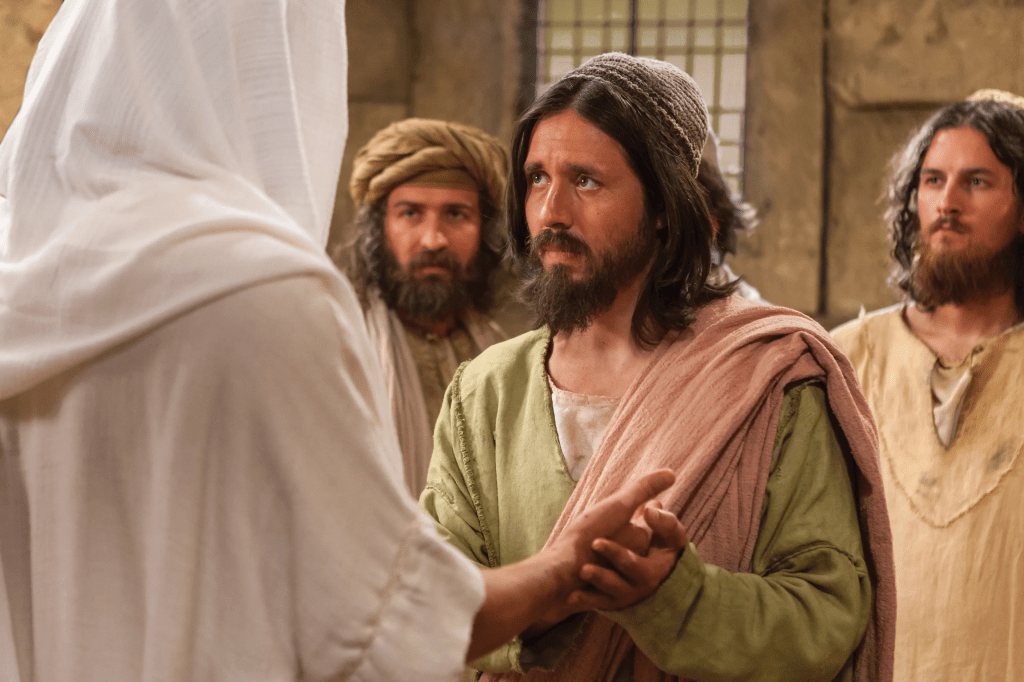
24 Now Thomas, one of the twelve, called the Twin, was not with them when Jesus came. 25 So the other disciples told him, “We have seen the Lord.” But he said to them, “Unless I see in his hands the mark of the nails, and place my finger into the mark of the nails, and place my hand into his side, I will never believe.”
26 Eight days later, his disciples were inside again, and Thomas was with them. Although the doors were locked, Jesus came and stood among them and said, “Peace be with you.” 27 Then he said to Thomas, “Put your finger here, and see my hands; and put out your hand, and place it in my side. Do not disbelieve, but believe.” 28 Thomas answered him, “My Lord and my God!” 29 Jesus said to him, “Have you believed because you have seen me? Blessed are those who have not seen and yet have believed.” (John 20:24–29 (ESV)
All four Gospels parallel each other concerning the events on Resurrection Sunday. The Holy Spirit specifically inspired the writers to provide particular information not found in the other Gospels. While each writer provides selective, insightful information, they do not contradict each other in telling the wonderful news that Jesus Christ is alive. Such is the case with today’s text from the Apostle John regarding Jesus’ appearance to Thomas and the ten other apostles.
Seeing is believing. This familiar expression means you need to see something before you can accept it as truth. This statement addresses the idea of one way humans know what they know. This is the science of Epistemology.
“Epistemology analyzes the ways in which human beings are able to acquire knowledge. Great debates rage over whether humans learn primarily through the mind—the rational approach to knowledge – or through the five senses of sight, sound, taste, touch and smell—the empirical approach,” explains Dr. R. C. Sproul.
“Even within Christian circles, the debate goes on as to whether reason or the senses is primary. As Christians, however, we should all agree Christianity is based ultimately on knowledge that comes to us from God Himself. Holding to that conviction is vitally important for our determination of truth, because knowledge that comes from God is far superior to anything we can deduce from an analysis of our situation, from introspection, or from observation of the world around us.”
Thomas experienced a crisis of faith based on how he deduced truth. Thomas was an empiricist. His approach to knowing truth, or what was real, was based on his senses; especially as it related to the death of Jesus Christ. His senses told him Jesus was dead. No rational argument or persuasion by his fellow disciples could dissuade him from what he had seen, heard, tasted, touched, and smelled concerning Jesus’ crucifixion and burial.
Thomas summarized his empiricist approach to truth when he said, “Unless I see in his hands the mark of the nails, and place my finger into the mark of the nails, and place my hand into his side, I will never believe.” Much like Christian, in John Bunyan’s classic allegory Pilgrim’s Progress, Thomas was a self-imposed prisoner in his personal Doubting Castle.
Eight days later, the disciples and all eleven apostles, including Thomas, were gathered inside their locked residence. Jesus appeared and again said, “Peace be with you.” Jesus then said to Thomas, “Put your finger here, and see my hands; and put out your hand, and place it in my side. Do not disbelieve, but believe.”
Jesus approached Thomas at his empiricist level. The Lord commanded His apostle to touch and see the marks of His crucified body. Jesus then commanded Thomas to no longer personally disbelieve but believe. Thomas responded, based on the empirical evidence, “My Lord and my God!”
While Thomas’ declaration of worship was in spirit and truth (John 4:24), Jesus did not allow Thomas, or believers today, to rest their faith in Christ solely upon empirical evidence as a determiner of truth. Jesus said, “Have you believed because you have seen me? Blessed are those who have not seen and yet have believed.” Jesus lauded a rational response to God’s revelation rather than resting on one senses on empirical evidence.
“Jesus responded to Thomas with a blessing on those who would believe in His resurrection without seeing Jesus’ physical, resurrected body (v. 29). This was probably not a rebuke of Thomas for needing evidence to believe. More likely, Jesus was signaling that those who believe in Him without seeing His physical, resurrected body are just as blessed as Thomas and the other disciples who did see it. We who believe in Jesus based on the Apostolic testimony are not lesser disciples than those who saw Him in the flesh,” concludes Dr. Sproul.
The Apostle Peter would echo this perspective when he wrote to the elect exiles in his first epistle. These were believers in Christ who encountered various trials. Peter wrote, “8 Though you have not seen him, you love him. Though you do not now see him, you believe in him and rejoice with joy that is inexpressible and filled with glory, 9 obtaining the outcome of your faith, the salvation of your souls,” (1 Peter 1:8–9 ESV).
Believers in Christ are to know what God has revealed of Himself in creation and in the Scriptures. It is important to not only know what we believe but also why we believe it. However, our faith in Christ must be rooted in the character of God who reveals Himself to His creation.
Soli deo Gloria!
.
 His Word Today