
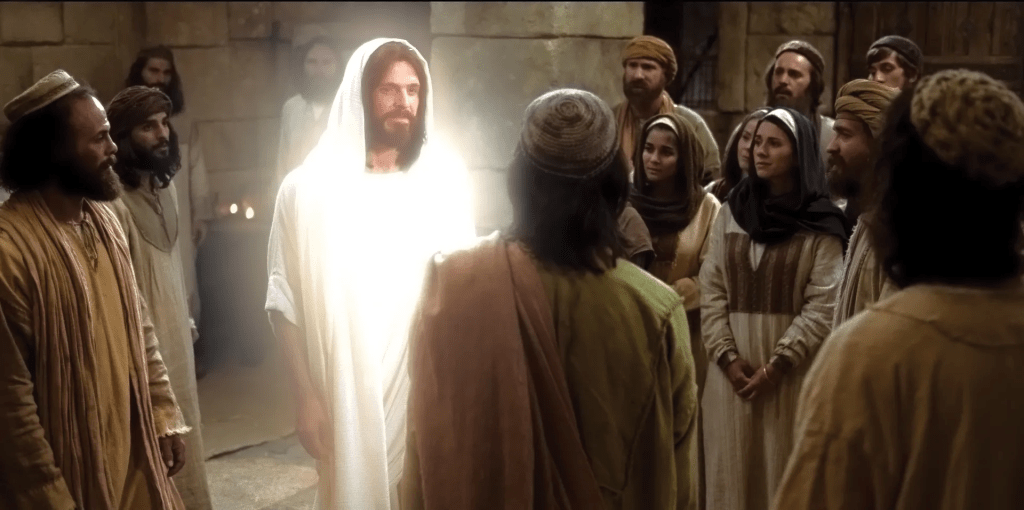
36 As they were talking about these things, Jesus himself stood among them, and said to them, “Peace to you!” 37 But they were startled and frightened and thought they saw a spirit. 38 And he said to them, “Why are you troubled, and why do doubts arise in your hearts? 39 See my hands and my feet, that it is I myself. Touch me, and see. For a spirit does not have flesh and bones as you see that I have.” 40 And when he had said this, he showed them his hands and his feet. 41 And while they still disbelieved for joy and were marveling, he said to them, “Have you anything here to eat?” 42 They gave him a piece of broiled fish, 43 and he took it and ate before them.” (Luke 24:36–43 (ESV)
19 On the evening of that day, the first day of the week, the doors being locked where the disciples were for fear of the Jews, Jesus came and stood among them and said to them, “Peace be with you.” 20 When he had said this, he showed them his hands and his side. Then the disciples were glad when they saw the Lord. 21 Jesus said to them again, “Peace be with you. As the Father has sent me, even so I am sending you.” 22 And when he had said this, he breathed on them and said to them, “Receive the Holy Spirit. 23 If you forgive the sins of any, they are forgiven them; if you withhold forgiveness from any, it is withheld.” (John 20:19–23 (ESV)
All four Gospels parallel each other concerning the events on Resurrection Sunday. The Holy Spirit specifically inspired the writers to provide particular information not found in the other Gospels. While each writer provides selective, insightful information, they do not contradict each other in telling the wonderful news that Jesus Christ is alive. Such is the case with today’s text from Luke and the Apostle John regarding Jesus’ appearance to ten of His apostles.
It was the same evening in which Jesus dined with the Emmaus Disciples (Luke24:28-32). John explains the doors of the place where the disciples in Jerusalem were staying were locked. The reason was the disciples feared the Jewish religious leaders. Perhaps they were concerned they would also face crucifixion. This is one evidence the disciples were not expecting Jesus’ resurrection. What they would soon encounter and experience would not be the result of their earnest wish Jesus’ death would be undone. The apostles knew Jesus died and their perspective was He would remain dead. They were without hope.
Suddenly, Jesus stood and was among them. This was a miraculous and instantaneous appearance. No locked doors prevented Him from being in their midst.
He said, “Peace” (εἰρήνη; Eirene) the Greek word meaning tranquility and freedom from worry. This parallels the Jewish word Shalom.
What was the disciples’ immediate response? Luke states, “But they were startled and frightened and thought they saw a spirit.”(Luke 24:37).They thought they were seeing a ghost or perhaps an evil spirit. Jesus said, “Why are you troubled, and why do doubts arise in your hearts?” (Luke 24:38). The disciples were not moving and uncertain as to who, or what, they were seeing.
Jesus then showed them His hands and feet. He told them to touch Him and see that He was not a ghost. “Touch me, and see. For a spirit does not have flesh and bones as you see that I have.” (Luke 24:39-40). The Apostle John states Jesus showed His disciples the crucifixion scars in His hands and side (John 20:20). The disciples saw Jesus was truly alive from the dead and not a phantom or a figment of their own imagination.
“The disciples disbelieved for joy and continued for a while in this state. Psychologically this is understandable. We should bear in mind that only (what we would call) “day before yesterday” their hearts had been pierced with a feeling of utter hopelessness. When Jesus breathed his last the situation seemed to be irreparably desperate. It was the end. Jesus was gone. He was dead. And now to believe that he was standing here in their very midst, alive and well, was almost impossible. Was what they were looking at a ghost? One moment they would say to themselves, “This must be Jesus. How wonderful.” The next moment they would say, “It is just too good to be true. It must be a ghost,” explains Dr. William Hendriksen.
While the disciples still could not believe what they were seeing because they were so joyful, Jesus said, ““Have you anything here to eat?” There is no indication Jesus had to eat in His glorified state but only that He could eat; and eat He did (Luke 24:43).
Jesus spoke again and said, “Peace be with you. As the Father has sent me, even so I am sending you.” 22 And when he had said this, he breathed on them and said to them, “Receive the Holy Spirit. 23 If you forgive the sins of any, they are forgiven them; if you withhold forgiveness from any, it is withheld.” (John 20:21-23).
“The gift is essential for the performance of the task given to the disciples (Luke 24:48-49; Acts 1:8). This occasion is a foreshadowing, an enacted prophecy, of the fullness of the Spirit to be bestowed on the church at Pentecost (Acts 1:4-5; 2:1-11),” states Dr. R.C. Sproul.
“The apostles, as the founders of the church and acting for it, receive the authority to declare God’s judgment on sins and the means of forgiveness of sins; faith in Jesus (Matt. 16:19; 18:18-20). Fundamentally, this declaration is made in the preaching of the Gospel,” concludes Dr. Sproul.
What a fellowship and divine joy it must have been for the disciples to once again be with Jesus. However, one disciple was conspicuously absent; Thomas. It is his encounter with the risen Lord we will examine next.
Have you had a joyful encounter with Jesus through the preaching of the Word of God and worshiping the Lord in spirit and in truth (John 4:24)? May the Lord give us expectant hearts when we gather to worship; individually and collectively each Lord’s Day.
May the Lord’s truth and grace be found here.
 His Word Today