
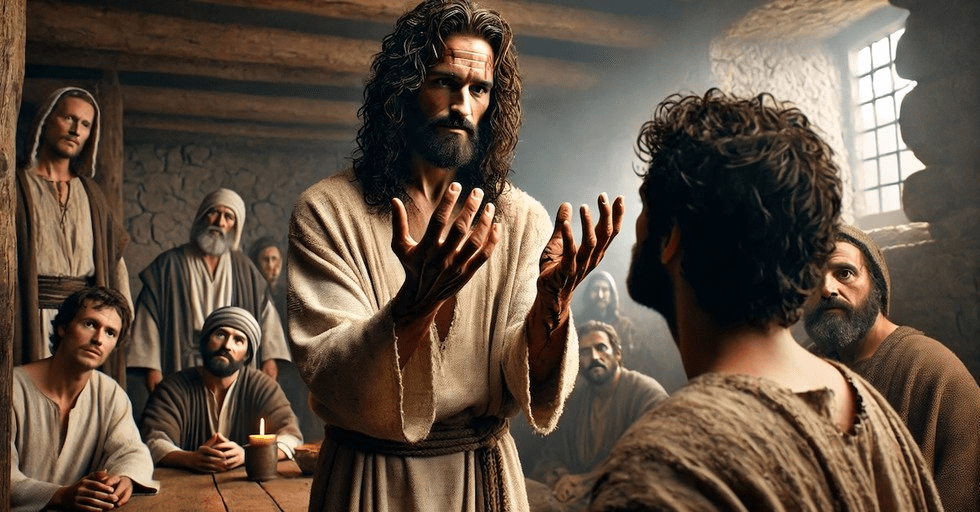
36 As they were talking about these things, Jesus himself stood among them, and said to them, “Peace to you!” 37 But they were startled and frightened and thought they saw a spirit. 38 And he said to them, “Why are you troubled, and why do doubts arise in your hearts? 39 See my hands and my feet, that it is I myself. Touch me, and see. For a spirit does not have flesh and bones as you see that I have.” 40 And when he had said this, he showed them his hands and his feet. 41 And while they still disbelieved for joy and were marveling, he said to them, “Have you anything here to eat?” 42 They gave him a piece of broiled fish, 43 and he took it and ate before them.” (Luke 24:36–43 (ESV)
19 On the evening of that day, the first day of the week, the doors being locked where the disciples were for fear of the Jews, Jesus came and stood among them and said to them, “Peace be with you.” 20 When he had said this, he showed them his hands and his side. Then the disciples were glad when they saw the Lord. 21 Jesus said to them again, “Peace be with you. As the Father has sent me, even so I am sending you.” 22 And when he had said this, he breathed on them and said to them, “Receive the Holy Spirit. 23 If you forgive the sins of any, they are forgiven them; if you withhold forgiveness from any, it is withheld.” (John 20:19–23 (ESV)
All four Gospels parallel each other concerning the events on Resurrection Sunday. The Holy Spirit specifically inspired one of two of the writers to provide particular information not found in the other Gospels. While each writer provides selective, insightful information, they do not contradict each other in telling the wonderful news that Jesus Christ is alive. Such is the case with today’s text from Luke and the Apostle John regarding Jesus’ appearance to ten of His apostles.
It was the same evening in which Jesus dined with the Emmaus Disciples (Luke24:28-32). Clopas and his companion traveled back to Jerusalem from Emmaus to tell their fellow disciples Jesus was alive (Luke 24:33-35). It was a Sunday evening; the first day of the week.
John explains the doors of the place where the disciples in Jerusalem were staying were locked. The reason was the disciples feared the Jewish religious leaders. Perhaps they were concerned they would also face crucifixion. This is one evidence the disciples were not expecting Jesus’ resurrection. What they would soon encounter and experience would not be the result of their earnest wish Jesus’ death would be undone. The apostles knew Jesus died and their perspective was He would remain dead. They were without hope.
Suddenly, Jesus stood and was among them. This was a miraculous and instantaneous appearance. No locked doors prevented Him from being in their midst. He said, “Peace” (εἰρήνη; Eirene) the Greek word meaning tranquility and freedom from worry. This parallels the Jewish word Shalom. However, this word takes on greater significance when viewed in light of Jesus’ substitutionary atonement and bodily resurrection. By grace alone, through faith alone in the person and work of Jesus Christ alone, God the Father justifies sinners and declares them righteous in His sight (Romans 5:1).
“It is Easter Sunday, late in the evening. Ten of the apostles, the men from Emmaus, and perhaps others, are gathered in a house somewhere in Jerusalem. For fear of the Jews the doors are locked (John 20:19). All of a sudden Jesus is standing right in their midst. How he entered we do not know. All we know is that the resurrection body must have certain properties which do not pertain to “the body of humiliation,” explains Dr. William Hendriksen. On this see also 1 Cor. 15:35–38.
“Not only is the Risen Lord standing here, right among them, but he also, to put them at rest, says, “Peace (be) with you.” When these words flow from his lips they must not be interpreted as a mere “How do you do?” The reference is to the peace which Jesus had obtained for all his people by his death on the cross.” See Eph. 2:14–18; Phil. 4:7.
What was the disciples’ immediate response? Luke states, “But they were startled and frightened and thought they saw a spirit.”(Luke 24:37).They thought they were seeing a ghost or perhaps an evil spirit. Jesus said, “Why are you troubled, and why do doubts arise in your hearts?” (Luke 24:38). The disciples were not moving and uncertain as to who, or what, they were seeing.
“One might ask, “But how can it be explained that the men from Emmaus were so startled and frightened, since only a few hours ago they had been conversing with Jesus?The sudden character of the appearance, and the fact that no one had seen Jesus enter the room—all at once, there he was, as if he had materialized out of thin air—may well account for these reactions on the part of the disciples,” concludes Dr. Hendriksen.
Perhaps this scene may be compared to when families are shocked and dumbfounded when a military family member makes an unexpected reunion appearance following their deployment. Initially, there is wonder and disbelief and then overwhelming tears of joy. What we are seeing in today’s study is the initial astonishment, in which joy would soon follow.
May the Lord’s truth and grace be found here.
Soli deo Gloria!
 His Word Today