
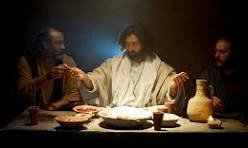
28 “So they drew near to the village to which they were going. He acted as if he were going farther, 29 but they urged him strongly, saying, “Stay with us, for it is toward evening and the day is now far spent.” So he went in to stay with them. 30 When he was at table with them, he took the bread and blessed and broke it and gave it to them. 31 And their eyes were opened, and they recognized him. And he vanished from their sight.” (Luke 24:28–31 ESV)
All four Gospels parallel each other concerning the events on Resurrection Sunday. The Holy Spirit specifically inspired one of two of the writers to provide particular information not found in the other Gospels. While each writer provides selective, insightful information, they do not contradict each other in telling the wonderful news that Jesus Christ is alive. Such is the case with today’s text from Luke regarding Jesus’ appearance to the so-called Emmaus Disciples.
There are times in our lives when we do not want fellowship with a friend or family member to end. Growing up, Christmas Day was always an exciting and enjoyable holiday. Sure, there were presents under our tree and a Christmas breakfast my dad prepared for our family to enjoy. However, the high point of the day was when we drove to my grandmother’s house for a large family gathering including aunts, uncles, and cousins. We ate, laughed, played games and overall just enjoyed being together. I hated to hear the inevitable announcement that it was time to leave and go home. This was a fifteen year tradition for me, concluding when my grandmother died. Those fifteen Christmas Days continue to resonate deep within my memory.
I wonder if the Emmaus Disciples felt the same way as they walked with Jesus. Upon reaching their destination, Jesus appeared to want to leave them. However, Clopas and his friend did not want this to happen. They strongly urged Jesus to stay with them. They reasoned it was evening and He should remain in their village with them until morning. Jesus complied.
As they began to have dinner, a time of great fellowship, Jesus took the bread, blessed and broke it and gave it to them. At that moment, their eyes were opened and they finally recognized it was the risen Jesus who was with them. He then immediately vanished from their sight.
“How was it that in the breaking of the bread they suddenly recognized him? Did they see the marks of the nails in his hands? Was it the manner in which he broke the bread and gave it to them that opened their eyes? Or was it the way he spoke to his Father that refreshed their memories? Whatever may be the answer, the body of his resurrection now possessed qualities enabling him to appear at will and also, as here, to vanish at will. So, almost before they fully realized what had happened, he was gone,” states Dr. William Hendriksen.
“They had been sovereignly kept from recognizing him until this point (cf. v. 16). His resurrection body was glorified, and altered from its previous appearance (see John’s description in Rev. 1:13–16), and this surely explains why even Mary did not recognize him at first (cf. John 20:14–16). But in this case, God actively intervened to keep them from recognizing him until it was time for him to depart,” explains Dr. John MacArthur.
“His resurrection body, though real and tangible (John 20:27)—and even capable of ingesting earthly food (Luke 24:42–43)—nonetheless possessed certain properties that indicate it was glorified, altered in a mysterious way (cf. 1 Cor. 15:35–54; Phil. 3:21). Christ could appear and disappear bodily, as seen in this text. His body could pass through solid objects—such as the grave clothes or the walls and doors of a closed room (John 20:19, 26). He could apparently travel great distances in a moment, for by the time these disciples returned to Jerusalem, Christ had already appeared to Peter (Luke 24:34). The fact that he ascended into heaven bodily demonstrated that his resurrection body was already fit for heaven. Yet it was his body, the same one that was missing from the tomb, even retaining identifying features such as the nail wounds (John 20:25–27). He was no ghost or phantom.”
What wonderful fellowship awaits us when we eternally are in the presence of our Lord Jesus Christ.
Soli deo Gloria!
 His Word Today