
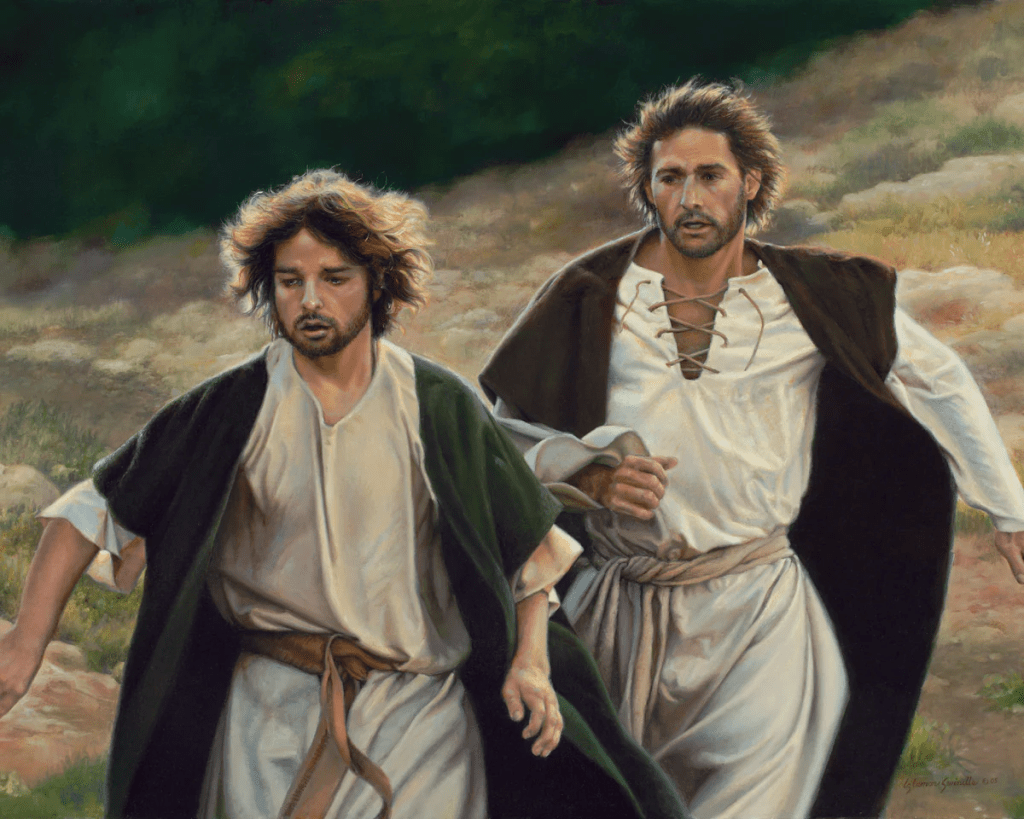
“Now on the first day of the week Mary Magdalene came to the tomb early, while it was still dark, and saw that the stone had been taken away from the tomb. 2 So she ran and went to Simon Peter and the other disciple, the one whom Jesus loved, and said to them, “They have taken the Lord out of the tomb, and we do not know where they have laid him.” 3 So Peter went out with the other disciple, and they were going toward the tomb. 4 Both of them were running together, but the other disciple outran Peter and reached the tomb first. 5 And stooping to look in, he saw the linen cloths lying there, but he did not go in. 6 Then Simon Peter came, following him, and went into the tomb. He saw the linen cloths lying there, 7 and the face cloth, which had been on Jesus’ head, not lying with the linen cloths but folded up in a place by itself. 8 Then the other disciple, who had reached the tomb first, also went in, and he saw and believed; 9 for as yet they did not understand the Scripture, that he must rise from the dead. 10 Then the disciples went back to their homes.” (John 20:1–10 ESV)
All four Gospels parallel each other concerning the events on Resurrection Sunday. The Holy Spirit specifically inspired one of two of the writers to provide particular information not found in the other Gospels. While each writer provides selective, insightful information, they do not contradict each other in telling the wonderful news that Jesus Christ is alive. Such is the case with today’s text from John.
John 20 records Jesus’ appearances to the following individuals: Mary Magdalene (vs. 1-18), the ten disciples (vs. 19-23), and to Thomas (vs. 24-29). “Once again John’s purpose in recording these resurrection appearances was to demonstrate that Jesus’ physical and bodily resurrection was the crowning proof that he truly is the Messiah and Son of God who laid down his life for his own (John 10:17–18; 15:13; cf. Rom. 1:4),” explains Dr. John MacArthur.
Upon hearing the news from Mary Magdalene about the empty tomb, and the angels’ declaration to her and the other women concerning Jesus’ resurrection (Matthew 28:1-6; Mark 16:1-6; Luke 24:1-7), Peter and John went to personally investigate. This was in spite of the skepticism by the other disciples (Luke 24:11). Luke solely focused on Peter’s reaction. “But Peter rose and ran to the tomb; stooping and looking in, he saw the linen cloths by themselves; and he went home marveling at what had happened.” (Luke 24:12 (ESV)
John’s Gospel records both Peter and John ran to the tomb. However, John was the faster of the two men and he arrived at the tomb before Peter. However, Peter eventually reached the same destination. Both men arrived at the same tomb, and the correct tomb; Jesus’ tomb.
5 “And stooping to look in, he (John) saw the linen cloths lying there, but he did not go in. 6 Then Simon Peter came, following him, and went into the tomb. He saw the linen cloths lying there, 7 and the face cloth, which had been on Jesus’ head, not lying with the linen cloths but folded up in a place by itself.” (John 20:5-7 ESV)
John came to the tomb and saw it was empty, but he did not go in. In writing this first-hand account, he gave no reason as to why. However, Peter did go in and surveyed the scene. He saw the burial cloths and the facial shroud in an orderly condition.
One of the evidences for the resurrection of Jesus Christ is the orderly condition of the grave clothes. The linen cloths Jesus’ followers used to wrap Him for burial and the face cloth were found separately, with the face cloth folded. The evidence shows a methodical moment had occurred and not an abrupt theft of Jesus’ body by the disciples.
Finally, John did go into the tomb. When he did so, he believed Jesus rose from the dead. John inserted a comment indicating that prior to this moment, he and Peter still had not understood Jesus’ words regarding Him rising from the dead. After this moment, both of them went back to their respective homes.
“Earlier when they saw Jesus’ signs, His disciples responded by believing in Him (John 2:11), and His resurrection would cause them to believe both the Scripture and His word (2:22). But the comment in vs.9, that they did not understand Scripture’s prediction of Christ’s resurrection may suggest that at this point John simply believed Mary’s report that Jesus’ body had been removed from the tomb. According to Luke 24:11-12, the women’s report, of seeing angels seemed to the male apostles ‘an idle tale’ and Peter’s trip to the empty tomb left him marveling,” explains Dr. R. C. Sproul.
“At this point some commentators seem to think that the purpose of the text is to emphasize the weakness of the apostles’ faith, as if the meaning were on this order: the faith of these men was but a step removed from unbelief, for they needed to see before they were willing to believe.—However, that is probably not the sense of the words,” states Dr. William Hendriksen.
“What is meant is this: they now saw and believed. They saw the things which the Lord had arranged in such a manner as to arouse and strengthen faith. Scripture also began to take on a new meaning now. Previously such beautiful passages as Ps. 16:10, 11; Ps. 110:1, 4; Ps. 118:22–24; and Is. 53:11, 12—passages which referred to Christ’s resurrection—had meant very little to them. Now these same passages were beginning to assume significance! They now understood that Christ’s glorious resurrection was a divine must. Cf. Luke 24:26. On and after Pentecost all this would become even clearer.”
Soli deo Gloria!
 His Word Today