
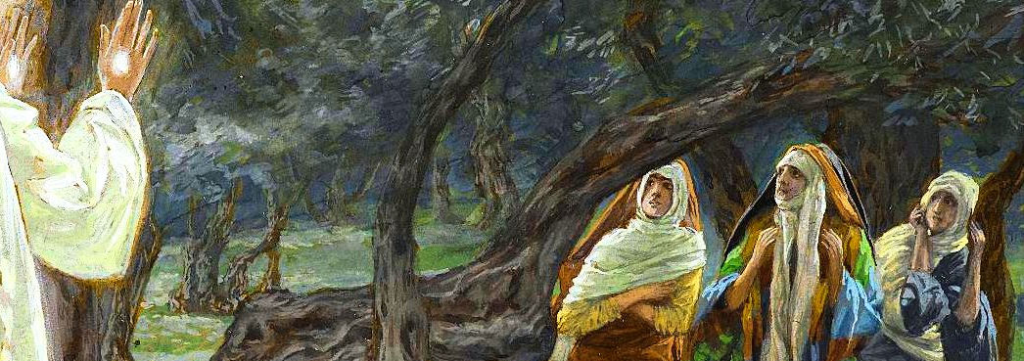
8 “So they departed quickly from the tomb with fear and great joy, and ran to tell his disciples. 9 And behold, Jesus met them and said, “Greetings!” And they came up and took hold of his feet and worshiped him. 10 Then Jesus said to them, “Do not be afraid; go and tell my brothers to go to Galilee, and there they will see me.” (Matthew 28:8–10 (ESV)
All four Gospels parallel each other concerning the events on Resurrection Sunday. The Holy Spirit specifically inspired one of two of the writers to provide particular information not found in the other Gospels. While each writer provides selective, insightful information, they do not contradict each other in telling the wonderful news that Jesus Christ is alive. Such is the case with today’s text from Matthew.
“Given the importance of the resurrection, it is no surprise that critics of the Christian faith often attack the resurrection accounts and defenders of the faith argue for their historical credibility. The four Gospels describe the empty tomb and the post-resurrection appearances of Jesus differently, but the differences are not irreconcilable. Much good work has been done in showing how the accounts fit together, and it is good for believers to equip themselves with a basic knowledge of such things as we face a culture increasingly hostile to the Christian faith. We must be prepared to give an answer for the hope that is within us (1 Peter 3:15–16),” explains Dr. R. C. Sproul.
“That we might be so equipped, we will note one important factor that argues for the historicity of Jesus’ resurrection. In each gospel account, women were the very first witnesses of the empty tomb. This is noteworthy because first-century Jewish culture did not view the testimony of women as reliable. So, if someone invented the resurrection, having women be the first witnesses of it would not be the smart way to go about telling the story. There would be no reason to have the women be the first witnesses of the resurrection unless, in fact, they were the first to see the empty tomb and the risen Lord. The Evangelists include this fact because they had to. It is what actually happened, and they note the women’s presence because they were relaying history.”
The women encountered the angels at Jesus’ empty tomb. These witnesses included Mary Magdalene and Joanna and Mary the mother of James and the other women with them (Matt. 28:7-8; Mark 16:7-8; Luke 24:8-11). Upon hearing the great news of Jesus’ resurrection, and the angel’s command to go and tell the disciples, the women ran with fear and great joy to spread the glorious news to Jesus’ followers. It was at that moment Jesus met them.
He said, “Greetings.” The text continues to say, “And they came up and took hold of his feet and worshiped him.” Being the Incarnate Lord of heaven and earth, Jesus received their worship.
“To put them at ease Jesus used an ordinary greeting when he met them, one that can perhaps be best rendered “Hello,” or “How do you do?” or “Good morning.” See also Matt. 26:49; 27:29. Immediately they recognized him, fell down before him, taking hold of his feet and worshipping him. He was real, even physical (“his feet”). He was Jesus, no one else, the very Jesus whom they had known for a considerable time, and to whom they had rendered valuable service,” states Dr. William Hendriksen.
He then told them, “Do not be afraid; go and tell my brothers to go to Galilee, and there they will see me.” The brothers of whom Jesus referred were the eleven apostles.
“My brothers,” not: “those habitual quarrelers, those men who promised to remain loyal to me no matter what would happen, but who when the crisis arrived left me and fled; those men who, with one exception, were not even present at Calvary when I was laying down my life for them.” None of that. Instead, “my brothers,” those whom I acknowledge as members of my family, those who share the inheritance with me, those whom I love,” explains Dr. Hendriksen.
“Our actions tend to reveal what we really believe, so if we believe Christ has been raised from the dead, we must tell the world. And we tell the world by telling those with whom we have personal contact about Jesus and supporting the work of the church to make disciples of all nations. Are you sharing the good news of Jesus’ resurrection? Are you giving to and praying for the task of world missions,” concludes Dr. Sproul.
Soli deo Gloria!
 His Word Today