
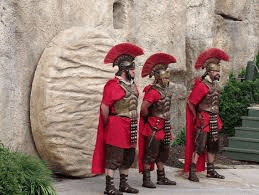
61 Mary Magdalene and the other Mary were there, sitting opposite the tomb. 62 The next day, that is, after the day of Preparation, the chief priests and the Pharisees gathered before Pilate 63 and said, “Sir, we remember how that impostor said, while he was still alive, ‘After three days I will rise.’ 64 Therefore order the tomb to be made secure until the third day, lest his disciples go and steal him away and tell the people, ‘He has risen from the dead,’ and the last fraud will be worse than the first.” 65 Pilate said to them, “You have a guard of soldiers. Go, make it as secure as you can.” 66 So they went and made the tomb secure by sealing the stone and setting a guard.” (Matthew 27:61–66 (ESV)
47 Mary Magdalene and Mary the mother of Joses saw where he was laid.” (Mark 15:47 (ESV)
55 The women who had come with him from Galilee followed and saw the tomb and how his body was laid. 56 Then they returned and prepared spices and ointments. On the Sabbath they rested according to the commandment.” (Luke 23:55–56 (ESV)
In our study of the Gospel of Matthew’s record of the Passion Week of the Lord Jesus Christ, it is necessary, and insightful, to examine all four Gospel accounts. This discipline provides us understanding of all the events and encounters which took place during those hours.
There is a lot of information surrounding the burial of Jesus Christ following His death on the cross. All four Gospels provide insight into this historical moment. The Synoptic Gospels all refer to the Jewish religious leaders’ efforts to secure Jesus’ tomb.
On the day after the Day of Preparation, which was the Sabbath, the Jewish religious leaders met with Pontius Pilate. They wanted Jesus’ tomb sealed and protected from theft or invasion. Their reasons were not altruistic. They remembered the Lord saying He would rise from the dead. While the leaders were sure Jesus would not rise from the dead, they did not want His disciples to steal His body and then say He had come back to life.
Therefore, the chief priests and the Pharisees wanted Pilate to make the tomb secure. Pilate was in no mood for discussion. He said to the Jews, ““You have a guard of soldiers. Go, make it as secure as you can.” They did so by sealing the tomb and setting a guard.
Concurrently, some of the women who were Jesus’ disciples followed these events and knew the exact location of the tomb where Jesus lay. During the Sabbath Day, they prepared spices and ointments in order to complete their annotating of Jesus’ body. This they would do on the first day of week.
“Jesus died late on a Friday afternoon nearly two thousand years ago. Ordinarily in that day, the Jews anointed the bodies of the dead with oil and spices as a sign of respect and to cover up the odor of decaying flesh. But since there was not enough time before the Sabbath to prepare Jesus’ body for burial according to all the proper customs, the body of our Lord could only be wrapped in a cloth and laid in a tomb before the sun set and the day of rest began (Mark 15:46),” explains Dr. R. C. Sproul.
“Ancient Jews reckoned their days from sundown to sundown. Jesus died on a Friday, was laid in the tomb from late afternoon Friday through early Sunday, and then was resurrected sometime Sunday morning near the break of dawn (Mark 16:1–8). That represents a total of three days—Friday, Saturday, and Sunday—because the Jews counted time inclusively. That is, when they said three days from Friday, they included Friday as one of those days.”
One lyricist put it this way: “It’s Friday; but Sunday’s coming.”
Soli deo Gloria!
 His Word Today
Powerful
LikeLike
Soli deo Gloria!
LikeLike