
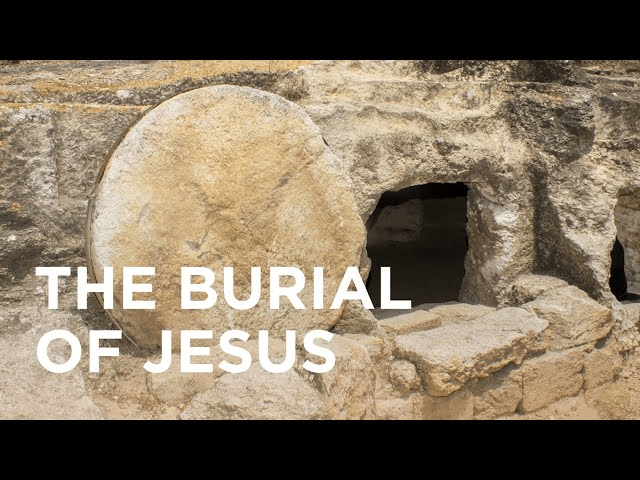
57”When it was evening, there came a rich man from Arimathea, named Joseph, who also was a disciple of Jesus. 58 He went to Pilate and asked for the body of Jesus. Then Pilate ordered it to be given to him. 59 And Joseph took the body and wrapped it in a clean linen shroud 60 and laid it in his own new tomb, which he had cut in the rock. And he rolled a great stone to the entrance of the tomb and went away. 61 Mary Magdalene and the other Mary were there, sitting opposite the tomb.” (Matthew 27:57–61 (ESV)
42 “And when evening had come, since it was the day of Preparation, that is, the day before the Sabbath, 43 Joseph of Arimathea, a respected member of the council, who was also himself looking for the kingdom of God, took courage and went to Pilate and asked for the body of Jesus. 44 Pilate was surprised to hear that he should have already died. And summoning the centurion, he asked him whether he was already dead. 45 And when he learned from the centurion that he was dead, he granted the corpse to Joseph. 46 And Joseph bought a linen shroud, and taking him down, wrapped him in the linen shroud and laid him in a tomb that had been cut out of the rock. And he rolled a stone against the entrance of the tomb.” (Mark 15:42–46 (ESV)
50 “Now there was a man named Joseph, from the Jewish town of Arimathea. He was a member of the council, a good and righteous man, 51 who had not consented to their decision and action; and he was looking for the kingdom of God. 52 This man went to Pilate and asked for the body of Jesus. 53 Then he took it down and wrapped it in a linen shroud and laid him in a tomb cut in stone, where no one had ever yet been laid. 54 It was the day of Preparation, and the Sabbath was beginning.” (Luke 23:50–54 (ESV)
38 “After these things Joseph of Arimathea, who was a disciple of Jesus, but secretly for fear of the Jews, asked Pilate that he might take away the body of Jesus, and Pilate gave him permission. So he came and took away his body. 39 Nicodemus also, who earlier had come to Jesus by night, came bringing a mixture of myrrh and aloes, about seventy-five pounds in weight. 40 So they took the body of Jesus and bound it in linen cloths with the spices, as is the burial custom of the Jews. 41 Now in the place where he was crucified there was a garden, and in the garden a new tomb in which no one had yet been laid. 42 So because of the Jewish day of Preparation, since the tomb was close at hand, they laid Jesus there.” (John 19:38–42 (ESV)
In our study of the Gospel of Matthew’s record of the Passion Week of the Lord Jesus Christ, it is necessary, and insightful, to examine all four Gospel accounts. This discipline provides us understanding of all the events and encounters which took place during those hours.
There is a lot of information surrounding the burial of Jesus Christ following His death on the cross. All four Gospels provide insight into this historical moment.
First, Matthew and Mark state it was evening. Mark, Luke and John indicate it was the Day of Preparation, the day before the Sabbath. Since Preparation Day was the day before the Sabbath, Jesus therefore died on a Friday since the Sabbath was/is Saturday (Mark 15:42; Luke 23:54; John 19:42).
Second, all four Gospels mention Joseph of Arimathea. Arimathea, also known as Ramah, was the birthplace of Samuel (I Sam. 1:1, 19; 2:11). It was located 15-20 miles from Jerusalem. Joseph was a rich man. He was a respected member of the Sanhedrin Council (Mark 15:43). He was a good and righteous man (Luke 23:50) who had not consented to have Jesus crucified (Luke 23:51). He was a disciple of Jesus, but secretly for fear of the Jews (John 19:38). He was also looking for the kingdom of God (Mark 15:43).
Third, Joseph courageously went to Pontius Pilate and asked for the body of Jesus. Pilate was initially surprised Jesus was dead so soon and summoned the centurion to know whether this was true. Victims of crucifixion often hung for days before they died. The centurion confirmed Jesus’ death to Pilate (Mark 15:44-45). Pilate then released the Lord’s body to Joseph.
“Though prisoners sentenced to death forfeited the right to burial under Roman law, their bodies were usually granted to relatives who asked for them, but Jesus’ mother was emotionally exhausted from the ordeal. There is no evidence that his brothers and sisters were in Jerusalem, and his closest friends, the disciples, had fled (except for John, who had Mary to take care of; John 19:26–27). In the absence of those closest to Jesus, Joseph courageously asked Pilate for Jesus’ body,” explains Dr. John MacArthur. .
Fourth, having received permission from Pilate, Joseph and Nicodemas, who himself brought a mixture of myrrh and aloes weighing about 75 pounds (John 19:39), wrapped Jesus’ body in a clean, linen shroud Joseph provided (Matt. 27:59; Mark 15:46; Luke 23:33; John 19:40).
Fifth, Joseph and Nicodemas laid Jesus’ body in Joseph’s own tomb cut out of/in the rock. Joseph then rolled a stone over the entrance to the tomb (Matt. 27:60; Mark 15:46). Luke and John record the new tomb had never been used, and was located in a garden close by (Luke 23:53; John 19:41). Matthew alone mentions that Mary Magdalene and the other Mary were also in attendance (Matt. 27:61).
“Joseph needs all the help he can get because he must take Jesus down from the cross, wash His body, anoint Him for burial, and finally place His body in the grave. He and Nicodemus only have a three-hour window in which to accomplish this work; Jesus died at the ninth hour (Matt. 27:45–50) and all work must stop when the Sabbath begins at the twelfth hour. Because he is a rich man, Joseph likely has servants who are helping in the process, although even with this help there will remain more work to be done, which is why the women return to His tomb on the first day of the week (Mark 16:1). That Jesus is buried in a rich man’s tomb is yet another fulfillment of prophecy (Isa. 53:9),” explains Dr. R. C. Sproul.
“Jesus’ fellow Israelites consider it especially charitable to provide a proper burial for someone who might not otherwise get one. No doubt this fact motivates Joseph of Arimathea; however, he is not merely doing a good deed. In coming forward to bury Jesus, Joseph identifies himself as a disciple of Christ and risks the Sanhedrin’s fury. After years of following Jesus behind closed doors, Joseph makes his true allegiance known.”
May our allegiance to Jesus be known as well.
Soli deo Gloria!
 His Word Today