
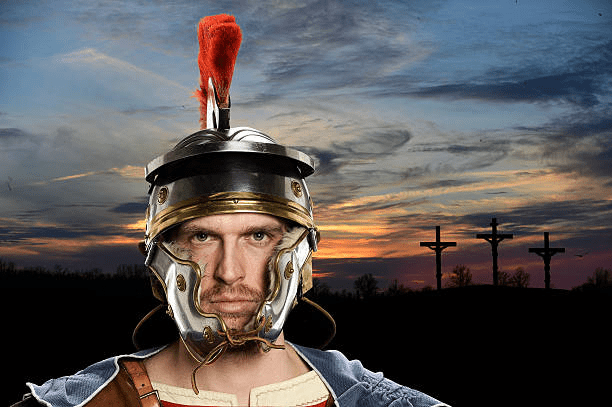
“When the centurion and those who were with him, keeping watch over Jesus, saw the earthquake and what took place, they were filled with awe and said, “Truly this was the Son of God!” (Matthew 27:54 (ESV)
“And when the centurion, who stood facing him, saw that in this way he breathed his last, he said, “Truly this man was the Son of God!” (Mark 15:39 (ESV)
“Now when the centurion saw what had taken place, he praised God, saying, “Certainly this man was innocent!” (Luke 23:47 (ESV)
In our study of the Gospel of Matthew’s record of the Passion Week of the Lord Jesus Christ, it is necessary, and insightful, to examine all four Gospel accounts. This discipline provides us understanding of all the events and encounters which took place during those hours.
“Given the emphasis in Matthew’s gospel on how Jesus fulfills the old covenant (Matt. 5:17; 12:15–21; 26:47–56), it is hard to miss the significance of the hour of His death. Our Savior dies at the ninth hour (27:45–50) — three o’clock p.m. — the same hour at which the daily sacrifices begin in the Jerusalem temple. By this we see that Christ fulfills all of the old covenant sacrifices. After His atonement, there is no need to offer up the blood of bulls and goats; sin has been dealt with and the temple rituals therefore pass away (Heb. 10:1–18),” states Dr. R. C. Sproul.
Today’s texts reveal another striking irony. The Jewish religious leaders and people gathered around the crucifixion scene mock and reject Jesus’ person and work. However, not only is one of the criminals brought to saving faith in Jesus (Luke 23:39-43), but arguably the centurion in charge of the execution.
A centurion (ἑκατοντάρχης; hekatontarchos) was a commander of 100 men in the Roman army. There were generally six centurions in each cohort 600) and ten cohorts in a legion (6,000). Each legion had six tribunes to whom its centurions were subordinate (Acts 22:26).
“The office of centurion was normally the highest one within reach of the ordinary soldier. A centurion had many duties besides maintaining discipline among the ranks. He had to oversee executions for capital offenses (Matt. 27:54; Mark 15:39, 44–45; Luke 23:47),” explains the Tyndale Bible Dictionary.
There are six centurions mentioned in the New Testament. These include the following.
- A centurion at Capernaum pleaded for the life of his dying servant because he believed that diseases would obey Jesus just as his soldiers obeyed him (Matt. 8:5–13; Luke 7:2–10).
- A centurion in Caesarea named Cornelius was converted to Christ through the testimony of the apostle Peter, whose reluctance to share the gospel with Gentiles had been broken down by a vision from God (Acts 10).
- A centurion in Acts 22:25–26 helped save the apostle Paul from a scourging when he reminded his tribune that the accused was a Roman citizen.
- Another centurion helped save Paul from a Jewish plot to murder him (Acts 23:17–22).
- A centurion named Julius was assigned to guard Paul on his journey from Caesarea to Rome (Acts 27:1). When their ship broke up in a storm, Julius prevented the soldiers from killing all the prisoners on board, including Paul (vv 42–43).
Foremost for today’ study was the centurion in charge of the squad that executed Jesus. All three Synoptic Gospels record his confession of the person of the Lord Jesus Christ. All three note the centurion’s initial statement “truly” (ἀληθῶς; alethos) or “certainly” (ὄντως; ontos). This mean he understood who Jesus really was.
Matthew includes the other soldiers also being filled (σφόδρα; sphodra) with awe (φοβέω; phobeo). This great number of men, and their leader, were greatly frightened and worshipful of the Lord. Luke records the centurion praised (δοξάζω; doxazo) the One, True God. This was significant.
“Ironically, many Jewish leaders will not believe even after these signs (Matt. 27:62–66; 28:11–15). To the soldiers guarding Jesus, however, these supernatural events prove they have killed a divine man (27:54). This may not be saving faith, but it does reveal that their hearts are not so hard as to miss the obvious,” states Dr. Sproul.
“The centurion was the one who uttered the words of confession, but he evidently spoke for his men as well. Their fear speaks of an awareness of their sin and the word ‘truly’ suggests a certainty and conviction that bespeaks of genuine faith. These men represent an answer to Jesus’ prayer in Luke 23:34. Their response contrasts sharply with the mocking taunts of Matt. 27:39-44,” comments Dr. John MacArthur.
Soli deo Gloria!
 His Word Today