
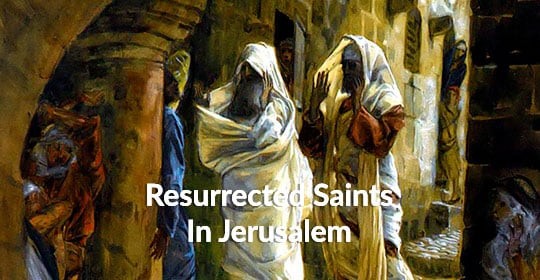
51 And behold, the curtain of the temple was torn in two, from top to bottom. And the earth shook, and the rocks were split. 52 The tombs also were opened. And many bodies of the saints who had fallen asleep were raised, 53 and coming out of the tombs after his resurrection they went into the holy city and appeared to many.” (Matthew 27:51–53 (ESV)
In our study of the Gospel of Matthew’s record of the Passion Week of the Lord Jesus Christ, it is necessary, and insightful, to examine all four Gospel accounts. This discipline provides us understanding of all the events and encounters which took place during those hours.
Matthew alone mentioned this miracle of the opened tombs. Who were these resurrected people?
To begin with, the earth shook at the moment of Jesus’ death. This occurred as the temple curtain was torn. It was a great earthquake. The earth violently trembled so that rocks were split in half, torn apart and divided. As this occurred, the tombs were opened. Graves were literally opened, and the dead were raised to life.
The text calls them saints. Saints (ἅγιος; hagios) refers to God’s people. They were set apart ones who were holy and dedicated to the Lord. This title refers to all believers in Jesus Christ (Rom. 1:7; I Cor. 1:1-2; 2 Cor. 1:1; Eph. 1:1; Phil. 1 :1; Col. 1:1).
These saints had fallen asleep (κοιμάω; koimao). This is another way saying they had physically died. However, they were raised (ἐγείρω; egeiro) or brought to physical life. God caused them to live again.
Matthew added these resurrected saints did not come out of their tombs until after the resurrection of Christ. When they did, they came into Jerusalem and appeared to many people. Dr. William Hendriksen shares the following insights.
“First, this was a real resurrection, not an appearance of corpses.”
“Secondly, it occurred at the very moment of Christ’s death and, together with the other signs, pointed to the significance of that death.”
“Thirdly, it is true that the original can be construed in either of two ways, depending on how we parse the phrase “after his [Christ’s] resurrection”; whether we conceive the sense to be “having left their tombs after his resurrection,” or “after his resurrection they went.…” But is it reasonable to believe that these saints, with glorious resurrection bodies, remained in the darkness and corruption of the tombs from Friday afternoon until Sunday morning? The meaning is, in all probability, that these saints were raised and left their tombs at the moment of Christ’s death. Not until after Christ’s resurrection did they enter Jerusalem and did they appear to many. Where they were from the moment when they left their graves until they appeared to many in what is still called “the holy city” (!) is not explained, just as also the whereabouts of Jesus during the intervals between his post-resurrection appearances is nowhere indicated.”
“Fourthly, everything seems to point to the fact that these saints did not again die. It must be that after they appeared to many for some small period of time, God took them—now body and soul—to himself in heaven, where their souls had been previously.”
“Finally, this sign, too, like those described in verse 51, 52a, is prophetic. It shows that Christ’s death guarantees our glorious resurrection at Christ’s return.”
“Today’s passage reports that the earthquake also opens several tombs, from which appear many resurrected saints after our Lord rises from the dead (vv. 52–53). We do not know their identities, but these holy ones clearly died before Jesus inaugurated the new covenant and are raised only after He is resurrected. By this we see that the only way believers, whether they live under the old covenant or the new, can find final salvation (resurrected life in a new heavens and earth, Rev. 20:1–6; 21) is through Christ’s death and resurrection. Scripture does not say whether the people of Matthew 27:52 die again or ascend to heaven. In any case, their resurrection is a sign that Jesus’ death has inaugurated the last days, for this raising to life is the signal event of judgment day (Dan. 12:1–2),” explains Dr. R. C. Sproul.
“The resurrection of others,” John Calvin says, “also makes evident that Jesus died and rose again not only for Himself, but also to restore life to His people.”
Soli deo Gloria!
 His Word Today