
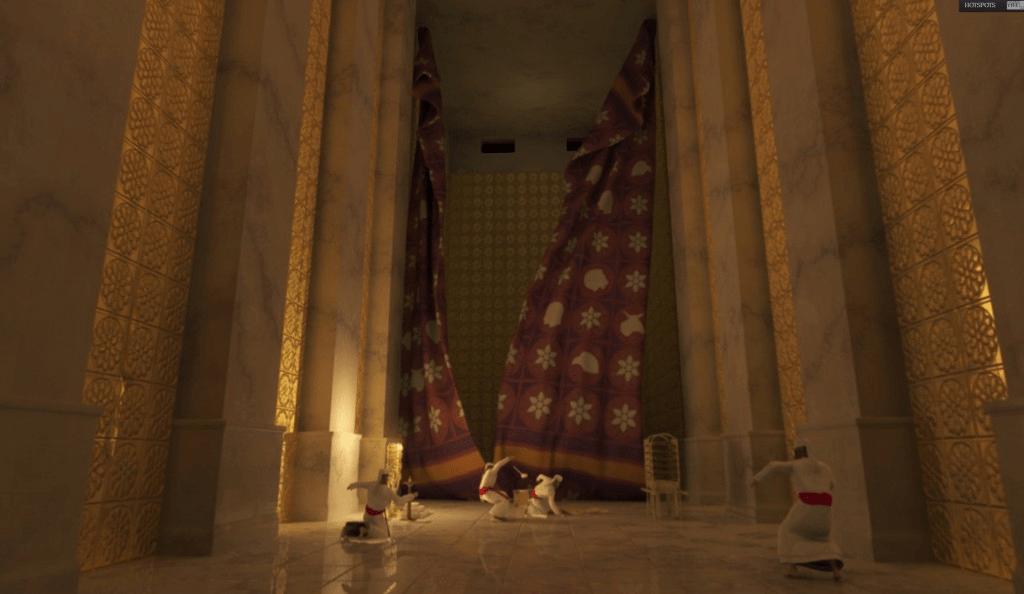
“And behold, the curtain of the temple was torn in two, from top to bottom. And the earth shook, and the rocks were split.” (Matthew 27:51 ESV)
“And the curtain of the temple was torn in two, from top to bottom.” (Mark 15:38 ESV)
“And the curtain of the temple was torn in two.” (Luke 23:45 (ESV)
In our study of the Gospel of Matthew’s record of the Passion Week of the Lord Jesus Christ, it is necessary, and insightful, to examine all four Gospel accounts. This discipline provides us understanding of all the events and encounters which took place during those days and hours.
Matthew, Mark and Luke alone recorded the events immediately following the Lord Jesus Christ’s death on the cross. Regarding those events, they mentioned the moment the tearing in half of the temple curtain,
The curtain separated the two inner chambers, or rooms, in the temple. These were the Holy Place and the Holy of Holies. Contained in the Holy Place were three pieces of furniture: the Table of Shewbread, the Golden Lampstand and the Golden Altar of Incense. Contained within the Holy of Holies was the Ark of the Covenant.
Separating the Holy Place from the Holy of Holies was the curtain. Exodus 26:31-35 describes the curtain in detail.
31 “And you shall make a veil of blue and purple and scarlet yarns and fine twined linen. It shall be made with cherubim skillfully worked into it. 32 And you shall hang it on four pillars of acacia overlaid with gold, with hooks of gold, on four bases of silver. 33 And you shall hang the veil from the clasps, and bring the ark of the testimony in there within the veil. And the veil shall separate for you the Holy Place from the Most Holy. 34 You shall put the mercy seat on the ark of the testimony in the Most Holy Place. 35 And you shall set the table outside the veil, and the lampstand on the south side of the tabernacle opposite the table, and you shall put the table on the north side.” (Exodus 26:31–35 (ESV)
What was the significance of the curtain? What was also the significance of the curtain being torn in two at the death of Jesus Christ? Dr. Benjamin Shaw, professor of Old Testament at Reformation Bible College in Sanford, Fla., answers these questions.
“When Moses was given the law on Mount Sinai, that law included instructions for building the tabernacle. Included were directions for making a curtain or veil (Ex. 26:30–35). The purpose of this curtain was to divide between the Holy Place and the Most Holy Place. In the Holy Place were the lampstand, the table for the bread of the presence, and the altar of incense. In the Most Holy Place was the Ark of the Covenant, covered by the mercy seat, on which were two cherubim guarding the presence of God. This was the place where God made His presence visible and from where He spoke to Moses.”
“The veil that divided the Holy Place from the Most Holy Place was embroidered with cherubim, representing the cherubim to the east of Eden, keeping mankind away from the presence of God. But a change took place. The absolute prohibition on entering God’s presence now became not so absolute. The door into the presence of God that had been so firmly slammed shut at Eden now opened a crack. It was a very small crack, to be sure, but it was a real crack. Now the high priest, once a year, accompanied by the billowing smoke of incense and the blood of sacrifices, could enter the Most Holy Place (Lev. 16). He could enter the place of God’s presence.”
“The people would have known about this if they were properly instructed. The law was to be read before the people every seven years (Deut. 31:9–13). The Levites would have mentioned such things in their instructional work among the people. But for most, the change would have seemed negligible. After all, it only affected the high priest, and only once a year. In addition, as more generations passed, there was no further change in the statutes to indicate that any new development could be expected. When the temple was built, a new veil embroidered with cherubim and setting apart the Most Holy Place was made (2 Chron. 3:14). In addition, the walls of the temple were adorned with cherubim. Except for the high priest, once a year, there was no entering the presence of God.”
“But the prophetic era hinted that further change would come. Isaiah 25:7 says, “And he will swallow up on this mountain the covering that is cast over all peoples, the veil that is spread over all nations.” The word “covering” is not the same as the word “veil.” However, the connection with the holy mountain of the Lord and the eager expectation of the people for the coming of the Lord at least hint at a further change, a very significant change.”
“Again, a period of silence ensued. Then, at the very end of Jesus’ ministry, at the very point of His death, the curtain of the temple was torn in two from top to bottom. This testimony is included in all three of the Synoptic Gospels (Matthew, Mark, and Luke). Something strange, marvelous, and wonderful happened. The way into God’s presence was once again opened. The Synoptic Gospels present the fact, while the author of Hebrews explains what happened.”
“First, we read that Jesus Himself has gone in behind the veil, the curtain (Heb. 6:19). He has entered as our High Priest. As the High Priest in the tabernacle and the temple, Jesus entered the Most Holy Place. However, it was not just the representative Most Holy Place of the temple—it was the true Most Holy Pace in heaven. There He has gone to anchor our hope.”
“Further, Jesus did not enter the Most Holy Place temporarily, as did the high priests of the Old Testament period. Instead, He entered once for all (Heb. 9:11–12). That is, He entered once for all for His people, and He entered permanently, never to exit.”
“Finally, the author of Hebrews tells us that we, too, enter the Most Holy Place by the blood of Jesus (Heb. 10:19–20). We are also told that the curtain represented the body of Christ. With the shedding of His blood, that curtain was torn. The way into the presence of God has been restored. The guarding cherubim with the flashing sword have been removed. What was lost in Adam has been regained in Christ.”
Soli Deo Gloria.
 His Word Today