
Ephesians 6:15. The Gospel of Peace. (Podcast #71).

Growing in the Grace & Knowledge of Jesus Christ

This article contains thoughts concerning the biblical doctrine of redemption. I trust you will benefit from these insights as I have.
“Even as the Son of man came not to be ministered unto, but to minister, and to give His life a ransom for many.”—Matthew 20:28. The doctrine of Redemption is one of the most important doctrines of the system of faith. A mistake on this point will inevitably lead to a mistake through the entire system of our belief,” states Charles H. Spurgeon.
“He had no form or majesty that we should look at him, and no beauty that we should desire him (Isa. 53:2).The promised Christ was unattractive in his appearance. Indeed, the prophet says that Jesus “grew up” this way (Isa. 53:2), which implies that our Savior was more homely than handsome. Certainly, in his sufferings and death, Jesus became so physically disfigured that he was socially rejected. The horror of his cross thus screamns against every sensibility of the divine aesthetic. It was so hideous that even the Father (in a manner of speaking, during the dark hours that his Son bore the guilt of our sin) looked away. Nevertheless, the Bible still tells us to look to Jesus on the cross for our salvation (e.g., Heb. 12:2),” explains Philip Graham Ryken
“Here we confront the paradox of the crucifixion, which was both the ugliest sin ever committed and the most beautiful sacrifice ever given. When we look at “the Passion and crucifixion of the Lord of glory,” writes Thomas Dubay, we witness “consummate splendor in monstrous horror.” There “at one and the same time we find supremely horrific ugliness and supremely divine and loving beauty.” In this paradox we also find our salvation, for the crucifixion of the Christ was the ugly sin that alone had the power to make this world beautiful again.”
“Unto him that loved us, and washed us from our sins in his own blood (Revelation 1:5) THE bare repetition of these words is sufficient to convince every hearer how well they are suited to the design of our present meeting. Redeeming love is certainly the most delightful of all themes to every real Christian. It is the immediate and direct object of our contemplation in the Lord’s Supper. This ordinance was instituted to keep up the remembrance of the sufferings and death of Christ, which was the great and finishing proof of his love. How then can you attend on it in a more becoming and dutiful, a more pleasant and desireable, or a more happy and useful frame of spirit, than when your hearts are filled with a sense of the love of Christ, and you find yourselves disposed to join, with a mixture of joy and wonder, in the doxology of the apostle John, in the text, Unto him that loved us, and washed us from our sins in his own blood,” states Pastor John Witherspoon.
“The theater of God’s redemption is this world. It is to this world that God came in Christ. Christ refused to allow His disciples to hide in an upper room with the doors locked by reason of fear. No booths were allowed to be built on the mountain of Transfiguration. We are called to be Christ’s witnesses in Jerusalem, Judea, Samaria, and to the ends of the earth. Jerusalem is in this world. Judea is in this world. Samaria is in this world. The ends of the earth are still on this earth. So we should not flee this world. But, oh, how many Christians try to do so. And in doing so, they may actually be displeasing the God who wants the world to be redeemed, not escaped,” explains Dr. R. C. Sproul.
Soli deo Gloria!
The article contains thoughts concerning the biblical doctrine of redemption. I trust you will benefit from these godly men as I have.
“The concept of redemption is fundamentally commercial language. The Greek terms agorazō and exagorazō which both derive from the word agora, which means “marketplace,” and thus “to redeem” means to purchase out of the marketplace. Another word the New Testament uses for redemption is lutroō, which speaks of a purchase by the payment of a ransom. Putting the two together, we discover that a key concept of redemption is slavery. Slaves were redeemed by the payment of a ransom,” explains author Mike Riccardi.
“Scripture testifies that man is in the bondage of slavery—that we are so beholden to the lust of the flesh, the lust of the eyes, and the boastful pride of life (cf. 1 John 2:15–17), that we are properly said to be enslaved to our sin (cf. John 8:34; Rom 6:16–18; 2 Pet 2:19). And our slavery is so pervasive that it extends even to our hearts: our slave-master has deceived us into loving our slavery. But thanks be to God that Scripture teaches Christ has come to redeem His people from the bondage of our slavery, to purchase us out of the slave-market of sin by the payment of the ransom price of His own life (I Timothy 2:5-6).”
“Rescuing souls is at the very foundation of the mission of God and at the heart of the grand story of redemption. Before the foundation of the world, God chose to rescue souls, and when the fullness of time had come, the Father sent the Son to rescue souls. The Son came to seek and to save that which was lost, and the Holy Spirit calls and regenerates the souls of all the Father has given to the Son. Our sovereign and triune God is the primary rescuer of lost souls. And in His wisdom, God has called us to be secondary instruments through which He rescues souls,” Pastor Burk Parsons.
“The covenant of redemption, which is the foundation for the triune God’s gracious restoration of fallen sinners to life and communion with God, describes the respective roles that are “appropriate” to the Father, the Son, and the Holy Spirit in the plan of redemption. Even though Christian theology affirms that all the works of the triune God are indivisibly the works of the Father, the Son, and the Holy Spirit (opera Trinitatis ad extra sunt indivisa), each of the persons of the Trinity plays a unique role in the salvation of the elect. The Father elects to save His people in Christ (Eph. 1:4). The Son is appointed and willingly offers Himself as the Savior and Mediator (Luke 22:29; Heb. 10:5–7). The Holy Spirit furnishes Christ with the gifts necessary to accomplish His saving work (Luke 1:35; 3:21–22; 4:18), and also applies the benefits of Christ’s work to those whom the Father gives to the Son (John 6:38–39; 17:4). Thus, in a delightful harmony of mutual love and purpose, Father, Son, and Holy Spirit eternally covenant to redeem an elect community” states Cornelius Venema.
“In the redemptive work of Christ in the New Testament: we are not saved simply because we need to be saved, but so that we might worship Him. That’s the point of your salvation—to worship the Lord your God. That’s why, for example, the author of Hebrews said we are never to neglect assembling together as saints (Heb. 10:25). We don’t come to church just to have our attendance taken; we come to church because the Lord has redeemed us, and the people of God should have their hearts filled with reverence and adoration and should come into the corporate assembly of the people of God to worship Him,” explains Dr. R. C. Sproul.
Soli deo Gloria!
“SOTERIOLOGY deals with the communication of the blessings of salvation to the sinner and his restoration to divine favor and to a life in intimate communion with God. It presupposes knowledge of God as the all-sufficient source of the life, the strength, and the happiness of mankind, and of man’s utter dependence on Him for the present and the future. Since it deals with restoration, redemption, and renewal, it can only be understood properly in the light of the original condition of man as created in the image of God, and of the subsequent disturbance of the proper relationship between man and his God by the entrance of sin into the world.” Dr. Louis Berkhof
“Redemption is directed to the need created by man’s bondage to sin. It speaks the language of purchase and ransom. Ransom is the securing of a release by the payment of a price. From what has the sinner been released? From the law and sin.” — Dr. Charles Horne.
Galatians 3:13 (ESV) – “Christ redeemed (agorazo; exagorazo us from the curse of the law by becoming a curse for us—for it is written, “Cursed is everyone who is hanged on a tree”
The Greek word translated “redeemed” was often used to speak of buying a slave’s or debtor’s freedom. Christ’s death, because it was a death of substitution for sin, satisfied God’s justice and exhausted his wrath toward his elect, so that Christ actually purchased believers from slavery to sin and from the sentence of eternal death (4:5; Titus 2:14; 1 Pet. 1:18; cf. Rom. 3:24; 1 Cor. 1:30; Eph. 1:7; Col. 1:14; Heb. 9:12).” – Dr. John MacArthur
Christ delivered sinners from the bondage of sin, of which the Mosaic Law was the instrument.
Hebrews 9:11–12 (ESV) – “11 But when Christ appeared as a high priest of the good things that have come, then through the greater and more perfect tent (not made with hands, that is, not of this creation) 12 he entered once for all into the holy places, not by means of the blood of goats and calves but by means of his own blood, thus securing an eternal redemption.”
Redemption from sin embraces the several aspects from which sin maybe scripturally viewed. In examining Hebrews 9:11-12, we note particularly (1) redemption from guilt –justification and forgiveness of sin (Rom. 3:24; Eph. 1:7; Col. 1:14; Heb. 9:15; (2) Redemption from the power of sin –deliverance from its enslaving defilement (Titus 2:14; I Peter 1:18); and (3) Redemption from the presence of sin – glorification (Rom. 8:23, 28-31).
“Because we as sinners are in bondage to sin and to Satan, we need someone to provide redemption and thereby ‘redeem’ us out of that bondage. When we speak of redemption, the idea of ‘ransom’ comes into view. A ransom is the price paid to redeem someone from bondage or captivity. Jesus said of Himself, ‘For even the Son of Man also came not to be served but to serve, and to give His life as a ransom for many.’ (Mark 10:45).” – Dr. Wayne Grudem
As one author writes, “Where do you find your worth? The world tempts us to define ourselves by our wealth, our strength, our skills, our accomplishments. The gospel gives a different answer. It calls us not to look inside ourselves, but rather to lift our gaze to the cross. Though we have no worth in and of ourselves to cling to, we see something remarkable: wounds. Bloody wounds. Scars that speak of how much we are worth to God: He gave His Son for our redemption.”
My worth is not in what I own
Not in the strength of flesh and bone
But in the costly wounds of love
At the cross.
My worth is not in skill or name
In win or lose, in pride or shame
But in the blood of Christ that flowed
At the cross.
Refrain:
I rejoice in my Redeemer
Greatest Treasure,
Wellspring of my soul
I will trust in Him, no other.
My soul is satisfied in Him alone.
As summer flowers we fade and die
Fame, youth and beauty hurry by
But life eternal calls to us
At the cross.
I will not boast in wealth or might
Or human wisdom’s fleeting light
But I will boast in knowing Christ
At the cross.
Refrain
Two wonders here that I confess
My worth and my unworthiness
My value fixed – my ransom paid
At the cross.
Refrain
(WORDS AND MUSIC BY KEITH GETTY, KRISTYN GETTY AND GRAHAM KENDRICK)
Soli deo Gloria!

“Christ saves us neither by the mere exercise of power, nor by his doctrine, nor by his example, nor by the moral influence which he exerted, nor by any subjective influence on his people, whether natural or mystical, but as a satisfaction to divine justice, as an expiation for sin, and as a ransom from the curse and authority of the law, thus reconciling us to God by making it consistent with his perfection to exercise mercy toward sinners.” – Dr. Charles Hodge.
“Redemptive History is understood as God’s self-revelation to mankind in the person of Jesus Christ, through whom God purposed to love a people as His own, even to the point of sending His Son in their likeness, being tempted and suffering death on the cross, bearing the full penalty of their sins, that they may live in Him through His resurrection from the dead. The life, death, and resurrection of the Savior, being the means of God’s redemptive purpose, was foreshadowed in all of history, specially revealed in the Bible, that those who follow after Christ by His death to the age of His resurrection might know God as faithful to His promises, and have complete access to fellowship with Him without fear of condemnation.” –Two Age Glossary
Continuing our study in the Vocabulary of Salvation, we turn our attention to the doctrine of Redemption. What is Redemption?
The words, and therefore the definition, of redemption has several meaning. In the Old Testament Hebrew language, there are three primary meanings for redemption.
The first term used for redemption has a legal context. The verb padah is used when an animal substitutes for (or redeems) a person or another animal. The root meaning is the ransom or the price paid.
“When a living being, person or animal, requires redemption, the substitution must be made, or price paid; otherwise, the creature involved is killed (Ex. 13:13; 34:20). However, there is evidence that this rule was not always strictly followed (Ex. 21:8; Job 6:23),” explains the Tyndale Bible Dictionary.
The second term involved is the Hebrew root ga’al, which is used primarily in relation to family rules and obligations, laws governing family property rights and responsibilities. Should a piece of property be lost by a family member, the next of kin had both the right and the obligation to redeem, or buy back, this property. This right of redemption protected the family inheritance. The noun derived from this root is equivalent to the English root “redemption,” and the person who buys back the property is the go’el or redeemer.
If an Israelite was forced to sell himself into slavery to pay his debts, a near relative could redeem them, or even they themselves (Lev. 25:47–49; Ruth 3:12-13). The relative might also redeem the family property in the same fashion (Lev. 25:25–28; Jer. 25:25; 32:6–9).
The third term used in Hebrew is the root verb kaphar, which means “to cover.” From this root, there is the meaning of covering sin, atonement, or expiation. The noun, kopher, means the price paid to cover sin, when the term is used in the religious sense. The word is also used to mean the payment made for any life that should be forfeited.
“A good illustration is the price paid by the owner of an ox that had gored a person to death. Under the law, the owner’s life was forfeited, but he could redeem himself by paying the required ransom (Ex. 21:28–32),” states the Tyndale Bible Dictionary.
There are two primary words for redeem, or redemption, in the New Testament. They are agorazo and exagorazo, which means to redeem or to pay a price. The second word has three derivatives. They are Lutro (Redeem), Lutrosis (Redemption), and Lutrotas (Redeemer).
In both instances, the New Testament teaches that redemption involves (1) To pay a ransom price for something of someone (Heb. 9:12); (2) To remove from a slave marketplace (Galatians 3:13); and (3) To effect a full release (Romans 3:24; 8:22-23; I Corinthians 1;30; Ephesians 1:7, 14; 4:30; Colossians 1:14).
Jesus Christ fulfills all the aspects of a redeemer. He became a Near Kinsmen Redeemer (Hebrews 2:14-16), He was able to Redeem (John 10:11-18), and He was willing to Redeem (Hebrews 10:10-14).
More to come. Have a blessed day in the Lord.
Soli deo Gloria!

“Propitiation does not detract from the love and mercy of God; it rather enhances the marvel of his love. For it shows the cost that redemptive love entails. God is love. But the supreme object of that love is himself. And because he loves himself supremely he cannot suffer what belongs to the integrity of his character and glory to be compromised or curtailed. That is the reason for the propitiation. God appeases his own holy wrath in the cross of Christ in order that the purpose of his love to lost men may be accomplished in accordance with and to the vindication of all the perfections that constitute his glory. “Whom God hath set forth to be a propitiation through faith in his blood to show his righteousness . . . that he might himself be just, and the justifier of him that hath faith in Jesus” (Rom. 3:25,26).” – Dr. John Murray, Westminster Theological Seminary
Why was propitiation necessary? It was necessary because of God the Father’s wrath against sin and the sinner. This is the divine reaction of the divine nature towards evil mankind.
John 3:36 (ESV) -_ “36Whoever believes in the Son has eternal life; whoever does not obey the Son shall not see life, but the wrath of God remains on him.”
Romans 1:18 (ESV) – 18 For the wrath of God is revealed from heaven against all ungodliness and unrighteousness of men, who by their unrighteousness suppress the truth.”
Ephesians 2:1–3 (ESV) – “And you were dead in the trespasses and sins 2 in which you once walked, following the course of this world, following the prince of the power of the air, the spirit that is now at work in the sons of disobedience— 3 among whom we all once lived in the passions of our flesh, carrying out the desires of the body and the mind, and were by nature children of wrath, like the rest of mankind.
Ephesians 5:1–6 (ESV) – “Therefore be imitators of God, as beloved children. 2 And walk in love, as Christ loved us and gave himself up for us, a fragrant offering and sacrifice to God. 3 But sexual immorality and all impurity or covetousness must not even be named among you, as is proper among saints. 4 Let there be no filthiness nor foolish talk nor crude joking, which are out of place, but instead let there be thanksgiving. 5 For you may be sure of this, that everyone who is sexually immoral or impure, or who is covetous (that is, an idolater), has no inheritance in the kingdom of Christ and God. 6 Let no one deceive you with empty words, for because of these things the wrath of God comes upon the sons of disobedience.
Colossians 3:1–6 (ESV) – “If then you have been raised with Christ, seek the things that are above, where Christ is, seated at the right hand of God. 2 Set your minds on things that are above, not on things that are on earth. 3 For you have died, and your life is hidden with Christ in God. 4 When Christ who is your life appears, then you also will appear with him in glory. 5 Put to death therefore what is earthly in you: sexual immorality, impurity, passion, evil desire, and covetousness, which is idolatry. 6 On account of these the wrath of God is coming.”
What is the result of propitiation? God the Father is just in forgiving sin. God the Father is just in bestowing righteousness.
Romans 3:21–26 (ESV) – “21 But now the righteousness of God has been manifested apart from the law, although the Law and the Prophets bear witness to it— 22 the righteousness of God through faith in Jesus Christ for all who believe. For there is no distinction: 23 for all have sinned and fall short of the glory of God, 24 and are justified by his grace as a gift, through the redemption that is in Christ Jesus, 25 whom God put forward as a propitiation by his blood, to be received by faith. This was to show God’s righteousness, because in his divine forbearance he had passed over former sins. 26 It was to show his righteousness at the present time, so that he might be just and the justifier of the one who has faith in Jesus.
“Christ did His work on the cross to placate the wrath of God. This idea of placating the wrath of God has done little to placate the wrath of modern theologians. In fact, they become very wrathful about the whole idea of placating God’s wrath. They think it is beneath the dignity of God to have to be placated, that we should have to do something to soothe Him or appease Him. We need to be very careful in how we understand the wrath of God. Let me remind you that the concept of placating the wrath of God has to do here not with a peripheral, tangential point of theology, but with the essence of salvation.” – Dr. R. C. Sproul.
Soli deo Gloria!
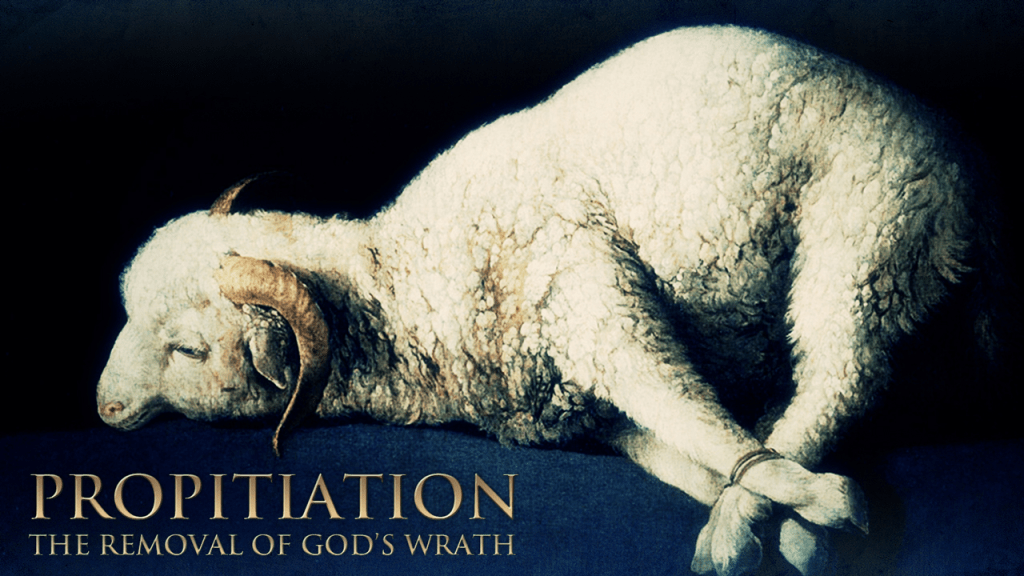
“To love and to be propitious are not convertible terms. It is false to suppose that the doctrine of propitiation regards propitiation as that which causes or constrains the divine love. It is loose thinking of a deplorable sort to claim that propitiation of the divine wrath does prejudice to or is incompatible with the fullest recognition that the atonement is the provision of the divine love.” – Dr. John Murray, Westminster Theological Seminary
In what New Testament texts do we find occurrences of the word Propitiation? Here is a list.
Romans 3:21–26 (ESV) – “21 But now the righteousness of God has been manifested apart from the law, although the Law and the Prophets bear witness to it— 22 the righteousness of God through faith in Jesus Christ for all who believe. For there is no distinction: 23 for all have sinned and fall short of the glory of God, 24 and are justified by his grace as a gift, through the redemption that is in Christ Jesus, 25 whom God put forward as a propitiation by his blood, to be received by faith. This was to show God’s righteousness, because in his divine forbearance he had passed over former sins. 26 It was to show his righteousness at the present time, so that he might be just and the justifier of the one who has faith in Jesus.
Hebrews 2:14–17 (ESV) – “14 Since therefore the children share in flesh and blood, he himself likewise partook of the same things, that through death he might destroy the one who has the power of death, that is, the devil, 15 and deliver all those who through fear of death were subject to lifelong slavery. 16 For surely it is not angels that he helps, but he helps the offspring of Abraham. 17 Therefore he had to be made like his brothers in every respect, so that he might become a merciful and faithful high priest in the service of God, to make propitiation for the sins of the people.
1 John 2:1–2 (ESV) – “My little children, I am writing these things to you so that you may not sin. But if anyone does sin, we have an advocate with the Father, Jesus Christ the righteous. 2 He is the propitiation for our sins, and not for ours only but also for the sins of the whole world.
John 4:7–10 (ESV) – “7 Beloved, let us love one another, for love is from God, and whoever loves has been born of God and knows God. 8 Anyone who does not love does not know God, because God is love. 9 In this the love of God was made manifest among us, that God sent his only Son into the world, so that we might live through him. 10 In this is love, not that we have loved God but that he loved us and sent his Son to be the propitiation for our sins.
What was the place on which propitiation was accomplished? It took place on the cross of Christ. This is the doctrine of penal, substitutionary atonement. See Luke 22:39-46; Romans 5:6-11; I Corinthians 1:18-31; I Corinthians 2:1-2; 2 Corinthians 5:17-21; Ephesians 2:13; Galatians 3:13-14; Colossians 2:13-15; Hebrews 9:11-14; Hebrews 10:1-14; I Peter 2:21-25.
“Propitiation is not a turning of the wrath of God into love. The propitiation of the divine wrath, effected in the expiatory work of Christ, is the provision of God’s eternal and unchangeable love, so that through the propitiation of his own wrath that love may realize its purpose in a way that is consonant with and to the glory of the dictates of his holiness. It is one thing to say that the wrathful God is made loving. That would be entirely false. It is another thing to say the wrathful God is loving. That is profoundly true. But it is also true that the wrath by which he is wrathful is propitiated through the cross. This propitiation is the fruit of the divine love that provided it. “Herein is love, not that we loved God, but that he loved us and sent his Son to be the propitiation for our sins” (I John 4:10). The propitiation is the ground upon which the divine love operates and the channel through which it flows in achieving its end,” explains Dr. Murray.
How is Jesus Christ’s propitiatory sacrifice applied to the sinner? It is by grace alone, through faith alone in the person and work of Jesus Christ alone. See Romans 1:16-17; Romans 3:21-26; Galatians 2:15-16; Galatians 3:10-14; Ephesians 2:1-9 Philippians 3:1-9; and Titus 3:1-5.
Soli deo Gloria!

“Propitiation presupposes the wrath and displeasure of God, and the purpose of propitiation is the removal of this displeasure. Very simply stated the doctrine of propitiation means that Christ propitiated the wrath of God and rendered God propitious to his people.” – Dr. John Murray, Westminster Theological Seminary
“Perhaps no tenet respecting the atonement has been more violently criticized than this one. It has been assailed as involving a mythological conception of God, as supposing internal conflict in the mind of God and between the persons of the Godhead. It has been charged that this doctrine represents the Son as winning over the incensed Father to clemency and love, a supposition wholly inconsistent with the fact that the love of God is the very fount from which the atonement springs.”
What is the meaning of Propitiation? Propitiation means to appease and placate the righteous wrath and justice of God the Father. It means,“To remove us from the wrath of God that we deserved. Christ died as a propitiation for our sins (I John 4:10,” explains Dr. Wayne Grudem.
Understandably, some modern theologians have reacted against using the term in reference to the God of the Bible. However, the word propitiation occurs in several biblical passages (Rom. 3:25; Heb.2:17; 1 John 2:2; 4:10). Additionally, the idea of the wrath of God is found throughout the Bible; it must be taken into account in the way sin is forgiven.
Propitiation comes from three Greek words. The first is ἱλαστήριον (hilasterion). It literally means mercy seat. It is a sin offering, by which the wrath of the deity shall be appeased, a means of propitiation (Rom. 3:25); (b) the covering of the ark, which was sprinkled with the atoning blood on the Day of Atonement (Heb. Kappôreth; Leviticus 16; Heb. 9:5).
Romans 3:23–25 (ESV) – “23 for all have sinned and fall short of the glory of God, 24 and are justified by his grace as a gift, through the redemption that is in Christ Jesus, 25 whom God put forward as a propitiation by his blood, to be received by faith. This was to show God’s righteousness, because in his divine forbearance he had passed over former sins.”
The second Greek word is ἱλάσκομαι (hilaskomai). It means to render favorable, to satisfy and to appease or pardon the wrath of God. In other words, to make atonement.
Hebrews 2:17 (ESV) – “Therefore he had to be made like his brothers in every respect, so that he might become a merciful and faithful high priest in the service of God, to make propitiation for the sins of the people.”
Third, there is the Greek word ἱλασμός (hilasmos) meaning to make atonement before an angry God. This word is found in two texts.
1 John 2:1–2 (ESV) – “My little children, I am writing these things to you so that you may not sin. But if anyone does sin, we have an advocate with the Father, Jesus Christ the righteous. 2 He is the propitiation for our sins, and not for ours only but also for the sins of the whole world.”
1 John 4:10 (ESV) – “In this is love, not that we have loved God but that he loved us and sent his Son to be the propitiation for our sins.”
The New Testament clearly teaches Jesus Christ died on the cross as a propitiatory sacrifice. His death on the cross satisfied the divine judgment against sinners and assuages the Father’s wrath against them, bringing about forgiveness and justification.
The idea that God cannot be angry towards sinners is not based on the OT or the NT. God does have anger for the sins of the human race (Psalm 5:5; 11:4-7). Whenever humans sin, they provoke the wrath of God (Romans 1:18). However, God’s anger is not an irrational lack of self-control. His wrath is the settled opposition of His holy nature to everything that is evil. Such opposition to sin cannot be dismissed with a casual wave of the hand. It requires something much more substantial.
The Bible states that it was only the cross that did this. Jesus is “the propitiation for our sins: and not for ours only, but also for the sins of the whole world” (1 John 2:2, kjv). This is the only way of interpreting the cross. Since God’s anger is real, then it must be taken into account in the way that sin, which caused that wrath, is addressed. Propitiation means that Jesus’ death on the cross for sinners put away God’s wrath against his people once and for all.
Soli deo Gloria!
There are three key words, or phrases, in the New Testament that explain the doctrine of the penal substitutionary atonement of Jesus Christ on the cross. They are the phrases in the place of, for the benefit of and the word ransom.
In the place of (ἀντί; anti) refers to a substitution for sin. There are many facets to the meaning of Christ’s death, but the central one—without which the others have no eternal meaning—is substitution. This simply means that Christ died in the place of sinners. The use of the Greek preposition anti clearly teaches this because it means in the place of. This meaning is found in a passage that has nothing to do with the death of Christ (Luke 11:11).
Most significantly, it is used in two passages that gives our Lord’s own interpretation of the meaning of His death. These are Matthew 20:28 and Mark 10:45). His death, He said, was to be a payment in the place of, or for, many.
Matthew 20:28 (ESV) – “28 even as the Son of Man came not to be served but to serve, and to give his life as a ransom for many.
Mark 10:45 (ESV) – “45 For even the Son of Man came not to be served but to serve, and to give his life as a ransom for many.”
The second word is also a Greek preposition. It is the word (ὑπέρ; hyper). The preposition, huper, is used in the New Testament, and it has two meanings. Sometimes it means for the benefit of and sometimes in the place of. It is also translated in the English with the word for
“The death of Christ was both in our place and for our benefit, and there is no reason why huper, when it is used in relation to His death, does not include both ideas,” explains Dr. Charles Ryrie.
The word vicarious, meaning substitute, is extremely important to our understanding of the atonement of Christ. He was the sinners’ substitute (Luke 22:14-20; John 11:50; Romans 5:6-10; 2 Corinthians 5:14-15; Galatians 1:3-4; I Thessalonians 5:9-10; Philemon 13).
“The late Swiss theologian Karl Barth once said that, in his judgment, the single most important word in all of the Greek New Testament is the miniscule word huper. This little word is translated by the English phrase “on behalf of. He was seeking to call attention to the importance of what is known in theology as the vicarious aspect of the ministry of Jesus,” states Dr. R. C. Sproul.
“We sometimes speak of Jesus’ work on the cross as the substitutionary atonement of Christ. This means that when He offered an atonement, it was not to satisfy God’s justice for His own sins, but for the sins of others. He stepped into the role of the Substitute, representing His people. He didn’t lay down His life for Himself; He laid it down for His sheep. He is our ultimate substitute.” See Genesis 3:21; 22:10-13; Exodus 12:12-13; Isaiah 53:1-6; John 10:11-18; 2 Corinthians 5:17-21; I Peter 2:20-24; 3:13-18.
The third word is the noun ransom (λύτρον; lytron). A ransom is the means or instrument by which release or deliverance is made possible. It is the means of release.
“Ransom” refers to the price paid to free a slave or a prisoner; “for” means “in place of.” Christ’s substitutionary death on behalf of those who would put their faith in him is the most glorious, blessed truth in all of Scripture (cf. Rom. 8:1–3; 1 Cor. 6:20; Gal. 3:13; 4:5; Eph. 1:7; Titus 2:14; 1 Pet. 1:18–19). The ransom was not paid to Satan, as some erroneous theories of the atonement teach. Satan is presented in Scripture as a foe to be defeated, not a ruler to be placated. The ransom price was paid to God to satisfy his justice and holy wrath against sin. In paying it, Christ “bore our sins in his body on the tree” (1 Pet. 2:24),” explains Dr. John MacArthur.
May we consider the substitutionary work Jesus Christ accomplished on the cross on our behalf.
Soli deo Gloria!
 His Word Today