The Gospel of Matthew: Praise from the Sick and Weak.

14 And the blind and the lame came to him in the temple, and he healed them. 15 But when the chief priests and the scribes saw the wonderful things that he did, and the children crying out in the temple, “Hosanna to the Son of David!” they were indignant, 16 and they said to him, “Do you hear what these are saying?” And Jesus said to them, “Yes; have you never read, “‘Out of the mouth of infants and nursing babies you have prepared praise’?” 17 And leaving them, he went out of the city to Bethany and lodged there.” (Matthew 21:14–17 (ESV)

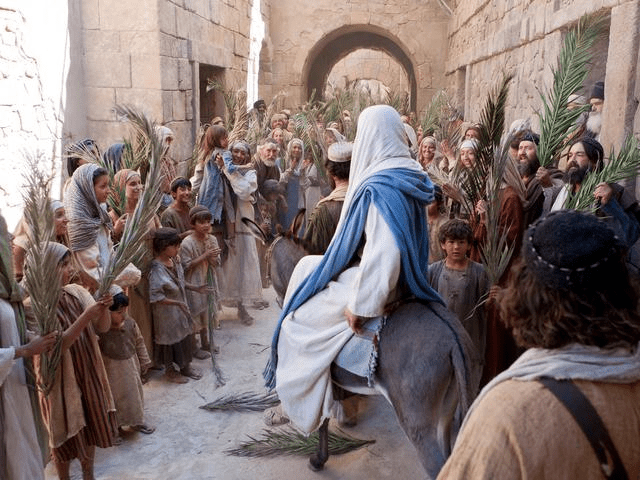
Immediately following Jesus cleansing the temple, the blind and the lame came to Him while He was in the temple court. This would refer to the area known as the Court of the Gentiles. Jesus healed these people of their maladies. It was a joyous moment. Children began crying out in the temple the same words the people said while Jesus entered Jerusalem; “Hosanna to the Son of David!”

“What a scene! While some people are expelled, others are welcomed. Jesus has not changed any. He is still the Good Shepherd. So, when the blind and the lame come to him right here, in the temple, his eyes, a moment ago flashing with the fire of holy indignation, fill with tender compassion. He did not say, “Come back some other time. I am not now in the mood for healing you.” On the contrary, the Great Physician is standing there in the midst of overturned tables, scattered coins, and knocked down benches, manifesting his healing power and marvelous compassion to those in need. None of those who came to him went away disappointed,” comments Dr. William Hendriksen.

Contrasting the joy of the healed and the praise of the children, were the indignant chief priests and scribes. To be indignant (ἠγανάκτησαν; eganaktesan) means to be angry. The religious leaders were passionately and actively incensed at the wonderful things happening in the temple. This was in stark contrast to their own graft and greed in the same location (Matt. 21:12-13).

They said to Jesus, ““Do you hear what these are saying?” You can sense the tone of their indignant words to the Lord. The religious leaders angrily condemn the compassion of the Lord and the praise of the children. They don’t want the infirm in the temple. They don’t want children in the temple. Finally, they don’t want Jesus in the temple. They embody the words of Isaiah the prophet: “Woe to those who call evil good and good evil, who put darkness for light and light for darkness, who put bitter for sweet and sweet for bitter!” (Isaiah 5:20 ESV)

And Jesus said to them, “Yes; have you never read, “‘Out of the mouth of infants and nursing babies you have prepared praise’?” 17 And leaving them, he went out of the city to Bethany and lodged there.” The Lord quoted from Psalm 8:2 in showing how the presumed weakness of children silenced the presumed strength of the religious leaders.

“What irked them at this particular moment was the following combination of facts: a. the cleansing of the temple; b. the miracles performed on the blind and the lame; and last but not least, c. the shouting of the children, repeating yesterday’s joyful outburst by their parents, etc., “Hosanna to the Son of David.” Was not this blasphemy? And that right here in the temple! That they, these very enemies of Jesus, were themselves guilty of blasphemy because of the desecration of the temple which they had allowed and to some extent even encouraged, and because of the murderous design in their hearts against him, they did not acknowledge. But these children must be stopped! What they are doing is terrible, and even more reprehensible is the fact that Jesus is allowing this to continue,” explains Dr. Hendriksen.

Following this exchange, Jesus left the temple and went to the city of Bethany. This was a small village 1.5 miles east of Jerusalem. It was here where Jesus stayed.

Matthew Henry writes, “Proud men cannot bear that honor should be done to any but to themselves, and are uneasy at nothing more than at the just praises of deserving men.”

Soli deo Gloria!
The Gospel of Matthew: Jesus Cleanses the Temple.

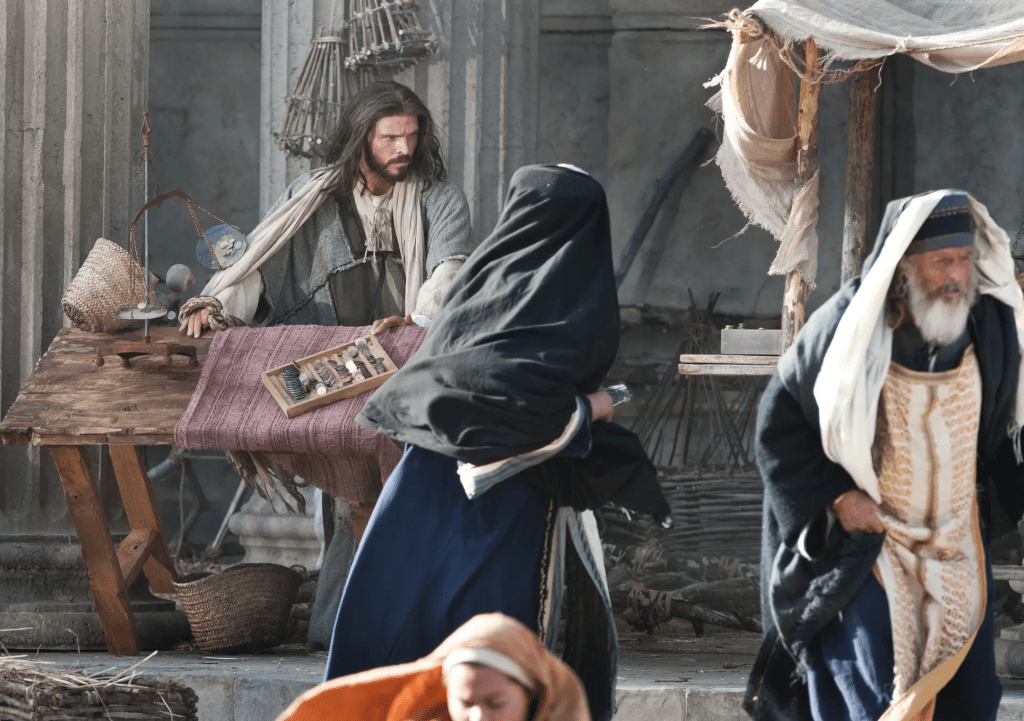
12 And Jesus entered the temple and drove out all who sold and bought in the temple, and he overturned the tables of the money-changers and the seats of those who sold pigeons. 13 He said to them, “It is written, ‘My house shall be called a house of prayer,’ but you make it a den of robbers.” (Matthew 21:12–13 ESV)

Jewish expectations of Messiah’s arrival were huge after Jesus came into Jerusalem on a donkey (Matt. 21:1–11). The people expected the Lord to begin driving out Rome from Israel. His next action contributed to this idea.

Matthew recounts Jesus cleansing the Jerusalem Temple a second time. John 2:13-22 records an earlier cleansing in the Lord’s ministry. Both incidents depict a public purging of the crass commercialism associated with the worship of God by the Jewish religious leaders.

Herod the Great (72 BC – 4 BC) administrated many building projects in Israel when he served as a vassal king for the Roman government. Of all his constructions, none were greater than the temple in Jerusalem. This was located at what is now called the Temple Mount; an area of approximately thirty-five acres.

Only the Jewish priests could enter the temple itself. It was surrounded by three courts: (1) Jewish men could enter the court closest to the temple. (2) Both Jewish men and women could occupy the next court. (3) The Court of the Gentiles, located furthest from the temple structure, was the closest any non-Jew could get to the sanctuary.

“From around the world, first-century Jews came to the temple at Passover to sacrifice to the Lord (Ex. 12:1–28Lev. 23:4–8). It was impractical to bring sacrificial animals long distances; so, they were available in Jerusalem — for a price,” explains Dr. R. C. Sproul.

Jesus drove out those who not only sold but also bought in the temple area. He then overturned the tables of the moneychangers and those who sold pigeons. When He did so, He quoted Isaiah 56:7 and Jeremiah 7:11 in referring to what the temple should be, a house of prayer, in contrast to what it became, a den of robbers.

“He regarded both merchants and customers guilty of desecrating the temple. Items being bought and sold included “pigeons” and other animals for sacrifice (cf. John 2:14). Currency-exchange agents, present in droves, were needed because Roman coins and other forms of currency were deemed unacceptable for temple offerings. Evidently, both merchants and money-changers were charging such excessive rates that the temple marketplace took on the atmosphere of a thieves’ den (Matt. 21:13). This kind of commerce took place in the court of the Gentiles, a large area covering several acres on the temple mount,” states Dr. John MacArthur.

I wonder how this compares to the commercialization of Christianity by religious marketers? Often in the mail, I receive a magazine containing all sorts of mementoes, figurines, wall-hangings, bookmarks, t-shirts, sweatshirts, hoodies and hats advertising all manner of so-called Christian slogans. All are available for a price. It’s troubling to see the Gospel so closely associated with American capitalism.

“Our Redeemer’s cleansing of the temple at the very least illustrates how concerned He is with the purity of worship. Our corporate praise and prayer is something that is always in need of reformation, for it is easy for anti-Christian practices to slip in unnoticed. Consider the importance of pure worship from a devoted heart and make it your aim to show reverence and awe when you praise the Lord alongside His people,” concludes Dr. Sproul.

Soli deo Gloria!

The Gospel of Matthew: Hosanna!

Most of the crowd spread their cloaks on the road, and others cut branches from the trees and spread them on the road. And the crowds that went before him and that followed him were shouting, “Hosanna to the Son of David! Blessed is he who comes in the name of the Lord! Hosanna in the highest!” 10 And when he entered Jerusalem, the whole city was stirred up, saying, “Who is this?” 11 And the crowds said, “This is the prophet Jesus, from Nazareth of Galilee.” (Matthew 21:8–11 (ESV)

What was the significance of the crowds spreading their cloaks on the road when Jesus approached Jerusalem? Spreading one’s garments on the road was an ancient act of homage to a coming king and reserved solely for high royalty. The Jews were acknowledging Jesus as their coming Messiah. However, the type of king they expected and wanted as not a Savior from their sins but rather a deliverer from the Roman government.

This is the context for the continual shouting “Hosanna to the Son of David! Blessed is he who comes in the name of the Lord! Hosanna in the highest!” Hosanna (Ὡσαννὰ) literally is a cry for help or happiness. It is a cry for someone to save and rescue.

“This is an exact quotation from verse 26 of the same psalm. This, along with the messianic title “Son of David,” make it clear that the crowd was acknowledging Christ’s messianic claim (see note on Matt. 1:1). The date of this entry was Monday, 10 Nisan, A.D. 30, exactly 483 years after the decree of Artaxerxes mentioned in Dan. 9:24–26,” explains Dr. John MacArthur.

Matthew perhaps used hyperbole or exaggeration when he wrote “And when he entered Jerusalem, the whole city was stirred up.” However, since the Holy Spirit inspired Matthew (2 Tim. 3:16-17; 2 Peter 1;20-21), we can be confident of the text’s grammatical accuracy. The phrase stirred up (σείσθη; eieisethe) means to quake, sit in motion or to quake with fear. It can also mean to get excited. This latter definition fits the context.

“Just as “all Jerusalem” was “troubled” in Matthew 2:3 when the King of the Jews was born, so here the religious establishment is once again stirred up, fearing that Jesus may usurp their power,” explains one commentator.

The people of Jerusalem continually asked, “Who is this?” Many people did not know who Jesus was let alone He was the prophet who Moses spoke of in Deuteronomy 18.

“Although Moses had predicted the coming of a “prophet like me,” to whom “you shall listen” (Deut. 18:15–18; see note on John 6:14), there is no indication that the crowds here in Jerusalem recognized Jesus as that prophet,” states one Bible scholar.

The ignorance of the crowd regarding Jesus’ identity at the time of His triumphant entry into Jerusalem would be equaled by their crucifixion of Him outside of Jerusalem later the same week. The contrast is loaded with irony.   

Soli deo Gloria!

The Gospel of Matthew: A Colt is Chosen. 

“Now when they drew near to Jerusalem and came to Bethphage, to the Mount of Olives, then Jesus sent two disciples, saying to them, “Go into the village in front of you, and immediately you will find a donkey tied, and a colt with her. Untie them and bring them to me. If anyone says anything to you, you shall say, ‘The Lord needs them,’ and he will send them at once.” This took place to fulfill what was spoken by the prophet, saying, “Say to the daughter of Zion, ‘Behold, your king is coming to you, humble, and mounted on a donkey, on a colt, the foal of a beast of burden.’ ” The disciples went and did as Jesus had directed them. They brought the donkey and the colt and put on them their cloaks, and he sat on them.”  (Matthew 21:1–7 (ESV)

We will glorify the King of Kings

We will glorify the Lamb

We will glorify the Lord of lords

Who is the great I am. – Twila Paris

Jesus and His disciples came to Bethpage as they approached Jerusalem on what is referred to as Palm Sunday. It was a small village, east of the capital city, located on the Mount of Olives. Bethpage means house of unripe figs.

Matthew’s Gospel is the only one mentioning the donkey, the colt’s mother. All three Synoptic Gospels refer to the colt, but only Mark and Luke say the colt was a foal no one had ever ridden (Mark 11:1-2; Luke 19:30). John says it was a young donkey (John 12:14).

This act was a fulfillment of Zechariah 9:9 which says, ““Say to the daughter of Zion, ‘Behold, your king is coming to you, humble, and mounted on a donkey, on a colt, the foal of a beast of burden.’ ”

Humble (πραῢς; praus) means gentle, meek and mild. It is an attribute and quality of gracious forbearance. It is quality of Christ believers in Christ are to emulate (Phil.2:1-11).

The Apostle Paul acknowledged the grace of Christ in his writings (Rom.1:7; I Cor. 1 :3; 16:23; 2 Cor. 1:2; 13;14; Gal.1:3; 6:18; Eph. 1:2; 6:24; Phil. 1:2; 4:23; I Thess. 5:28; 2 Thess. 1:2; 3:18; I Tim. 1:2; 2 Tim. 1:2; Titus 1:4; Philemon  1:3, 25). So too did the Apostle Peter (2 Peter 3:18) as did the Apostle John (John 1:14; 2 John 3; Rev. 1:4-5).

“Colts that had not yet been ridden sometimes accompanied their mothers. Following a common Jewish practice of reading the Hebrew text for all one can get from it, Matthew reads Zechariah 9:9 as referring to two animals instead of referring to the same animal in two ways. The text is messianic, as ancient interpreters generally acknowledged, but applying this part to himself redefines Jesus’ messiahship: officials used donkeys for civil, not military, processions (e.g., 1 Kings 1:33). Thus this text is not a “triumphal entry” in the sense of Roman triumphal processions; it is Jerusalem’s reception of a meek and peaceful king,” explains commentator Craig Keener.

“Just how it was that Jesus knew about this colt and its dam—whether through union of his divine and human nature, or simply through information which he had received in a very natural way from the owners—we do not know. One thing we do know, namely, that when he orders the two disciples to untie the animals and to bring them to him, he is exercising his right of requisitioning whatever he needs for the fulfilment of his mediatorial task,” states Dr. William Hendriksen.

Soli deo Gloria!

The Gospel of Matthew: A Promise Fulfilled.

“Now when they drew near to Jerusalem and came to Bethphage, to the Mount of Olives, then Jesus sent two disciples, saying to them, “Go into the village in front of you, and immediately you will find a donkey tied, and a colt with her. Untie them and bring them to me. If anyone says anything to you, you shall say, ‘The Lord needs them,’ and he will send them at once.” This took place to fulfill what was spoken by the prophet, saying, “Say to the daughter of Zion, ‘Behold, your king is coming to you, humble, and mounted on a donkey, on a colt, the foal of a beast of burden.’ ” (Matthew 21:1–5 (ESV)

Imagine waiting for some promised event or reunion. A long period of time has elapsed since the promise was initially given. You may begin to wonder if the pledge will ever happen. However, suddenly circumstances begin to occur creating an excitement and anticipation that what was promised may actually be fulfilled.

Perhaps this applies to a holiday gathering, a championship game, or the final installment of a movie trilogy. Regarding a cinematic trilogy, imagine the first two films of the series building to a suspenseful penultimate climax only to have the final film be a disappointment in not living up to its hype and your personal expectations. It’s not the film is bad, but it not as good as you hoped it would be.

This was the cultural, historical, and religious context of Jesus’ earthly ministry in general and His entrance into Jerusalem in particular in what is referred to as His Triumphant Entry. God promised the Jews a Messiah who would come to redeem Israel (Gen. 3:15; Gen. 12:1-3; 49:10; 2 Samuel 7:12-17; Isaiah 7:14; 9:6; 11:1-5). Many believed Jesus to be this long expected Savior and Lord. However, instead of a Messiah destined to save His people from the tyranny of their sin, Israel came to believe and await an Anointed One who would deliver them from the tyranny of the Roman government and establish an earthly kingdom in its place.

“Since it was Passover, there were probably about 2 million people in and around Jerusalem. This was the only time in His ministry that Jesus actually planned and promoted a public demonstration. Up to this time, He had cautioned people not to tell who He was, and He had deliberately avoided public scenes,” explains commentator Warren Wiersbe.

“Why did Jesus plan this demonstration? For one thing, He was obeying the Word and fulfilling the prophecy recorded in Zechariah 9:9. This prophecy could apply only to Jesus Christ, for He is the only One with credentials that prove He is Israel’s King.”

“Until the last week of His life, Jesus warned people not to disclose His identity (Matt. 8:1–4; 9:27–31; 16:20). Any talk of His being a king would have aroused Rome’s ire and put His life at risk before the appropriate time. The emperor did not look kindly on potential rivals and would move quickly to crush any threat to his power. Jesus’ approach to establishing His kingdom, however, was radically different than the many others who tried to overthrow Rome,” states Dr. R. C. Sproul.

“Although Jesus designs this event to show Himself the promised King of kings, He does not come to Jerusalem as a conquering king. In fulfillment of Zechariah 9:9, the Messiah enters the city as a humble king on a donkey, not a triumphant warrior on a horse. Indeed, this victorious arrival will come (Rev. 19:11–16), but not until His return to renew the heavens and earth.”

While Jesus may not meet people’s expectations, He always meets their needs. The greatest need being the salvation of their souls. Have a blessed day in the Lord.

Soli deo Gloria!

Reading Recommendations: Providence.

 “Remember this and stand firm, recall it to mind, you transgressors, remember the former things of old; for I am God, and there is no other; I am God, and there is none like me, 10 declaring the end from the beginning and from ancient times things not yet done, saying, ‘My counsel shall stand, and I will accomplish all my purpose,’” (Isaiah 46:9–10 (ESV)

Today’s reading recommendation is Pastor John Piper’s book Providence. Published in 2020 by Crossway, it may be considered his Magnum Opus (great work). Dr. Piper has crafted a masterpiece of sound biblical doctrine and practical application.

John Piper is founder and lead teacher of desiringGod.org and chancellor of Bethlehem College & Seminary. He previously served for over three decades as the pastor of Bethlehem Baptist Church in Minneapolis, Minnesota. He is the author of over fifty books.  

Piper’s thesis is fourfold. First, he invites the reader “into a world of counterintuitive wonders of God’s unsearchable judgments and inscrutable ways (Rom. 11:33).

Second, he desires readers to penetrate through words into the reality of biblical truth. Like the words Trinity, Discipleship, Evangelism, Exposition, Counseling, Ethics, Politics and Charismatics, the word Providence is not found in the Scriptures. However, the doctrine or teaching certainly is according to Piper.

He defines providence as God’s purposeful sovereignty. Providence contains the idea of God’s purposeful action. He alone has the right and power to do all that He wills. “My counsel shall stand, and I will accomplish all my purpose,” (Isaiah 46:10).

“Providence means to supply what is needed; to give sustenance or support. So in reference to God, the noun providence has come to mean the act of purposefully providing for, or sustaining and governing, the world. God sees to it that things happen in a certain way,” explains Dr. Piper.

Third, Piper wants the reader to enter into a God-centered world. “Jesus said to look at the birds because God clothes them (Matt. 6:26), and to consider the lilies because God clothes them (Matt. 6:28-30). His aim was to free His people from anxiety. He really considered it a valid argument that if our heavenly Father feeds the birds and clothes the lilies, how much more surely will He feed and clothe His children,” states Piper.

Fourth, Piper invites us to know God’s involvement in our lives is so all-embracing, pervasive and powerful. All life’s occurrences are what God designs for our glorification of Him and His sanctification and ultimate glorification of us (2 Thess.1:12).

The book is divided into three parts. Part 1 defines providence. Part 2 focuses on the ultimate goal of providence. Part 3 is on the nature and means of providence.

At 711 pages, not including a General and Scripture index, Piper’s work seems intimidating at first glance. However, the chapters have multiple subheadings containing an average of four-five paragraphs. Reading each section a day makes the reading journey much more manageable and enjoyable.

Have a blessed day. Read well!

Soli deo Gloria!

Reading Recommendations: The Works of Jerry Bridges.

24 Do you not know that in a race all the runners run, but only one receives the prize? So run that you may obtain it. 25 Every athlete exercises self-control in all things. They do it to receive a perishable wreath, but we an imperishable. 26 So I do not run aimlessly; I do not box as one beating the air. 27 But I discipline my body and keep it under control, lest after preaching to others I myself should be disqualified.” (1 Corinthians 9:24–27 ESV)

There are but a handful of authors, secular or sacred, in whom I always read their books or articles. Whether for personal enjoyment, or greater knowledge and insight regarding a particular theological subject, I am never disappointed in their efforts. These include Louis L’Amour, Robert B. Parker, John MacArthur,   R. C. Sproul, J. I. Packer, the Reformers, the Puritans, J. Gresham Machen and Francis Schaeffer. Last, but certainly not least, is Jerry Bridges.

Jerry Bridges (1929-2016) was an evangelical Christian author, speaker and staff member of The Navigators; an evangelical publishing company of devotional books and Bible studies. Based in Colorado Springs, CO, the Navigators specialize in small groups and one on one mentoring.

Jerry spoke at various Bible conferences and also served as an adjunct professor at Grace Theological Seminary. It was while I was a doctoral student at Grace that I had Jerry as a professor.

Jerry’s primary and prolific contribution to the evangelical church were his many books. Winsome, witty, insightful and openly honest are some of the adjectives describing Jerry’s writing. He never shied away from the tough topics, and never lost his grounding in the inspirited and inerrant Word of God. Here is brief list of Jerry’s publications.   

My personal favorite is The Pursuit of Holiness. It was the first of Jerry’s books I bought. My reason was not exactly spiritual in purchasing it. I am a recreational runner and there was a picture of a runner on the front cover of my copy. I was     initially intrigued and as I read it, thoroughly challenged.

My wife and I have led small group studies with Jerry’s materials; particularly on the subject of Trusting God: Even When Life Hurts and Respectable Sins. Jerry’s writing always contains solid biblical doctrine balanced with practical application.

I encourage you to take up and read anything written by Jerry Bridges. You will be blessed. Read well!

Soli deo Gloria!

Reading Recommendations: It Is Well.

For the word of the cross is folly to those who are perishing, but to us who are being saved it is the power of God.” (1 Corinthians 1:18 (ESV)

“From time to time I’ve been asked, “Where is the cross in your church?” People look around our 1911 meeting house and find no cross there. You won’t find it in gold, silver, or wood. You won’t find it embroidered on a banner or carved in the paneling. It’s nowhere on the pulpit or on the table. Where is it? It’s there. It’s there at the heart of our church. It’s in the Bible. It’s in the sermons. It’s in the songs and the prayers. And it’s in the hearts of the people.” — Mark Dever

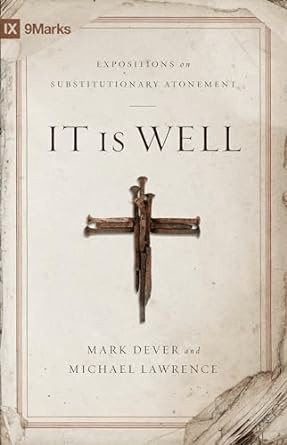
The preceding quotation is from the preface of It Is Well: Expositions on Substitutionary Atonement.  The book is co-authored by Pastor Mark Dever, senior pastor of Capitol Hill Baptist Church in Washington, D. C., and the President of 9Marks, and Pastor Michael Lawrence, senior pastor of Hinson Baptist Church in Portland, Oregon.

Together, these men seek to explain the purpose and meaning of the substitutionary atonement of Jesus Christ on the cross. The book is a collection of meditations concerning God’s sacrifice for sinners in Christ. Their desire is for believers in Christ to re-center their life on the cross.

It Is Well, published in 2010 by Crossway, contains fourteen chapters examining various biblical truths, from both the Old and New Testaments, on the vocabulary and significance of the crucifixion of Christ. Topics include The Passover, The Day of Atonement, the meaning of Ransom, Propitiation, Justification, and the Curse of handing on a tree.

“Theological and devotional, expositional and inspirational: these are four words that will capture this excellent work on the doctrine of penal substitution,” explains Daniel L. Akin, president, Southeastern Baptist Theological

“Dever and Lawrence remind us that at the heart of Christianity is Christ, and the heart of Christ’s ministry is the cross, and the heart of the cross is penal substitution,” states Thomas R. Schreiner, Southern Baptist Theological Seminary.

“The theological glue that holds the gospel facts together is the substitutionary atonement of Jesus Christ. Yet no concept is more unique and audacious to the Christian faith than that of a crucified Messiah and Savior. Dever and Lawrence have provided an extensive, simple, and practical guide to grasping this subject without compromising its complexity,” comments Rick Holland, Pastor, Mission Road Bible Church, Prairie Village, KS.

Have a blessed day. Read well!

Soli deo Gloria!

Reading Recommendations: God’s Passion for His Glory.

“The emanation or communication of the divine fullness, consisting in the knowledge of God, love to him, and joy in him, has relation indeed both to God and the creature: but it has relation to God as its fountain, as the thing communicated is something of its internal fullness. The water in the stream is something of the fountain; and the beams of the sun are something of the sun. And again, they have relation to God as their object: for the knowledge communicated is the knowledge of God; and the love communicated, is the love of God; and the happiness communicated, is joy in God. In the creature’s knowing, esteeming, loving, rejoicing in, and praising God, the glory of God is both exhibited and acknowledged, his fullness is received and returned. Here is both an emanation and remanation. The refulgence shines upon and into the creature, and is reflected back to the luminary. The beams of glory come from God, are something of God, and are refunded back again to their original. So that the whole is of God, and in God, and to God; and he is the beginning, and the middle, and the end.” – Jonathan Edwards, The End for Which God Created the World

Jonathan Edwards (1703-1758) is one of my heroes. He is arguably the greatest theologian America ever produced. I enjoy reading what he prolifically wrote. I also enjoy reading books about him that are prolifically written. One such publication is entitled God’s Passion for His Glory by another great American theologian; Dr. John Piper.

Published in 1998, I periodically find myself returning to its pages for refreshment and fresh insights by two men passionate for the glory of God. The first lived in the 18th century colonial America while the second lives in the 21st century Representative Republic of America. Both preached the truth, and lived, in light of the all-encompassing, eternal and holy God of heaven and earth.

God’s Passion for His Glory containstwo main sections. PART ONE is entitled A Personal Encounter with Jonathan Edwards by John Piper. It consists to four chapters: CHAPTER ONE: The End for Which God Created the World: Why Publish an Old Book? A Personal and Public Concern. CHAPTER TWO: Jonathan Edwards, The Man and His Life: Learning from an Unmodern Evangelical. CHAPTER THREE: Jonathan Edwards, A Mind in Love with God: The Private Life of a Modern Evangelical.  CHAPTER FOUR: Jonathan Edwards, Enjoying God and the Transformation of Culture; The Public Life of a Modern Evangelical.

PART TWO is a reprint of Edwards’ work The End for Which God Created the World. The book contains an introduction, and two chapters; respectively containing three and seven sections. Dr. Piper adds a preface to PART TWO entitled A Note on How to Read the End for Which God Created the World.

[The secondary teacher] should regard himself as learning from the masters along with his [students]. He should not act as if he were a primary teacher, using a great book as if it were just another textbook of the sort one of his colleagues might write. He should not masquerade as one who knows and can teach by virtue of his original discoveries. . . . The primary sources of his own knowledge should be the primary sources of learning for his students, and such a teacher functions honestly only if he does not aggrandize himself by coming between the great books and their . . . readers. He should not “come between” as a nonconductor, but he should come between as a mediator—as one who helps the less competent make more effective contacts with the best minds,” explains author Mortimer Adler, How To Read a Book.

I find it is best to read this work in brief portions. This enables the reader to thoroughly digest the magnitude of thoughts presented by both John Piper and Jonathan Edwards. There is great value in reading God’s Passion for His Glory as the secondary teacher, John Piper, brings clarity for today’s reader from the work of the primary teacher, Jonathan Edwards.

“The longer I live, the more clearly I see my dependence on those who have gone before. The more I know of what others have thought, the less original my thinking appears. I am content to have it so. For, at least in the realm of truth, the ancient Preacher does not overstate the case when he says: “There is nothing new under the sun” (Ecclesiastes 1:9),” explains Dr. Piper.

Soli deo Gloria!