
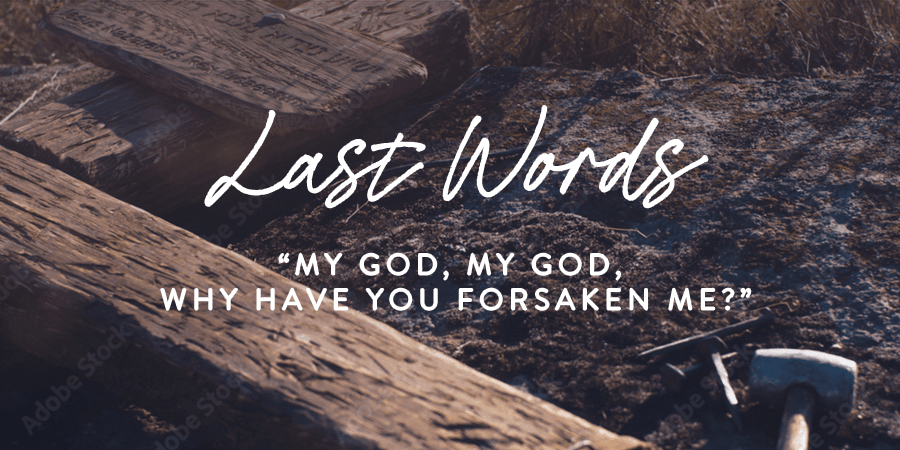
45 “Now from the sixth hour there was darkness over all the land until the ninth hour. 46 And about the ninth hour Jesus cried out with a loud voice, saying, “Eli, Eli, lema sabachthani?” that is, “My God, my God, why have you forsaken me?” (Matthew 27:45–46 ESV)
33 “And when the sixth hour had come, there was darkness over the whole land until the ninth hour. 34 And at the ninth hour Jesus cried with a loud voice, “Eloi, Eloi, lema sabachthani?” which means, “My God, my God, why have you forsaken me?” (Mark 15:33–34 ESV)
44”It was now about the sixth hour, and there was darkness over the whole land until the ninth hour, 45 while the sun’s light failed.” Luke 23:44-45a ESV)
In our study of the Gospel of Matthew’s record of the Passion Week of the Lord Jesus Christ, it is necessary, and insightful, to examine all four Gospel accounts. This discipline provides us understanding of all the events and encounters which took place during those hours.
The Synoptic Gospels, Matthew, Mark and Luke, all record the phenomenon of darkness over all the land during Jesus’ crucifixion. It was a darkness over all the earth. No place exempted. This occurred from the sixth hour until the ninth hour. According to Jewish time, this would have been from Noon until 3:00 P.M.
Curiously, only Matthew and Mark recount Jesus’ most significant cry from the cross; “Eli, Eli, lema sabachthani?” The following thoughts are by Dr. Sinclair Ferguson from his message “Actions that Speak Louder than Words—Almost.”
Around three o’clock in the afternoon the Savior who is, incidentally, in the process of being asphyxiated —you didn’t die by the wounds of crucifixion, you died by the asphyxiation which your position hanging on the cross inevitably brought upon you. And here is this striking statement of a man in the process of asphyxiation, as he cries out, “My God, my God, why have you forsaken me?”
Of course these are the words of the 22nd Psalm at the beginning. And it’s a Psalm that you should read right through to the end because it ends in triumph. This is not a cry of Jesus abandoning trust in God. This is a cry of Jesus expressing the fact that he is going through an experience of God forsakenness that will be an experience from which he emerges in triumph. This is not a cry of doubt. This is a cry of desolation. Issuing from a heart of faith. Otherwise why turn to the 22nd Psalm?
But in many ways it’s the explanation of the darkness. Isn’t it? That the light of the world is now in unapproachable darkness. That the light of the world is now in what he himself had called in a striking expression — the outer darkness. And we understand, I think, don’t we, particularly if we have lived in any rural place, that there is darkness and there is outer darkness. There is a darkness that falls on Columbia, but it’s not really dark. You drive into Columbia when Columbia is shrouded in darkness and you will see as in every city that strange aura of light which means that the darkness cannot really and finally and fully penetrate into this city.
But if you come from some rural place, far from a city, you know there is a darkness in which you cannot see your hand when it is placed up against your eyes. There is a deep darkness. And this is what’s happening to Jesus. He is actually going into deep darkness where he can see absolutely nothing. He is going, as I sometimes say, into that one sphere in which the 23rd Psalm ceases to function. He is not able to say here, “I will fear no evil for you are with me and your rod and your staff they comfort me.” He is not able to say, “Even though I walk through the valley of the shadow of death, I know I will never feel utterly alone.” And perhaps more significantly he is going to the place where the benediction doesn’t work. That great benediction of Aaron and the priests. As they came forth and raised their hands and blessed the people. “The Lord bless you and keep you. The Lord make his face to shine upon you. The Lord lift up his countenance upon you and give you peace.”
How many times within the temple had Jesus heard that benediction pronounced and now the benediction wasn’t working. Because the peace had gone. The light of the countenance of God was not to be seen. And so there’s something very striking here because, in fact, this is the deep darkness that became penetrable to Abraham only because he saw the light of God’s presence passing through the darkness, and saying, “If it takes this curse to fall upon me, I will keep my promise of salvation.” Or as the New Testament itself rather puts it, “Even if it means that curse falling upon the Son of my love, I will keep my saving promise.” That’s why he cries out, “My God, why am I forsaken?” Or as Paul puts it, alluding to both this event and the experience of Abraham, “he became accursed for us in order that the blessing that was promised through Abraham might come.” (Galatians 3:14).
His robes for mine, O wonderful exchange
Clothed in my sin, Christ suffered ‘neath God’s rage
Draped in His righteousness, I’m justified
In Christ I live, for in my place He died.
Chorus
I cling to Christ and marvel at the cost
Jesus forsaken, God estranged from God
Bought by such love, my life is not my own
My praise, my all, shall be for Christ alone.
His robes for mine, O wonderful exchange
Clothed in my sin, Christ suffered ‘neath God’s rage
Draped in His righteousness, I’m justified
In Christ I live, for in my place He died.
His robes for mine, what cause have I for dread? God’s daunting law, Christ mastered in my stead Faultless, I stand with righteous works not mine
Saved by my Lord’s vicarious death and life.
His robes for mine, God’s justice is appeased.
Jesus is crushed, and thus the Father’s pleased
Christ drank God’s wrath on sin, then cried, “‘Tis done!”
Sin’s wage is paid, propitiation won.
His robes for mine, such anguish none can know
Christ, God’s beloved, condemned as though His foe.
He, as though I, accursed and left alone
I, as though He, embraced and welcomed home.
Soli deo Gloria!
Source: Musixmatch
Songwriters: Chris Anderson / Greg David Habegger
His Robes for Mine lyrics © Church Works Worship
 His Word Today