
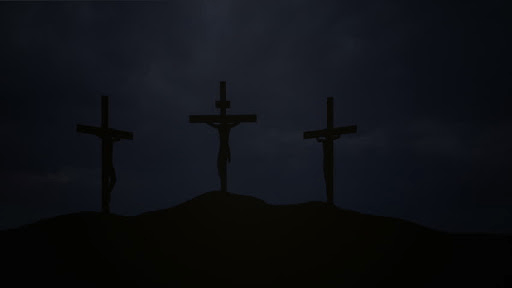
“Now from the sixth hour there was darkness over all the land until the ninth hour.” (Matthew 27:45 (ESV)
“And when the sixth hour had come, there was darkness over the whole land until the ninth hour.” (Mark 15:33 (ESV)
44”It was now about the sixth hour, and there was darkness over the whole land until the ninth hour, 45 while the sun’s light failed.” Luke 23:44-45a ESV)
In our study of the Gospel of Matthew’s record of the Passion Week of the Lord Jesus Christ, it is necessary, and insightful, to examine all four Gospel accounts. This discipline provides us understanding of all the events and encounters which took place during those hours.
The Synoptic Gospels, Matthew, Mark and Luke, all record the phenomenon of darkness over all the land during Jesus’ crucifixion. It was a darkness over all the earth. No place exempted. This occurred from the sixth hour until the ninth hour. According to Jewish time, this would have been from Noon until 3:00 P.M.
What caused of this darkness? Some attribute it to an eclipse of the sun. However, this could not have been possible because the Jews used a lunar calendar with Passover always occurring during the full moon. This made an eclipse impossible.
Rather, this was a supernatural darkness. God announced to the shepherds the incarnation of the Son of God with His glorious light (Luke 2:9). John the apostle spoke of Jesus as “the light of men (John 1:4, 9). Jesus declared He was the light of the world (John 8:12; 9:5; 12:35-36). What a contrast between Jesus’ birth and His death.
The Scriptures offer no definitive explanation for the darkness. However, it would seem it was a visual display of God the Father’s judicial and righteous wrath poured out upon the Son of God; Jesus Christ. The judgment of God is directly associated with darkness (Matt. 8:12; 22:13; 25:30; 2 Peter 2:4; Jude 6).
“The darkness meant judgment, the judgment of God upon our sins, his wrath as it were burning itself out in the very heart of Jesus, so that he, as our Substitute, suffered most intense agony, indescribable woe, terrible isolation or forsakenness. Hell came to Calvary that day, and the Savior descended into it and bore its horrors in our stead,” explains Dr. William Hendriksen.
“How do we know that this answer is correct? Note the following: Frist, darkness in Scripture is very often a symbol of judgment. See Isa. 5:30; 60:2; Joel 2:30, 31; Amos 5:18, 20; Zeph. 1:14–18; Matt. 24:29, 30; Acts 2:20; 2 Peter 2:17; Rev. 6:12–17. Second, with a view to his impending death the Savior had himself stated that he was giving and was about to give his life as “a ransom for many” (Matt. 20:28; 26:28; Mark 10:45),” concludes Dr. Hendriksen.
“The darkness was intended to arouse the people to consider the astonishing design of God in the death Christ. For if they were not altogether hardened, an unusual change in the order of nature must have made a deep impression on their senses, so as to look forward to an approaching renewal of the world. Yet is was a terrific spectacle which was exhibited to them, that they might tremble at the judgment of God. It was an astonishing display of the wrath of God that He did not spare even His only begotten Son and was not appeased in any other way than by that price of expiation,” states John Calvin.
Soli deo Gloria!
 His Word Today