
“And when they had crucified him, they divided his garments among them by casting lots.” (Matthew 27:35 (ESV)
24 “And they crucified him and divided his garments among them, casting lots for them, to decide what each should take. 25 And it was the third hour when they crucified him.” (Mark 15:24–25 (ESV)
33 And when they came to the place that is called The Skull, there they crucified him, and the criminals, one on his right and one on his left. 34 And Jesus said, “Father, forgive them, for they know not what they do.” And they cast lots to divide his garments.” (Luke 23:33–34 (ESV)
23 When the soldiers had crucified Jesus, they took his garments and divided them into four parts, one part for each soldier; also his tunic. But the tunic was seamless, woven in one piece from top to bottom, 24 so they said to one another, “Let us not tear it, but cast lots for it to see whose it shall be.” This was to fulfill the Scripture which says, “They divided my garments among them, and for my clothing they cast lots.” So the soldiers did these things,” (John 19:23–24 (ESV)
In our study of the Gospel of Matthew’s record of the Passion Week of the Lord Jesus Christ, it is necessary, and insightful, to examine all four Gospel accounts. This discipline provides us understanding of all the events and encounters which took place during those hours.
For the next several days we will examine what occurred during the first three hours of Jesus’ crucifixion. Today’s focus is the casting of lots for Jesus’ clothing.
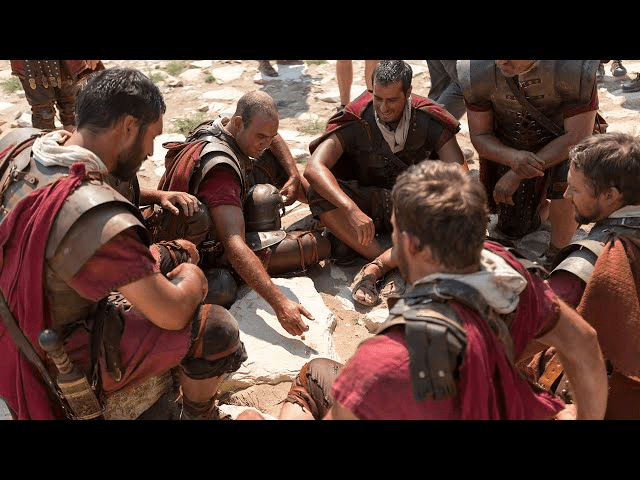
All four Gospels contain this event. However, John explicitly stated the Roman soldiers in charge of the crucifixion were the ones who cast lots for Jesus’ clothes (John 19:23). Casting lots involved throwing a specially marked pebble, piece of pottery, or stick in making decisions based upon chance or luck. In other words, the soldiers rolled the dice to see who would win Jesus’ garments. No mention is made of the two criminals’ clothes. Just the Lord’s.
John mentioned there were four soldiers at the crucifixion. They divided Jesus’ clothes among the four of them. However, when they examined Jesus’ tunic, they did not want to divide it into fourths, but rather see which solider would win it outright (John 19:23b-24a). John stated this behavior fulfilled Old Testament Scripture (John 19:24b; Psalm 22:18).
“Having crucified him, the legionaries divided his garments by casting lots. In all probability by means of the throwing of dice the four pieces—head-gear, sandals, belt, and outer garment—are divided among the four (John 19:23) soldiers. The seamless tunic, all of one piece, woven all the way from top to bottom, is also put into the lottery, all of this in accordance with the prophecy of Ps. 22:18 (LXX Ps. 21:19), though this reference to fulfilment is not found in Matthew but in John 19:23, 24,” explains Dr. William Hendriksen.
“People were usually hung on a cross naked, but Jesus might be allowed a loincloth due to the shame His people associate with nakedness. Either way, His clothing now belongs to the soldiers guarding Him, a custom observed with every crucified victim. Yet this time prophecy is also fulfilled as lots are cast for Christ’s clothing (Matt. 27:35; see Ps. 22:18). John Calvin appropriately comments, “God determined that His own Son should be stripped of his raiment, that we, clothed with his righteousness and with abundance of all good things, may appear with boldness in company with the angels,” states Dr. R. C. Sproul.
Mark recorded it was the third hour when Jesus’ crucifixion began (Mark 15:25). Based upon the Jewish reckoning of time, the crucifixion occurred at 9:00 A.M. Pilate sentenced Jesus to death at 6:00 A.M. (John 19:14), but it wasn’t until three hours later the execution actually began at Golgotha.
“The clear implication of the passage which we are studying must not escape us. It is this: Jesus bore for us the curse of nakedness in order to deliver us from it! (Cf. Gen. 3:9–11, 21; 2 Cor. 5:4; Rev. 7:13, 14). Surely if what Ham did to his father Noah is singled out for special mention because of its reprehensible character, then what the soldiers did when they disrobed Jesus and then divided his garments among themselves, casting lots, should cause us to pause with horror. Such a pause is suggested by the words: These things, indeed, the soldiers did (John 19:24). They did that which was shameful. Yet, by means of that shameful deed God’s eternal plan (hence, also prophecy) was fulfilled. Hence, we pause in abhorrence … and adoration,” concludes Dr. Hendriksen.
Many people continue to deny the severity of Jesus’ substitutionary atonement on the cross. They deny the shame, the curse and the wrath of God the Father poured out upon the sinless Son of God. However, it was in my place condemned He hung on the cross. I encourage you to read and meditate upon Romans 3:21-26.
Soli deo Gloria!
 His Word Today