
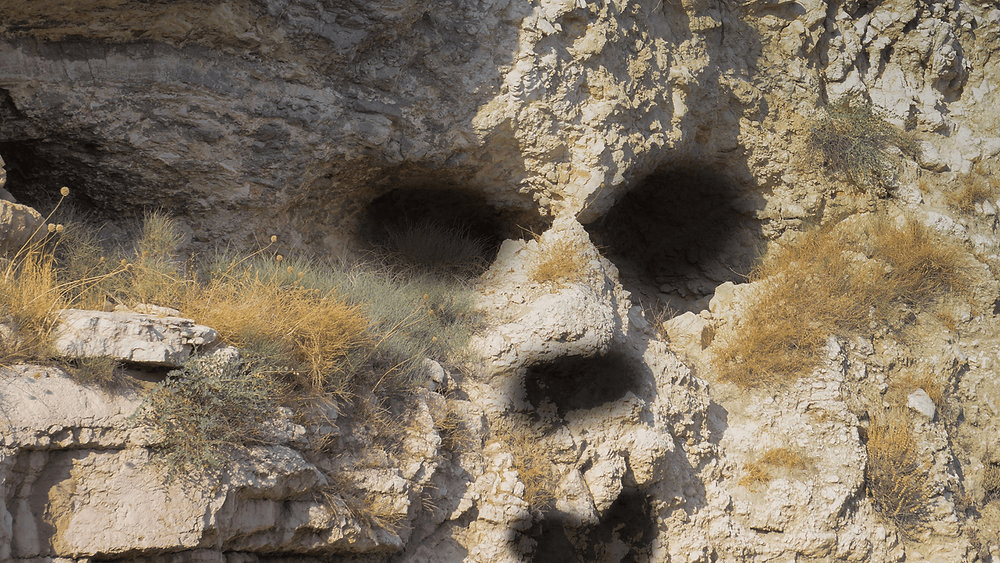
31 “And when they had mocked him, they stripped him of the robe and put his own clothes on him and led him away to crucify him. 32 As they went out, they found a man of Cyrene, Simon by name. They compelled this man to carry his cross. 33 And when they came to a place called Golgotha (which means Place of a Skull), 34 they offered him wine to drink, mixed with gall, but when he tasted it, he would not drink it.” Matthew 27:31–34 (ESV)
20 “And when they had mocked him, they stripped him of the purple cloak and put his own clothes on him. And they led him out to crucify him. 21 And they compelled a passerby, Simon of Cyrene, who was coming in from the country, the father of Alexander and Rufus, to carry his cross. 22 And they brought him to the place called Golgotha (which means Place of a Skull). 23 And they offered him wine mixed with myrrh, but he did not take it.” (Mark 15:20–23 (ESV)
26 And as they led him away, they seized one Simon of Cyrene, who was coming in from the country, and laid on him the cross, to carry it behind Jesus. 27 And there followed him a great multitude of the people and of women who were mourning and lamenting for him. 28 But turning to them Jesus said, “Daughters of Jerusalem, do not weep for me, but weep for yourselves and for your children. 29 For behold, the days are coming when they will say, ‘Blessed are the barren and the wombs that never bore and the breasts that never nursed!’ 30 Then they will begin to say to the mountains, ‘Fall on us,’ and to the hills, ‘Cover us.’ 31 For if they do these things when the wood is green, what will happen when it is dry?” 32 Two others, who were criminals, were led away to be put to death with him. 33 And when they came to the place that is called The Skull, there they crucified him, and the criminals, one on his right and one on his left.” (Luke 23:26–33 (ESV)
16 “So he delivered him over to them to be crucified. So they took Jesus, 17 and he went out, bearing his own cross, to the place called The Place of a Skull, which in Aramaic is called Golgotha.” (John 19:16–17 (ESV)
In our study of the Gospel of Matthew’s record of the Passion Week of the Lord Jesus Christ, it has been necessary, and insightful, to examine all four Gospel accounts. This discipline provides us understanding of all the events and encounters which took place during those hours and days.
Three more crosses; three more men. Luke alone mentioned two criminals who also faced crucifixion (Luke 23:32). He did not mention their names, but only their being led away to their death along with Jesus.
Three more crosses; three more men. Just another day for the Roman executioners at a location called Golgotha. In Aramaic, this meant The Place of a Skull (John 19:17).
The word Golgotha appears only in the New Testament accounts of the Crucifixion. Three of the Gospels use the Hebrew-Aramaic term, “Golgotha” (Matt. 27:33; Mark 15:22; John 19:17). Only Luke used the Latin equivalent, “Calvary,” meaning “skull or cranium” (Luke 23:33).
Why was the name Place of a Skull or The Skull used when referring to Jesus’ place of execution? Scholars offer varying opinions and reasons.
“The reason why this place was called “the skull” is unknown, although several explanations have been offered. An early tradition, apparently originating with Jerome (ad 346–420), asserted that it was a common place of execution and that the skulls of many who had been executed were strewn around the site. No first-century evidence has been found to substantiate this viewpoint,” explains the Tyndale Bible Dictionary.
“Some suggest that it was a place of execution and that “skull” was used figuratively, simply as a symbol of death. Origen (ad 185–253) mentioned an early, pre-Christian tradition that the skull of Adam was buried in that place. This is probably the oldest explanation of the name, and is referred to by several writers after Origen.”
“Others have said that the name resulted from the fact that the place of the Crucifixion was a hill that had the natural shape of a skull. No early evidence from any sources has been found to substantiate this view, and the NT accounts do not refer to the place as a hill.”
Three more crosses; three more men. What is known is Golgotha/Calvary was outside the Jerusalem city proper (John 19:20; Heb. 13:12). It could have been on an elevated site, since people saw it from a distance (Mark 15:40). It was probably near a road since Matthew and Mark mention “passersby” (Matt.t 27:39; Mark 15:29). The Gospel of John alone places it near a garden containing the tomb where they buried Jesus (John 19:41). The use of the definite article, “the place of the skull,” indicates it was a familiar place.
Three more crosses; three more men. Luke alone mentioned Jesus was hung on the center cross of three (Luke 23:33). For the Jews, to be hung on a tree, in this case a cross, was a sign of God’s curse upon the executed (Deut. 21:23; Gal. 3:13). Jesus Christ became a curse on behalf of sinners like you and me.
Soli deo Gloria!
 His Word Today