
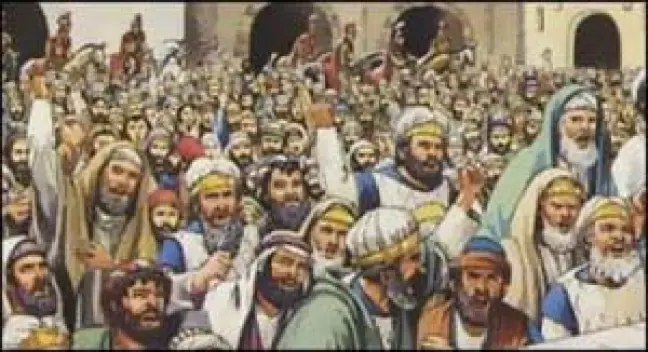
6 When the chief priests and the officers saw him, they cried out, “Crucify him, crucify him!” Pilate said to them, “Take him yourselves and crucify him, for I find no guilt in him.” 7 The Jews answered him, “We have a law, and according to that law he ought to die because he has made himself the Son of God.” 8 When Pilate heard this statement, he was even more afraid. 9 He entered his headquarters again and said to Jesus, “Where are you from?” But Jesus gave him no answer. 10 So Pilate said to him, “You will not speak to me? Do you not know that I have authority to release you and authority to crucify you?” 11 Jesus answered him, “You would have no authority over me at all unless it had been given you from above. Therefore he who delivered me over to you has the greater sin.” (John 19:6–11 (ESV)
In our study of the Gospel of Matthew’s record of the Passion Week of the Lord Jesus Christ, it has been necessary, and insightful, to examine all four Gospel accounts. This discipline provides us understanding of all the events and encounters which took place during those hours and days. Today we continue our study by exclusively examining John’s Gospel account.
Pontius Pilate was a man caught between a rock and a hard place. He faced two equally dangerous or difficult choices or circumstances. On the one hand, he found no guilt in Jesus to warrant Pilate to execute Him (John 18:38). On the other hand, he faced the increasingly hostile Jewish leaders and the riotous crowd.
Pilate sought to satisfy the blood lust of the Jewish religious leaders and the crowd. Therefore, he had Jesus flogged. To be flogged (μαστιγόω; mastigoo) means to be scourged and beaten with a whip. If he could present Jesus as a hapless figure, perhaps the Jews would relent and no longer seek His death.
However, Pilate’s efforts to satisfy the Jewish people were of no avail. He had the Lord flogged and humiliated but the people continually cried out, “Crucify him, crucify him!” Pilate then said, “Take him yourselves and crucify him, for I find no guilt in him.” This is the second time John recorded Pilate making this statement of Jesus’ guiltlessness (John 18:38).
The Jews remained undeterred. They retorted, ““We have a law, and according to that law he ought to die because he has made himself the Son of God.” This was a veiled reference to Leviticus 24:16 which says, “Whoever blasphemes the name of the Lord shall surely be put to death. All the congregation shall stone him. The sojourner as well as the native, when he blasphemes the Name, shall be put to death.”
The irony here is striking. The Jews sought to convict and execute Jesus for the very behavior they displayed toward Jesus. The English proverb “there are none so blind as those who will not see” certainly applies. Understanding cannot be forced on someone who chooses to be ignorant.
However, Pilate’s limited understand began to stir within him. The biblical text states he became even more afraid. He fearfully asked Jesus, “Where are you from?” Pilate was experiencing what psychologists call xenophobia, which is the fear of the unknown. Jesus was someone the governor had never before encountered.
“Many Roman officials were deeply superstitious. While Jews interpreted Jesus’ claims as messianic, to the Greco-Roman person, the title “Son of God” would place Jesus in the category of “divine men” who were gifted with supernatural powers. Pilate was afraid because he had just whipped and tortured someone who, in his mind, could bring down a curse or vengeance upon him,” explains Dr. John MacArthur.
When Jesus did not reply to Pilate’s question, he said, “You will not speak to me? Do you not know that I have authority to release you and authority to crucify you?” Pilate spoke like a man used to being in control. The irony here is that he did not understand who as truly in control.
Jesus aptly replied, “You would have no authority over me at all unless it had been given you from above. Therefore he who delivered me over to you has the greater sin.”
“Jesus’ statement here indicates that even the most heinous acts of wickedness cannot circumvent the sovereignty of God. Pilate had no real control (vv. 10–11), yet still stood as a responsible moral agent for his actions. When confronted with opposition and evil, Jesus often found solace in the sovereignty of his Father (e.g., John 6:43–44, 65; 10:18, 28–29).”
Regarding the statement, “he who delivered me over to you has the greater sin,” Dr. MacArthur comments, “This could refer either to Judas or Caiaphas. Since Caiaphas took such an active part in the plot against Jesus (11:49–53) and presided over the Sanhedrin, the reference may center on him (18:30, 35). The critical point is not the identity of the person but guilt because of the deliberate, high-handed, and coldly calculated act of handing Jesus over to Pilate, after having seen and heard the overwhelming evidence that he was Messiah and Son of God.”
Soli deo Gloria!
 His Word Today