
27 Then the soldiers of the governor took Jesus into the governor’s headquarters, and they gathered the whole battalion before him. 28 And they stripped him and put a scarlet robe on him, 29 and twisting together a crown of thorns, they put it on his head and put a reed in his right hand. And kneeling before him, they mocked him, saying, “Hail, King of the Jews!” 30 And they spit on him and took the reed and struck him on the head.” (Matthew 27:27–30 ESV)
16 And the soldiers led him away inside the palace (that is, the governor’s headquarters), and they called together the whole battalion. 17 And they clothed him in a purple cloak, and twisting together a crown of thorns, they put it on him. 18 And they began to salute him, “Hail, King of the Jews!” 19 And they were striking his head with a reed and spitting on him and kneeling down in homage to him.” (Mark 15:16–19 (ESV)
“Then Pilate took Jesus and flogged him. 2 And the soldiers twisted together a crown of thorns and put it on his head and arrayed him in a purple robe. 3 They came up to him, saying, “Hail, King of the Jews!” and struck him with their hands. 4 Pilate went out again and said to them, “See, I am bringing him out to you that you may know that I find no guilt in him.” 5 So Jesus came out, wearing the crown of thorns and the purple robe. Pilate said to them, “Behold the man!” (John 19:1–5 ESV)
In our study of the Gospel of Matthew’s record of the Passion Week of the Lord Jesus Christ, it has been necessary, and insightful, to examine all four Gospel accounts. This discipline provides us understanding of all the events and encounters which took place during those hours and days.
Pontius Pilate was a man caught between a rock and a hard place. He faced two equally dangerous or difficult choices or circumstances. On the one hand, he found no guilt in Jesus to warrant Pilate to execute Him (John 18:38). On the other hand, he faced the increasingly hostile Jewish leaders and the riotous crowd.
Pilate sought to satisfy the blood lust of the Jewish religious leaders and the crowd. Therefore, he had Jesus flogged. To be flogged (μαστιγόω; mastigoo) means to be scourged and beaten with a whip. If he could present Jesus as a helpless figure, perhaps the Jews would relent and no longer seek His death.
“Pilate appears to have flogged Jesus as a strategy to set him free (see vv. 4–6). He was hoping that the Jews would be appeased by this action and that sympathy for Jesus’ suffering would result in their desire he be released (see Luke 23:13–16). Scourging was a horribly cruel act in which the victim was stripped, tied to a post, and beaten by several torturers, i.e., soldiers who alternated when exhausted. For victims who were not Roman citizens, the preferred instrument was a short wooden handle to which several leather thongs were attached. Each leather thong had pieces of bones or metal on the end. The beatings were so savage that sometimes victims died. The body could be torn or lacerated to such an extent that muscles, veins, or bones were exposed. Such flogging often preceded execution in order to weaken and dehumanize the victim (Isa. 53:5). Apparently, however, Pilate intended this to create sympathy for Jesus,” explains Dr. John MacArthur.
Additionally, the soldiers mocked and ridiculed Jesus. They placed a makeshift crown of thorns and placed it on His head. They put a reed in His right hand symbolizing a scepter, placed a scarlet or purple robe on Him befitting a king, knelt before Him and mockingly exclaimed, ““Hail, King of the Jews!” They then spit on Him and beat His head.
“This “crown” was made from the long spikes (up to 12 inches) of a date palm formed into an imitation of the radiating crowns that oriental kings wore. The long thorns would have cut deeply into Jesus’ head, adding to the pain and bleeding. purple robe. The color represented royalty. The robe probably was a military cloak flung around Jesus’ shoulders, intended to mock his claim to be King of the Jews,” states Dr. MacArthur.
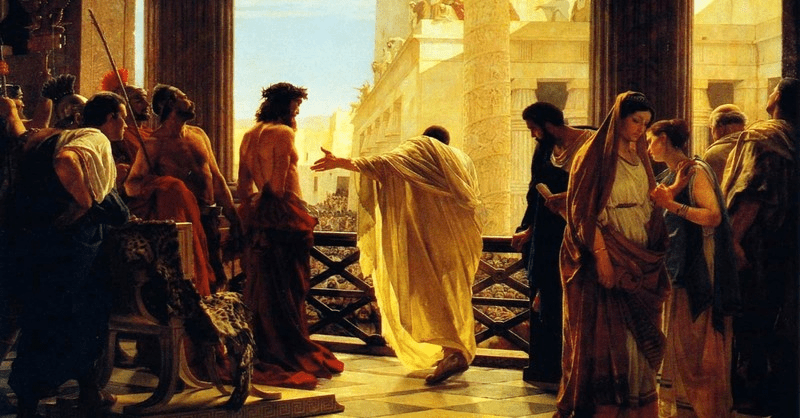
Following this brutal treatment, Pilate brought Jesus before the crowd and said, “See, I am bringing him out to you that you may know that I find no guilt in him.” “Behold the man!
Ecce Homo! (Behold the Man) is an 1871 painting of Jesus Christ before Pontius Pilate by Antonio Ciseri. It is the artist’s depiction, one author describes, “of a moment woven into the fabric of salvation history, and into our very souls.”
See Him there, the great I Am
A crown of thorns upon His head.
The Father’s heart displayed for us
Oh God, we thank You for the cross.
Lifted up on Calvary’s hill
We cursed Your name and even still.
You bore our shame and paid the cost
Oh God, we thank You for the cross.
Behold the Lamb
The story of redemption written on His hands.
Jesus, You will reign forevermore
The victory is Yours.
We sing Your praise
Endless hallelujahs to Your holy name.
Jesus, You will reign forevermore
The victory is Yours.
Offer up this sacrifice
For every sin, our Savior died
The Lord of Life can’t be contained
Our God has risen from the grave
Our God has risen from the grave.
When the age of death is done
We’ll see Your face, bright as the sun
We’ll bow before the King of Kings
Oh God, forever we will sing.
WRITTEN BY KRISTIAN STANFILL, MELODIE MALONE, & PHIL WICKHAM
Soli deo Gloria!
 His Word Today