
6 When Pilate heard this, he asked whether the man was a Galilean. 7 And when he learned that he belonged to Herod’s jurisdiction, he sent him over to Herod, who was himself in Jerusalem at that time. 8 When Herod saw Jesus, he was very glad, for he had long desired to see him, because he had heard about him, and he was hoping to see some sign done by him. 9 So he questioned him at some length, but he made no answer. 10 The chief priests and the scribes stood by, vehemently accusing him. 11 And Herod with his soldiers treated him with contempt and mocked him. Then, arraying him in splendid clothing, he sent him back to Pilate. 12 And Herod and Pilate became friends with each other that very day, for before this they had been at enmity with each other.” (Luke 23:6–12 (ESV)
Our study of Jesus’ life and ministry from the Gospel of Matthew shifts today to the Gospel of Luke. This is because only Luke recorded Jesus’ appearance before Herod Antipas during the hours preceding the Lord’s crucifixion. Pontius Pilate sent Jesus to Herod to perhaps free himself of the responsibility of sentencing Jesus to death.
Who was Herod Antipas? He was one of the sons of Herod the Great; who was Rome’s appointed king over Israel at the birth of Jesus (Matt. 2:1-18). Upon Herod’s death (Matt. 1:19), Antipas was one of his successors. He became the ruler of Galilee and Perea (Luke 3:1-2). These were the northern territories where Jesus and John the Baptist carried out most of their ministries. Antipas was this ruler who beheaded John the Baptist (Matt. 14:1-12; Mark 6:17-29; Luke 3:19-20).
There are three specific times when Antipas and Jesus are mentioned together in the Gospels.
- Early in Jesus’ ministry Antipas heard of him and commented, perhaps with irony, that Jesus was John the Baptist resurrected (Mt 14:1–2; Mk 6:14–16; Lk 9:7–9). It was obvious to Antipas that Jesus’ ministry was even more remarkable than John’s, but he was reluctant to use force to bring about the meeting for fear of once more arousing the people against him. Eventually, Jesus withdrew from Antipas’s territories without the two meeting.
- Later, as Jesus became more popular, Antipas saw a potential threat to his own power and threatened to kill Jesus. Thus it was that on Jesus’ final trip to Jerusalem he was warned by some of the Pharisees that he should leave Antipas’s territories for his own safety (Lk 13:31–33). Jesus sent as answer to “that fox” that he would continue his ministry of healing and casting out demons for a little longer, and when he had finished, he would then go to Jerusalem to die. The lion and fox were often contrasted in ancient literature. The Lion of Judah, Jesus Christ, was not going to be coerced by the crafty coward, Antipas.
- The final encounter between the two occurred when Jesus was tried by Antipas in ad 33 (Lk 23:6–12). Since this event is mentioned only by Luke, some scholars consider it legendary. It must be remembered, however, that Luke’s addressee was Theophilus, probably a Roman officer, who would be especially interested in the reconciliation between Pilate and Antipas mentioned in this passage.
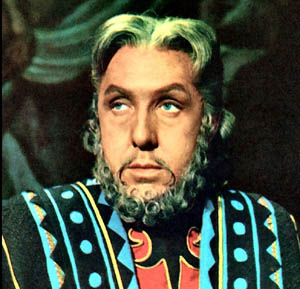
In spite of Herod’s efforts to interrogate Jesus, the Lord gave no answer to the king’s questions (Luke 23:9). Therefore, Herod and his soldiers mocked Jesus treating Him with contempt. They placed “splendid clothing” on the Lord and sent Him back to Pilate (Luke 23:11). The splendid clothing refers to a bright and shining apparel. Perhaps this was one of Herod’s garments, but not the robe the Roman soldiers placed on Jesus (Matt. 27:27-28). Ironically, following this incident Herod and Pilate became friends, when before they were enemies (Luke 23:12).
“Herod was probably too scared to condemn Jesus to death. His conscience had not allowed him to forget what he had done to another innocent person, John the Baptist. He was filled with haunting superstition. But also, he was probably too angry with Jesus to acquit him, for his curiosity had not been gratified,” states Dr. William Hendriksen.
“Jesus had refused to perform a miracle or even to answer any of his questions. So he and his bodyguard started to treat the manacled prisoner with contempt and ridicule. They dressed him in a brilliant robe, as if he were already an earthly king, and sent him thus arrayed back to Pilate. From the Hasmonean Palace, where Herod was probably staying, the procession returned to Pilate and the Praetorium.”
Soli deo Gloria!
 His Word Today