
3 “Then when Judas, his betrayer, saw that Jesus was condemned, he changed his mind and brought back the thirty pieces of silver to the chief priests and the elders, 4 saying, “I have sinned by betraying innocent blood.” They said, “What is that to us? See to it yourself.” 5 And throwing down the pieces of silver into the temple, he departed, and he went and hanged himself. 6 But the chief priests, taking the pieces of silver, said, “It is not lawful to put them into the treasury, since it is blood money.” 7 So they took counsel and bought with them the potter’s field as a burial place for strangers. 8 Therefore that field has been called the Field of Blood to this day. 9 Then was fulfilled what had been spoken by the prophet Jeremiah, saying, “And they took the thirty pieces of silver, the price of him on whom a price had been set by some of the sons of Israel, 10 and they gave them for the potter’s field, as the Lord directed me.” (Matthew 27:3–10 (ESV)
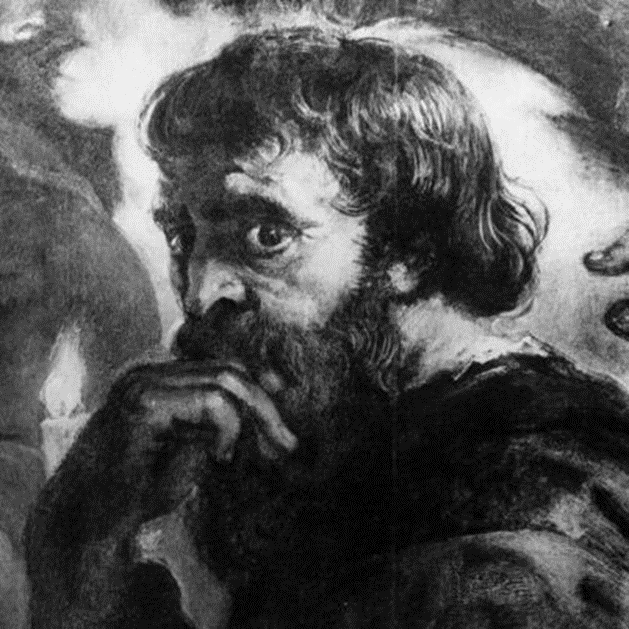
Matthew is the lone Gospel writer to speak of the ignoble end of Judas Iscariot. Judas was a tragic figure in the earthly ministry of Jesus Christ. He embodied the wicked individual the psalmist described in Psalm 1.
“Blessed is the man who walks not in the counsel of the wicked, nor stands in the way of sinners, nor sits in the seat of scoffers; 2 but his delight is in the law of the Lord, and on his law he meditates day and night. 3 He is like a tree planted by streams of water that yields its fruit in its season, and its leaf does not wither. In all that he does, he prospers. 4 The wicked are not so, but are like chaff that the wind drives away. 5 Therefore the wicked will not stand in the judgment, nor sinners in the congregation of the righteous; 6 for the Lord knows the way of the righteous, but the way of the wicked will perish.” (Psalm 1:1–6 ESV)
Judas was not a God-blessed man. This was because Judas walked, or lived, in the counsel of the ungodly. He stood, or agreed, with the way and lifestyle of sinners. Finally, he fostered the mocking ridicule of the Lord. Unlike the righteous man who is like a tree, Judas was rather like chaff that the wind drives away. He had no solid, spiritual foundation in his life; even though he was in the Lord’s presence for three years. Judas’ end will be him not standing in the judgment as righteous and he will not participate with the congregation of the righteous.
What can we observe from today’s text from Matthew?
- Judas did not repent of his sin. He just changed his mind.
- While acknowledging his sin against Jesus Christ, he did not seek forgiveness from Christ.
- Judas did not speak on behalf of Christ concerning the Lord’s innocence.
- Because of his lost condition, Judas despaired and committed suicide by hanging himself (Acts 1:12-20).
- Judas fulfilled Old Testament prophecy.
“Matthew’s juxtaposition of Peter’s denial and Judas’ death invites us to compare the state of their souls. Like Peter, Judas is remorseful after the fact, changing his mind about the wisdom of his deed after seeing Jesus condemned (Matt. 27:3–4). Unlike Peter, Judas does not feel the “godly grief” of repentance (2 Cor. 7:10),” explains Dr. R. C. Sproul.
“The Greek verb for Judas’ change of mind (Matt. 27:3) is not the one normally used for repentance. Moreover, Judas does not really try to stop what he has started and will not testify of Christ’s innocence before Pilate. Were Judas repentant, justice and righteousness would move him to intervene on Jesus’ behalf. Godly sorrow leads people to run to God, but Judas’ despair makes him run into the arms of death (v. 5).”
John Calvin writes, “True repentance is displeasure at sin, arising out of fear and reverence for God, and producing, at the same time, a love and desire of righteousness.”
“Once more, the Jewish leaders care more about the minutiae of ceremonial regulation than the greater sin of killing an innocent man (Amos 5:21–24). They use the blood money paid to Judas to buy a place to bury Gentiles (Matt. 27:6–8), thereby fulfilling prophecy (vv. 9–10). “The text Matthew cites seems to be a paraphrase of Jeremiah 19:1–14 and Zechariah 11,” states Dr. Sproul.
“Both prophets allude to Israel’s rejecting the shepherds God sent to them and the destruction that results. For centuries the Almighty sent His prophets to shepherd His people, but His people rejected them and the destruction of exile occurred. Now with the condemnation of Jesus to death, the leaders have rejected the “Shepherd and Overseer” of their souls (1 Peter 2:25), and they make themselves even more worthy of God’s wrath than their ancestors.”
Neither Judas’ betrayal of Christ nor his suicide is the unpardonable sin. The unforgivable sin was his rejection of the grace of God in the person and work of Jesus Christ. Simon Peter and Judas both committed sins, but Peter repented and received restoration. Let each of us repent of our sins and turn to Jesus Christ for renewal and restored intimate fellowship (I John 1:8-10).
Soli deo Gloria!
 His Word Today