
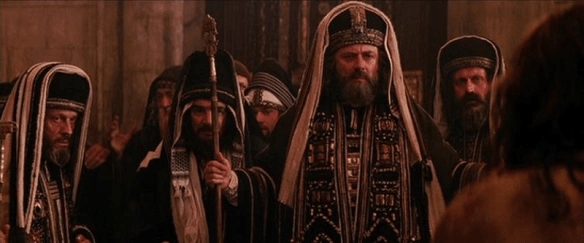
“When morning came, all the chief priests and the elders of the people took counsel against Jesus to put him to death. 2 And they bound him and led him away and delivered him over to Pilate the governor.” (Matthew 27:1–2 (ESV)
“And as soon as it was morning, the chief priests held a consultation with the elders and scribes and the whole council. And they bound Jesus and led him away and delivered him over to Pilate.” (Mark 15:1 (ESV)
“Then the whole company of them arose and brought him before Pilate.” (Luke 23:1 (ESV)
Jesus’ trial before Annas and Caiaphas eventually resulted in His trial before the Sanhedrin. As previously noted, the Sanhedrin was the supreme judicial council, or “high council”, of Judaism. It contained 71 members and was located in Jerusalem.
“The name Sanhedrin (Greek, sunedrion, from sun, “together,” and hedra, “seat”) occurs for the first time in the reign of Herod the Great (Antiquities 14.9.3–5). This is the term used throughout the NT (22 times), along with “the elders” (Luke 22:66; Acts 22:5) and “gerousia” (Acts 5:21),” states the Tyndale Bible Dictionary.
The previous two religious trials occurred in the pre-daylight hours. With the arrival of morning, the entire Sanhedrin council pronounced Jesus guilty of blasphemy and sent Him to Pontius Pilate, the Roman governor, for final sentencing. They wanted Jesus executed.
“From about three o’clock until daybreak Jesus must have been held in imprisonment somewhere in the palace of Caiaphas. Then “early in the morning”—the Sanhedrin is convened once more. A few minutes may have sufficed, since the verdict, “Guilty of blasphemy and therefore worthy of death” had already been agreed upon. Besides, Jesus must be rushed off to Pilate before the crowds know what is going on. So, very quickly Jesus is sentenced to death,” explains Dr. William Hendriksen.
“The Jewish authorities have to bring Jesus to Pilate, because they were not authorized by the Romans to execute the death penalty themselves. Pilate would be available as early as sunrise; like other Roman officials, he would finish his regular public day before noon,” states commentator Craig Keener.
“Jesus’ first Jewish trials occurred under the cover of darkness. Since Jewish law required trials to be conducted during the day, the chief priests and the elders of the people realized an official trial was necessary. The brief trial recorded in Matthew 27:1 was simply for the court to reaffirm what had taken place earlier. The court decided that Jesus must die, but they did not have the power to put that decision into action (John 18:31). To get a death sentence, they needed to take the case to Pilate, the governor, the procurator of Judea and Samaria, a.d. 26–36 (cf. Luke 3:1). Jesus was therefore bound and brought by the Jews to Pilate. Pilate’s home was in Caesarea, but at this festival time, he was in his Jerusalem palace,” concludes the Bible Knowledge Commentary.
All of this was according to the sovereign and providential plan of God the Father (Acts 2:22-24).
Soli deo Gloria!
 His Word Today