
16 For I am not ashamed of the gospel, for it is the power of God for salvation to everyone who believes, to the Jew first and also to the Greek. 17 For in it the righteousness of God is revealed from faith for faith, as it is written, “The righteous shall live by faith.” (Romans 1:16–17 (ESV)
Is the Protestant Reformation over? Some would say that it is. Recent overtures resulting in theological agreements between Evangelical Protestants and Roman Catholics would seem to support this idea that little is left of the theological disagreements which occurred in the 16th century.
On October 31, 2016, Pope Francis said that after five hundred years, Protestants and Catholics “have the opportunity to mend a critical moment of our history by moving beyond the controversies and disagreements that have often prevented us from understanding one another.” In light of the pope’s statement, one evangelical professor of theology commented, “From that, it sounds as if the Reformation was an unfortunate and unnecessary squabble over trifles, a childish outburst that we can all put behind us now that we have grown up.”
Tell that to John Wycliffe who the Catholic Church persecuted for translating the Bible into English. Tell that to Jon Huss who was burned at the stake for speaking against the abuses of the Roman Catholic Church. Tell that to Martin Luther, Huldrych Zwingli, John Calvin and others who were hounded, hunted and hurt by the those who refused, and continue to refuse, to acknowledge its errors. People have asked me is the Protestant Reformation over? I say no!
The Latin phrase Semper Reformanda applies here. Rather than mean that churches should always be changing in order to conform to the ever-changing culture, instead it means “always being reformed” or “The church reformed and always being reformed according to the Word of God.” God’s Word should always be reforming God’s people, and for that matter God’s churches. Each and every generation must return to God’s Word each and every day so that the Scriptures would continue reforming our lives, and keeping us from heresy.
The impasse which occurred between the Reformers of the 16th Century and the Roman Catholic Church remain in full force today. These issues are as critical now as they were then. What key takeaways from the Reformation would we be wise to apply to the context of Christianity in the 21st Century?
The first would be that the sole authority for the Christian is to be the Scriptures: Sola Scriptura. Secondly, the commitment to objective truth instead of subjective experience is another lasting benefit from the Reformation. Thirdly, there is the commitment to the doctrine of sola fide or faith alone. This is a short-handed slogan which summarizes the doctrines of grace alone and Christ alone within the specific context of the biblical gospel of salvation.
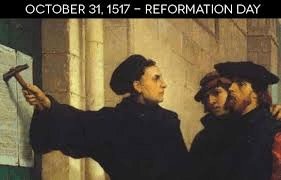
Luther’s peace with God eventually came not from an emotional experience, but rather through the truth of the God’s Word specifically contained in Romans 1:16-17. On the basis of biblical truth, God credited Martin Luther with Christ’s righteousness, which resulted in Martin’s positional, personal and emotional peace with God.
The Reformation is far from over. It continues on and is as critical today as it was in Martin Luther’s day when biblical truth was at stake regarding how a sinner becomes righteous before God.
Today’s children of the Protestant Reformation hold that salvation is by grace alone, through faith alone, in the person and work of Jesus Christ alone, to the glory of God alone based upon the teachings and truth of the Scriptures alone.
May we continue to hold to these truths as tenaciously as did Martin Luther. It won’t be easy, but “Here we stand; we can do none other. God help us!”
Soli deo Gloria!
 His Word Today