
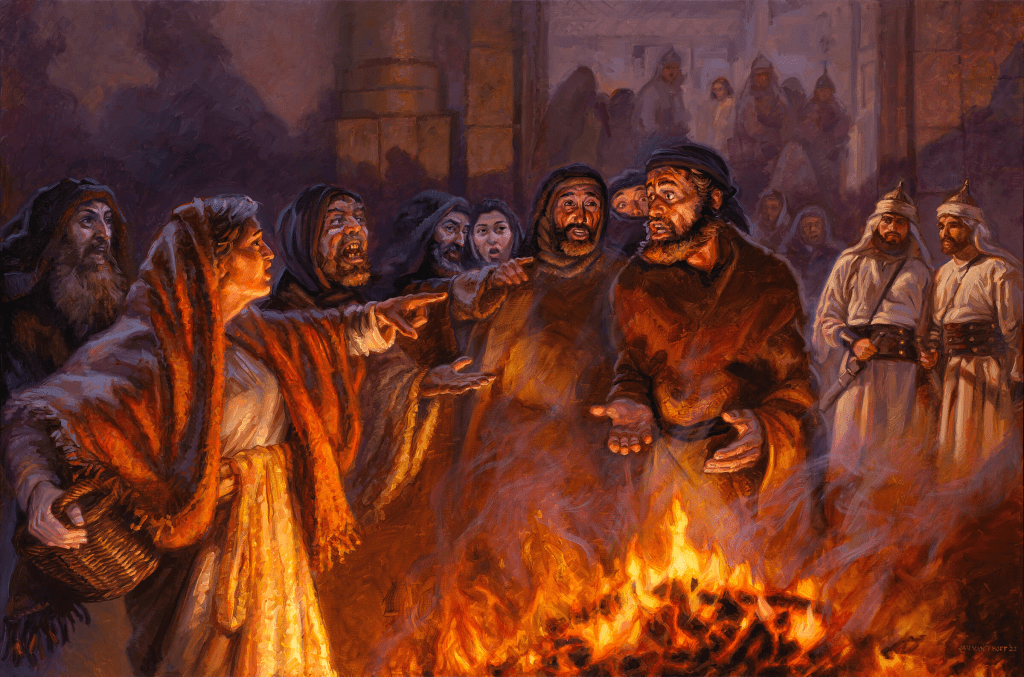
69”Now Peter was sitting outside in the courtyard. And a servant girl came up to him and said, “You also were with Jesus the Galilean.” 70 But he denied it before them all, saying, “I do not know what you mean.” Matthew 26:69–70 (ESV)
66 “And as Peter was below in the courtyard, one of the servant girls of the high priest came, 67 and seeing Peter warming himself, she looked at him and said, “You also were with the Nazarene, Jesus.” 68 But he denied it, saying, “I neither know nor understand what you mean.” And he went out into the gateway and the rooster crowed.” (Mark 14:66–68 (ESV)
54 “Then they seized him and led him away, bringing him into the high priest’s house, and Peter was following at a distance. 55 And when they had kindled a fire in the middle of the courtyard and sat down together, Peter sat down among them. 56 Then a servant girl, seeing him as he sat in the light and looking closely at him, said, “This man also was with him.” 57 But he denied it, saying, “Woman, I do not know him.” (Luke 22:54–57 (ESV)
15 “Simon Peter followed Jesus, and so did another disciple. Since that disciple was known to the high priest, he entered with Jesus into the courtyard of the high priest, 16 but Peter stood outside at the door. So the other disciple, who was known to the high priest, went out and spoke to the servant girl who kept watch at the door, and brought Peter in. 17 The servant girl at the door said to Peter, “You also are not one of this man’s disciples, are you?” He said, “I am not.” 18 Now the servants and officers had made a charcoal fire, because it was cold, and they were standing and warming themselves. Peter also was with them, standing and warming himself.” (John 18:15–18 (ESV)
“Apparently, one reason Caiaphas and the other priests and elders become incensed during the trial of Jesus is His pledge that even they will one day recognize Him, whom they now deny, as Messiah. This seems to be one of our Lord’s points in Matthew 26:64. His promise that the Sanhedrin will see Him on the clouds likely alludes to several things, including Jerusalem’s destruction in AD 70 and Jesus’ being seated at the right hand of the Father (the session of Christ). Moreover, Daniel 7:13–14, wherein the Son of Man judges creation, is clearly being echoed. Jesus is saying that the Jewish leaders who judge Him will one day be judged by Him. They cannot take this role reversal, and so they spit on Him at the close of t heir trial (Matt. 26:67–68),” states Dr. R. C. Sproul.
Jesus had experienced two of His three religious trials. Simon Peter’s denial of Jesus also transpired in three trials, as Jesus predicted (Matt. 26:30-35). Therefore, it is wise to examine each denial in order of their occurrence. The purpose of this is not to just voyeuristically observe a historical event. Rather, it is also to identify the circumstances of this historical event and how it may apply in our own lives as believers in Christ.
Make no mistake. Simon Peter was a true believer and disciple of Jesus. He was not an apostate, which is a biblical renouncer or defector. Judas was an apostate. However, it is clear Peter committed apostasy. What is the difference? Judas was an apostate. It was who he was. Peter committed apostasy, which is what he did, but of which he later repented.
Jesus told Peter in the upper room earlier that evening Satan sought permission from the Lord to sift the apostle like wheat. 31 “Simon, Simon, behold, Satan demanded to have you, that he might sift you like wheat, 32 but I have prayed for you that your faith may not fail. And when you have turned again, strengthen your brothers.” 33 Peter said to him, “Lord, I am ready to go with you both to prison and to death.” 34 Jesus said, “I tell you, Peter, the rooster will not crow this day, until you deny three times that you know me.” (Luke 22:31–34 (ESV)
Peter’s first trial occurred by a night fire in the courtyard of the high priest’s residence. The guards who seized Jesus in Gethsemane kindled a fire. Nights in the dessert can become chilly and cold (John 18:18). Peter was warming himself by the fire. It was at that moment, which all four Gospels report, one of the servant girls of the high priest recognized Peter as one of Jesus disciples and said so. “You also were with Jesus the Galilean,” (Matt. 26:69). Luke wrote she looked at Peter closely (Luke 22:56). This was not a case of mistaken identity.
However, the bold and impetuous fisherman and the leader of the twelve denied he knew Jesus. He said, ““I do not know what you mean” (Matt. 26:70), “I neither know nor understand what you mean” (Mark 14:68), and “Woman, I do not know him” (Luke 22:57). John records, “17 The servant girl at the door said to Peter, “You also are not one of this man’s disciples, are you?” He said, “I am not.” (John 18:17).
“As the trial of our Savior winds down, the “trial” of another is beginning. Peter’s actions at this moment are unlike the rest of the disciples. At least he has continued to follow the Lord at a distance (Matt. 26:56, 58),” continues Dr. Sproul.
Matthew Henry notes that this does not bode well for the one whom Jesus once called His rock (Matt.16:13–20): “To follow [Christ] afar off, is by little and little to go back from him.”
Peter’s hearing before the servants in the courtyard manifests the truth of this observation. More to come.
Soli deo Gloria!
 His Word Today