
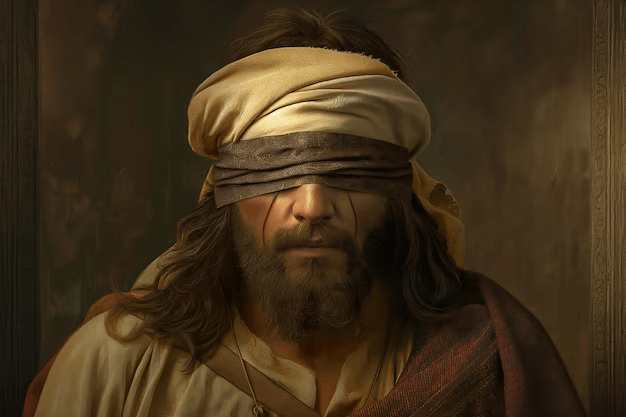
66 “What is your judgment?” They answered, “He deserves death.” 67 Then they spit in his face and struck him. And some slapped him, 68 saying, “Prophesy to us, you Christ! Who is it that struck you?” (Matthew 26:66–68 (ESV)
64 “You have heard his blasphemy. What is your decision?” And they all condemned him as deserving death. 65 And some began to spit on him and to cover his face and to strike him, saying to him, “Prophesy!” And the guards received him with blows.” (Mark 14:64–65 (ESV)
63 “Now the men who were holding Jesus in custody were mocking him as they beat him. 64 They also blindfolded him and kept asking him, “Prophesy! Who is it that struck you?” 65 And they said many other things against him, blaspheming him.” (Luke 22:63–65 (ESV)
“There’s none so blind as those who will not see.” — John Heywood, English Poet
Caiaphas demanded Jesus tell him if He was the Son of God. Jesus replied “I am” (Mark 14:62). He used the phrase (ἐγώ εἰμί; ego eimi) to reference the divine name of Yahweh. This is the name the LORD revealed to Moses (Ex. 3:14; Deut. 32:39; Isaiah 41:4; 43:10, 13, 25; 45:18; 52:6; Hosea 13:4; Joel 2:27). It is the name Jesus invoked with the Pharisees (John 8:58). It is the name prefacing Jesus’ seven “I Am” statements of deity in John’s Gospel (John 6; 8:12; 9: 10; 11; 14; 15).
When Caiaphas heard Jesus say this, the high priest tore his garments. This was a symbolic gesture of shock, horror and fury (Gen. 37:29; 2 Kings 18:37; 19:1; Ezra 9:3; Jer. 36:24; Joel 2:13). Caiaphas then said, ““He has uttered blasphemy. What further witnesses do we need? You have now heard his blasphemy” (Matt. 26:65).
Blasphemy (βλασφημία; blasphemia) means to slander and utter an insult towards God. Caiaphas accused Jesus of blaspheming God. The hypocritical irony was that Caiaphas was the one blaspheming God. The very God who stood before him.
To add injury to insult, the emboldened Jewish religious leaders, consisting of the high priests, scribes and the elders (Matthew 26:57), verbally declared Jesus to be guilty of death. This would be their judgment because Leviticus 24:16 says, “Whoever blasphemes the name of the Lord shall surely be put to death. All the congregation shall stone him. The sojourner as well as the native, when he blasphemes the Name, shall be put to death.” Their judgment of Jesus would become Jesus’ judgment upon them.
Additionally, the religious leaders and guards began to verbally and physical mock and abuse the Lord. They struck Him, slapped Him, and spit on Him. They blindfolded Him and proceeded to demand Jesus tell them who hit Him. Luke concludes the scene by saying, “And they said many other things against him, blaspheming him.”(Luke 22:65).
“Today’s passage reveals that the Sanhedrin want Christ executed because they believe Him to be a blasphemer. Our Savior, as prophesied, has remained silent through most of His trial (Matt. 26:62–63; see Isa. 53:7), but Jesus finally declares Himself to be the Christ under oath (Matt. 26:64). The claim to be the promised son of David is not blasphemous in itself; rather, it is the kind of Messiah that Jesus claims to be that is the problem for the Jewish leaders. In asserting that He will be seated at the right hand of “Power,” Jesus puts Himself on God’s level, appropriating to Himself Yahweh’s power and authority,” explains Dr. R. C. Sproul.
“This would be blasphemy indeed were He incorrect, but Jesus, the incarnate Son of God, has all divine power and authority (9:1–8). Caiaphas and the others could see this if they would look, but their own power and position, which holds first place in their hearts, blinds them to the truth (26:65–66; see Matt.12:22–32).”
John Calvin writes, “this insolence was turned by the providence of God to a very different purpose; for the face of Christ, dishonored by spitting and blows, has restored to us that image which had been disfigured, and almost effaced, by sin.”
“In spitting upon Jesus and striking Him, the leaders are the ones who commit blasphemy. However, as Let us never forget the high price Jesus paid to purchase us and always live after the example He gives as the true image of God,” concludes Dr. Sproul.
Soli deo Gloria!
 His Word Today