
62 And the high priest stood up and said, “Have you no answer to make? What is it that these men testify against you?” 63 But Jesus remained silent. And the high priest said to him, “I adjure you by the living God, tell us if you are the Christ, the Son of God.” 64 Jesus said to him, “You have said so. But I tell you, from now on you will see the Son of Man seated at the right hand of Power and coming on the clouds of heaven.” 65 Then the high priest tore his robes and said, “He has uttered blasphemy. What further witnesses do we need? You have now heard his blasphemy.” (Matthew 26:62–65 ESV)
60 “And the high priest stood up in the midst and asked Jesus, “Have you no answer to make? What is it that these men testify against you?” 61 But he remained silent and made no answer. Again the high priest asked him, “Are you the Christ, the Son of the Blessed?” 62 And Jesus said, “I am, and you will see the Son of Man seated at the right hand of Power, and coming with the clouds of heaven.” 63 And the high priest tore his garments and said, “What further witnesses do we need? 64 You have heard his blasphemy. What is your decision?” And they all condemned him as deserving death.” (Mark 14:60–64 (ESV)
It is Matthew and Mark who provide an extensive report of Jesus’ appearance before Caiaphas. Following the chief priests’ efforts to convict Jesus by false testimony and lying witnesses, Caiaphas began interrogating the Lord. Unlike Isaiah, the disciples, and even Peter, who had a sense of un-doneness in the presence of the Son of God (Isaiah 6:1-7; Luke 5:1-11; 8:22-25; John 12:36-43), the high priest possessed no such understanding. Caiaphas approached the Lord with an arrogance befitting his ignorance.
14 The natural person does not accept the things of the Spirit of God, for they are folly to him, and he is not able to understand them because they are spiritually discerned.” (1 Corinthians 2:14 (ESV)
5 For those who live according to the flesh set their minds on the things of the flesh, but those who live according to the Spirit set their minds on the things of the Spirit. 6 For to set the mind on the flesh is death, but to set the mind on the Spirit is life and peace. 7 For the mind that is set on the flesh is hostile to God, for it does not submit to God’s law; indeed, it cannot.” (Romans 8:5–7 (ESV)
Caiaphas treated the Lord Jesus with disrespect because he was a natural person, according to I Corinthians 2:14. To be natural (ψυχικός; psychikos) refers to the fallen, sinful nature which does not accept or receive anything from the Holy Spirit. Caiaphas did not receive Jesus as Lord because the high priest, in spite of his religious position and authority, was at heart an unforgiven and rebellious sinner.
Caiaphas demanded Jesus tell him if He was the Son of God. Jesus replied “I am” (Mark 14:62). He used the phrase (ἐγώ εἰμί; ego eimi) to reference the divine name of Yahweh. This is the name the LORD revealed to Moses (Ex. 3:14; Deut. 32:39; Isaiah 41:4; 43:10, 13, 25; 45:18; 52:6; Hosea 13:4; Joel 2:27). It is the name Jesus invoked with the Pharisees (John 8:58). It is the name prefacing Jesus’ seven “I Am” statements of deity in John’s Gospel (John 6; 8:12; 9: 10; 11; 14; 15).
Jesus also said that He was the Son of Man. This was a reference to this title of deity from Daniel 7:13-14.
13 “I saw in the night visions, and behold, with the clouds of heaven there came one like a son of man, and he came to the Ancient of Days and was presented before him. 14 And to him was given dominion and glory and a kingdom, that all peoples, nations, and languages should serve him; his dominion is an everlasting dominion, which shall not pass away, and his kingdom one that shall not be destroyed.” (Daniel 7:13–14 (ESV)
When Caiaphas heard Jesus say this, the high priest tore his garments. This was a symbolic gesture of shock, horror and fury (Gen. 37:29; 2 Kings 18:37; 19:1; Ezra 9:3; Jer. 36:24; Joel 2:13). Caiaphas then said, ““He has uttered blasphemy. What further witnesses do we need? You have now heard his blasphemy” (Matt. 26:65).
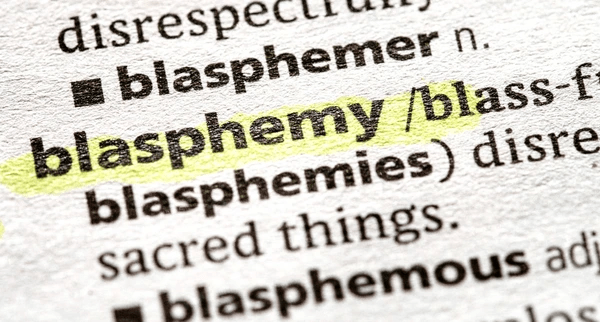
Blasphemy (βλασφημία; blasphemia) means to slander and utter an insult towards God. Caiaphas accused Jesus of blaspheming God. The hypocritical irony was that Caiaphas was the one blaspheming.
“Here the hypocrisy of the high priest becomes very clear. He acts as if he is overwhelmed with grief, though he could have shouted for joy. The man puts on a real show. He tears his high priestly robe, and says, “He has blasphemed,” using the word “blasphemed” in its gravest sense: unjustly he has claimed for himself the prerogatives that belong to God alone,” explains Dr. William Hendriksen.
“Not that claiming to be the Messiah would in and by itself constitute blasphemy. But representing oneself as the fulfilment of Daniel’s prophecy, that is, as the One who, coming with the clouds of heaven, would receive a. authority to judge all the nations, and b. everlasting dominion (see Dan. 7:13, 14); such a claim—and it was indeed this claim that Jesus was making—could be made only by God! Hence, either a. Jesus was indeed divine, “the Son of God,” in the fullest sense of that term, or else b. he was guilty of blasphemy, punishable by death (Lev. 24:16).”
People often say “seeing is believing.” Caiaphas was seeing Jesus, but he was not believing in Jesus. Jesus said it this way to Thomas: “Have you believed because you have seen me? Blessed are those who have not seen and yet have believed.” (John 20:29 (ESV)
Soli deo Gloria!
 His Word Today