
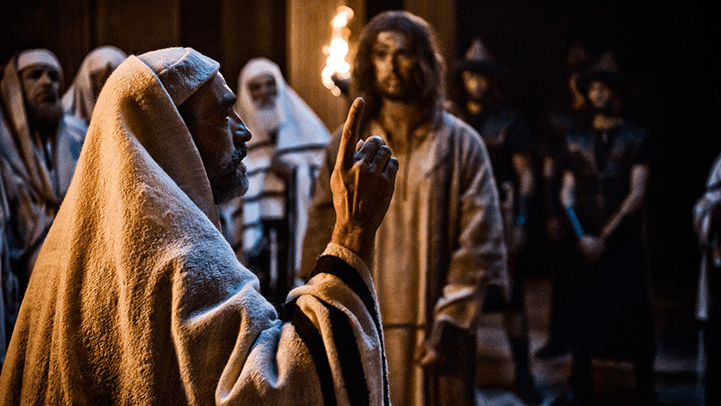
59 “Now the chief priests and the whole council were seeking false testimony against Jesus that they might put him to death, 60 but they found none, though many false witnesses came forward. At last two came forward 61 and said, “This man said, ‘I am able to destroy the temple of God, and to rebuild it in three days.’ ” (Matthew 26:59–61 (ESV)
55 “Now the chief priests and the whole council were seeking testimony against Jesus to put him to death, but they found none. 56 For many bore false witness against him, but their testimony did not agree. 57 And some stood up and bore false witness against him, saying, 58 “We heard him say, ‘I will destroy this temple that is made with hands, and in three days I will build another, not made with hands.’ ” 59 Yet even about this their testimony did not agree.” (Mark 14:55–59 (ESV)
Justice should be about discovering truth. It is being morally righteous by following, and upholding, the letter and the spirit of law. The chief priests and the whole council were not seeing justice in their trial against Jesus. They sought to condemn Him any way they could.
Matthew and Mark alone record the account of the false witnesses against Jesus. The chief priests and the whole council sought this false testimony. The Jewish religious leaders displayed a complete lack of integrityleaders. The irony was they could not find anything to condemn Jesus although many false witnesses came forward.
The only accusation they could find was Jesus’ statement “‘I am able to destroy the temple of God, and to rebuild it in three days.’ ” (John 2:18-20). However, Jesus was referring to His resurrection from the dead (John 2:21-22).
The title chief priests is plural. This refers to both Annas and Caiaphas. The whole council refers to the Sanhedrin. The Sanhedrin was the Supreme Court or “high council” of Judaism. It contained 71 members and they met in Jerusalem. The Sanhedrin is prominent in the Passion narratives of the Gospels as the religious court that tried Jesus. They also appear Acts as the judicial body who investigated and persecuted the growing church (Acts 3-5).
“The name Sanhedrin (Greek, sunedrion, from sun, “together,” and hedra, “seat”) occurs for the first time in the reign of Herod the Great (Antiquities 14.9.3–5). This is the term used throughout the NT (22 times), along with “the elders” (Lk 22:66; Acts 22:5) and “gerousia” (Acts 5:21),” states the Tyndale Bible Dictionary.
“Probably this trial took place in a large upper room of that wing of the palace where Caiaphas lived. The question might be asked, “But why have a trial at all, since the Sanhedrin had decided a long time ago that Jesus must be put to death (John 11:49, 50), an agreement which very recently had been reconfirmed (Matt. 26:4)?” Answer: the verdict must be made official and reasons must be formulated, so that the sentence that subsequently will be based upon it can be justified before the Jews, and so that the indispensable co-operation of the Gentiles—especially of Pilate—can be obtained,” explains Dr. William Hendriksen.
“Our Savior’s trial is the greatest miscarriage of justice ever committed. Matthew makes this plain, stating that the council seeks “false testimony” (v. 59). Whatever they feel about their actions — and they likely believe themselves to be doing God’s will — Caiaphas and his cohorts only want evidence against Jesus. They could care less about the truth and are probably frustrated in their inability to build a case against Him (vv. 59–60a). Even as this chaos surrounds Him, our Lord remains in control, refusing to answer the false charges (vv. 62–63a,” states Dr. R. C. Sproul.
John Calvin writes, “Christ is silent not only because the objection [is] frivolous, but because, having been appointed to be a sacrifice, he [has] thrown aside all anxiety about defending himself,”
God remains in control.
Dr. Clothier
 His Word Today