
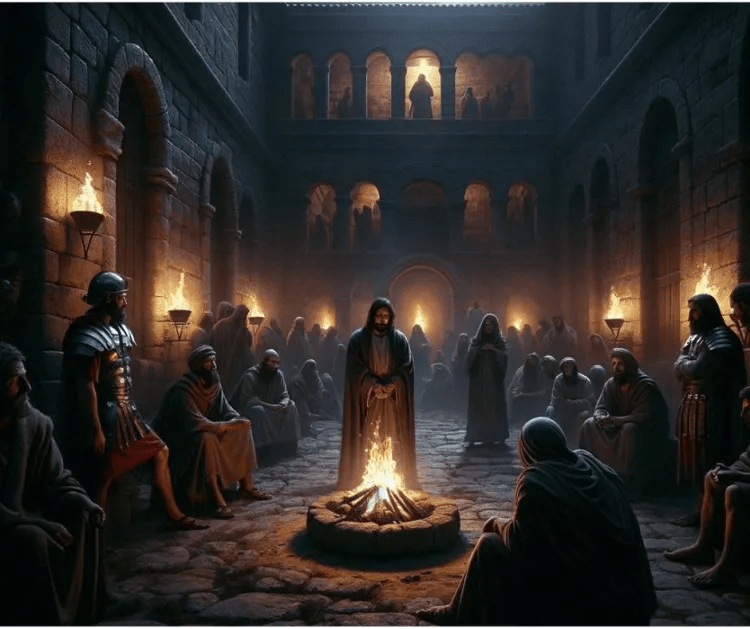
57 Then those who had seized Jesus led him to Caiaphas the high priest, where the scribes and the elders had gathered. 58 And Peter was following him at a distance, as far as the courtyard of the high priest, and going inside he sat with the guards to see the end.” (Matthew 26:57–58 (ESV)
53 And they led Jesus to the high priest. And all the chief priests and the elders and the scribes came together. 54 And Peter had followed him at a distance, right into the courtyard of the high priest. And he was sitting with the guards and warming himself at the fire.” (Mark 14:53–54 (ESV)
54 Then they seized him and led him away, bringing him into the high priest’s house, and Peter was following at a distance. 55 And when they had kindled a fire in the middle of the courtyard and sat down together, Peter sat down among them.” (Luke 22:54–55 (ESV)
12 So the band of soldiers and their captain and the officers of the Jews arrested Jesus and bound him. 13 First they led him to Annas, for he was the father-in-law of Caiaphas, who was high priest that year. 14 It was Caiaphas who had advised the Jews that it would be expedient that one man should die for the people.” (John 18:12–14 (ESV)
To understand the context of Matt. 26:57–68, and the other gospel accounts, it is necessary to know Jesus had to undergo two trials. The first was an ecclesiastical, or religious, trial, which would be in three stages. The second was a civil trial. This also would be in three stages.
The second religious trial took place before Caiaphas. John indicated Caiaphas was the current high priest (John 18:13). John also mentioned Caiaphas had stated it would be advantageous for Jesus to die for the people (John 11:45=53).
Concurrent with Jesus’ trials was Peter’s attendance. He followed at a distance and got as far as the high priest’s courtyard. He sat with guards, warming himself at a fire kindled by the soldiers. Matthew recorded Peter wanted to see what would happen to Jesus (Matt. 26:58). John provides additional information regarding Peter’s presence.
15 Simon Peter followed Jesus, and so did another disciple. Since that disciple was known to the high priest, he entered with Jesus into the courtyard of the high priest, 16 but Peter stood outside at the door. So the other disciple, who was known to the high priest, went out and spoke to the servant girl who kept watch at the door, and brought Peter in.” (John 18:15–16 (ESV)
“Though all the disciples had fled, two soon rallied, and began to follow the band which was leading Jesus to the high priest’s palace. Still fearful, Peter was following (imperfect tense) from a considerable distance (Matthew, Mark, Luke). With him was someone who is simply called another disciple. That this unnamed person was no one else than the author of the Fourth Gospel we have tried to prove,” explains Dr. William Hendriksen.
“The “other disciple” (John) was known—though not of necessity intimately—to the high priest. How it was that Annas (see on verse 13)—hence, probably also his son-in-law—knew John remains a mystery. Theories—such as, that John was a distant relative, or that his father’s firm delivered fish to the high priest’s palace (the view of Nonnus, an Egyptian scholar, about 400 a.d.)—are nothing but guesses. It is important, nevertheless, to bear in mind the fact as such (that John was known to the high priest). See also on 18:10. This explains why, without difficulty, John—who, having by this time regained courage, had shortened the distance between himself and the band—entered with Jesus into the court of the high priest.”
This scene set the stage for Peter’s three denials of knowing Jesus.
Soli deo Gloria!
 His Word Today