
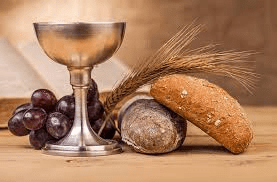
26 Now as they were eating, Jesus took bread, and after blessing it broke it and gave it to the disciples, and said, “Take, eat; this is my body.” 27 And he took a cup, and when he had given thanks he gave it to them, saying, “Drink of it, all of you, 28 for this is my blood of the covenant, which is poured out for many for the forgiveness of sins.” (Matthew 26:26–28 ESV)
14 “Therefore, my beloved, flee from idolatry. 15 I speak as to sensible people; judge for yourselves what I say. 16 The cup of blessing that we bless, is it not a participation in the blood of Christ? The bread that we break, is it not a participation in the body of Christ? 17 Because there is one bread, we who are many are one body, for we all partake of the one bread. 18 Consider the people of Israel: are not those who eat the sacrifices participants in the altar? 19 What do I imply then? That food offered to idols is anything, or that an idol is anything? 20 No, I imply that what pagans sacrifice they offer to demons and not to God. I do not want you to be participants with demons. 21 You cannot drink the cup of the Lord and the cup of demons. You cannot partake of the table of the Lord and the table of demons. 22 Shall we provoke the Lord to jealousy? Are we stronger than he?” (1 Corinthians 10:14–22 ESV)
The following article is from Tabletalk, Ligonier Ministries daily Bible study magazine. It originally appeared Nov. 19, 2008; author unknown. May the LORD encourage you by the following insights taken from I Corinthians 10:14-22).
“Given that transubstantiation and consubstantiation are found wanting, it remains for us to try to define how Jesus is present in the Lord’s Supper. Some believe the Lord’s Supper is only a memorial; thus, Christ is not present in a unique way when we take the sacrament. Yet more is going on in the Lord’s Supper than the remembering of our Savior’s death, as important as that may be. For example, today’s passage speaks of participation or fellowship in the body and blood of Christ when we come to the Lord’s Table (1 Cor. 10:16). Something is happening besides the simple remembrance of the cross.”
“Moreover, as Dr. Keith A. Mathison observes, the fact that many of those who took the sacrament in Corinth unworthily became ill or died (1 Cor. 11:29–30) proves “that there is much more to the sacrament than mere symbolism and subjective acts of mental recollection” (Given for You, p. 234).”
“The Westminster Confession of Faith summarizes the biblical teaching on Christ’s special presence in the Lord’s Supper, saying that worthy receivers feed on Jesus “not carnally and corporally, but spiritually.” Christ is spiritually “present to the faith of believers,” and we feed upon “Christ crucified, and all benefits of His death” (29.7). The confession affirms that in the Supper we commune with Jesus, both in His humanity and in His divinity, in a way not possible at other times. As we eat the bread and drink the wine, we by faith commit ourselves anew to Jesus and renew the covenant, showing that we need His physical body and blood to save us as much as we need food to nourish us. We meet with Jesus as a whole person, and He strengthens us for the journey from the resources He has both as the Son of God and as a glorified human being.”
“This is possible because of our union with Christ by virtue of the Holy Spirit. In the final analysis, it is a mystery as to how all this happens. But it is to this mystery we have been called to partake of regularly, participating in faith, believing that God has accomplished through His Son all that the Passover in Egypt and the giving of the covenant at Sinai pointed to, namely, the inauguration and consummation of a new covenant.”
“The Lord’s presence in the Lord’s Supper is not easy to conceptualize, but we do affirm that He is truly present every time we take the sacrament with other believers. It behooves us to remind ourselves of this fact and realize that the sacrament is not an afterthought, it is a means of grace that conveys to the faithful the benefits we need to progress in holiness. As you take the Supper, consider the presence of Christ and the way He meets all our needs.”
Soli deo Gloria!
 His Word Today