
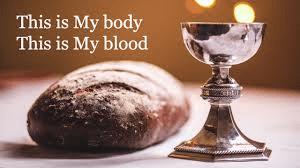
26 Now as they were eating, Jesus took bread, and after blessing it broke it and gave it to the disciples, and said, “Take, eat; this is my body.” 27 And he took a cup, and when he had given thanks he gave it to them, saying, “Drink of it, all of you, 28 for this is my blood of the covenant, which is poured out for many for the forgiveness of sins. 29 I tell you I will not drink again of this fruit of the vine until that day when I drink it new with you in my Father’s kingdom.” (Matthew 26:26–29 ESV)
22 And as they were eating, he took bread, and after blessing it broke it and gave it to them, and said, “Take; this is my body.” 23 And he took a cup, and when he had given thanks he gave it to them, and they all drank of it. 24 And he said to them, “This is my blood of the covenant, which is poured out for many. 25 Truly, I say to you, I will not drink again of the fruit of the vine until that day when I drink it new in the kingdom of God.” (Mark 14:22–25 ESV)
18 For I tell you that from now on I will not drink of the fruit of the vine until the kingdom of God comes.” 19 And he took bread, and when he had given thanks, he broke it and gave it to them, saying, “This is my body, which is given for you. Do this in remembrance of me.” 20 And likewise the cup after they had eaten, saying, “This cup that is poured out for you is the new covenant in my blood.” (Luke 22:18–20 ESV)
23 For I received from the Lord what I also delivered to you, that the Lord Jesus on the night when he was betrayed took bread, 24 and when he had given thanks, he broke it, and said, “This is my body, which is for you. Do this in remembrance of me.” 25 In the same way also he took the cup, after supper, saying, “This cup is the new covenant in my blood. Do this, as often as you drink it, in remembrance of me.” (1 Corinthians 11:23–25 ESV)
Were the bread and the wine Jesus blessed and gave thanks for His actual body and blood? Some church traditions, and theologians, advocate this view, or a moderate interpretation of the same. What is the biblical understanding of what Jesus meant and how does it apply to the church today when she observes the Lord’s Supper or Communion.
As we consider the various views concerning the Lord’ Supper, one thing is not debated. Jesus commanded His disciples to commemorate and remember, this ordinance. Why is it important to regularly remember Jesus’ death, burial and resurrection? It is because people forget its significance; even believers in Christ.
“Celebrating the Lord’s Supper is one way in which we recall God’s sacrifice of His Son. The bread and wine visibly depict the broken body and shed blood of Christ Jesus and help us remember His death, although the remembering of His death is not all that happens at His table. Nevertheless, the Lord’s Supper is tied inextricably to the past, orienting us to the death of Christ for His people, the single greatest event in world history,” states one commentator.
“To this day, some believers hold that the Lord’s Supper is merely past-oriented, only an opportunity to remember Christ’s death. Those theological traditions with the most adherents, however, all believe that Jesus is uniquely present in time and in space when the Lord’s Supper is celebrated,” comments Dr. R. C. Sproul.
However, there are other denominations which take the presence of the Lord Jesus at Lord’s Supper a step further. This debate centers on four perspectives. While we will define these four views, time and space limit an expanded discussion and examination.
First, the view of transubstantiation articulated by the Roman Catholic communion. The Roman Catholic Church advocates the miracle of the Mass. This means the substance of the bread and wine used in the Lord’s Supper is miraculously changed into the actual body and blood of Christ. Therefore, if you were to ask a Roman Catholic if they have received Christ, they would perhaps respond they have; during the celebration of the Mass.
Second, the doctrine of consubstantiation articulated by the Lutheran community. The term means that Christ is substantively present within the bread and wine. Attending a Lutheran church as a child, this was the view taught in confirmation classes I attended. “We must note, however, that the word consubstantiation, though it is used widely in theological circles to describe the Lutheran view, is not a term that the Lutherans tend to embrace,” explains Dr. Sproul.
Third, the Reformed and Anglican affirmation of the real presence of Christ in the Lord’s Supper. John Calvin used the word “substance” as a synonym for “real” or “true.” He taught the divine nature of Christ is present at the Lord’s Supper as He is everywhere.
Fourth, the memorial-sign view of the sacrament espoused by Ulrich Zwingli and by the majority of those in the Baptist churches and denominations. This view articulates the Lord’s Supper is strictly a memorial, with the bread and wine representative, or symbolic, of Christ’s body and blood.
“The debate goes on, as the church tries to plumb the depths and the riches of this sacrament that was instituted by Jesus and practiced on a regular basis in the primitive Christian church, and this debate has survived even to our day,” concludes Dr. Sproul.
Soli deo Gloria!
.
 His Word Today