
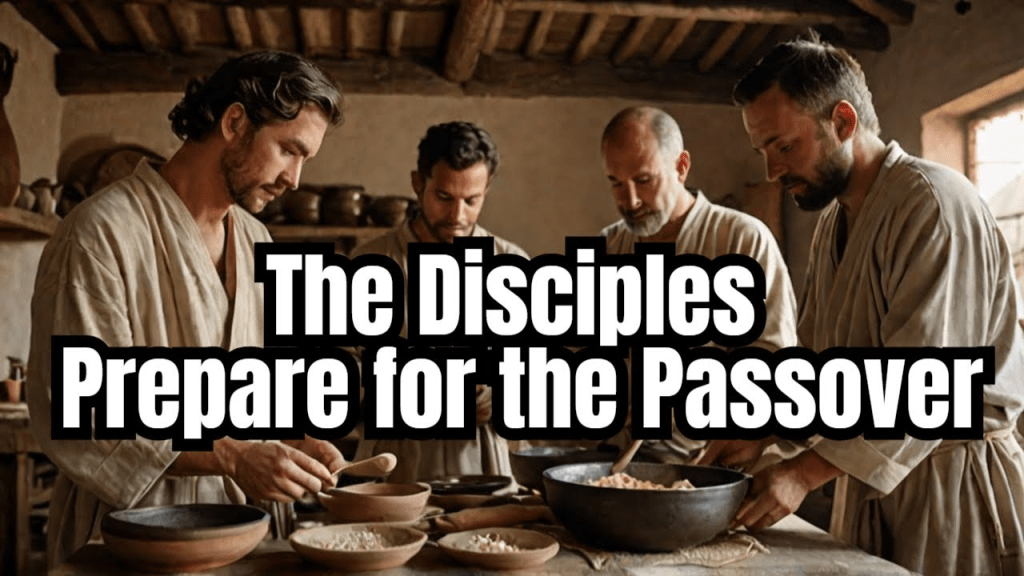
17 “Now on the first day of Unleavened Bread the disciples came to Jesus, saying, “Where will you have us prepare for you to eat the Passover?” 18 He said, “Go into the city to a certain man and say to him, ‘The Teacher says, My time is at hand. I will keep the Passover at your house with my disciples.’ ” 19 And the disciples did as Jesus had directed them, and they prepared the Passover.” Matthew 26:17–19 (ESV)
12 “And on the first day of Unleavened Bread, when they sacrificed the Passover lamb, his disciples said to him, “Where will you have us go and prepare for you to eat the Passover?” 13 And he sent two of his disciples and said to them, “Go into the city, and a man carrying a jar of water will meet you. Follow him, 14 and wherever he enters, say to the master of the house, ‘The Teacher says, Where is my guest room, where I may eat the Passover with my disciples?’ 15 And he will show you a large upper room furnished and ready; there prepare for us.” 16 And the disciples set out and went to the city and found it just as he had told them, and they prepared the Passover.” (Mark 14:12–16 (ESV)
7 “Then came the day of Unleavened Bread, on which the Passover lamb had to be sacrificed. 8 So Jesus sent Peter and John, saying, “Go and prepare the Passover for us, that we may eat it.” 9 They said to him, “Where will you have us prepare it?” 10 He said to them, “Behold, when you have entered the city, a man carrying a jar of water will meet you. Follow him into the house that he enters 11 and tell the master of the house, ‘The Teacher says to you, Where is the guest room, where I may eat the Passover with my disciples?’ 12 And he will show you a large upper room furnished; prepare it there.” 13 And they went and found it just as he had told them, and they prepared the Passover.” (Luke 22:7–13 (ESV)
“Now before the Feast of the Passover, when Jesus knew that his hour had come to depart out of this world to the Father, having loved his own who were in the world, he loved them to the end.” (John 13:1 (ESV)
As the last week of the Lord Jesus Christ is studied, it is important to compare all four Gospels, their particular narratives and themes pertaining to the death, burial and resurrection of the Lord. Today’s focus concerns the preparation for the Passover Feast. This particular feast would picture, and immediately precede, the historical death, burial and resurrection of the Lord Jesus Christ.
All four narratives document the initial preparation for the Passover. The
Synoptic Gospels (Matthew, Mark, Luke) also refer to the day of Unleavened Bread. What is the significance of this distinction? Both titles refer to the same Spring seasonal celebration of the Lord’s deliverance of Israel from Egypt (Ex. 12:1-28). Both titles were used interchangeably. It would be comparable to our expressions of Merry Christmas, Happy Holidays and Seasons Greetings, in which all refer to the observance of the Lord’s incarnation to a greater, or lesser, extent.
“The Passover lambs were killed (Mark 14:12) on 14 Nisan (March/April). That evening, the Passover meal was eaten. The Feast of Unleavened Bread followed immediately after Passover, from 15–21 Nisan. The entire time was often referred to either as “Passover” (Luke 22:1), or as the Feast of Unleavened Bread. Therefore the first day refers to 14 Nisan,” explains Dr. John MacArthur.
All four accounts reveal the sovereign authority of the Lord Jesus. He knows what is going to occur in the ensuing hours and He diligently seeks the fulfillment of Scripture and His atoning mission. This includes the Passover, for He is the fulfillment of the Passover Lamb (John 1:29-35; I Cor. 5:6-8). Each Gospel provides a unique perspective on the events. However, none are contradictory to each other.
“Nothing is said about the purchase of a lamb. We may probably assume that this had been attended to a few days earlier. See Exod. 12:3. Further preparations had to be made however,” explains Dr. William Hendriksen.
“During the afternoon the lamb must be killed in the forecourt of the temple (cf. Exod. 12:6). A room of sufficient size must be obtained, and everything in connection with this room and its furniture must be arranged. Besides, purchases must be made: of unleavened bread, bitter herbs, wine, etc. The lamb must be made ready for use, the sauce must be prepared. Since it was now Thursday morning, there can be no delay.”
“With the Passover at hand, the disciples come to Jesus to inquire of the place where the meal is to be eaten (Matt. 26:17). This festival, one of the most important feast days on the Jewish calendar, has to be celebrated within Jerusalem proper, and so our Lord and His followers must find a place to eat the Passover meal within the city, for they have been staying in Bethany (v. 6). Christ is able to direct His disciples on how they may find a room in which to eat the Passover, and they then go forth to follow His instructions (vv. 18–19),” states Dr. R. C. Sproul.
Matthew, Mark and Luke all conclude their narratives with these words referring to the disciples; “They prepared the Passover.”
“Some preachers and scholars have long portrayed Jesus as a helpless victim of events, one who is caught off-guard by His arrest and crucifixion. Today’s passage, among many others, indicates that this view is mistaken. Our Savior’s death is no accident of history, it occurred according to the definite plan and foreknowledge of God and of His Christ. He is the sovereign Lord of history who controls all things even until this very day,” concludes Dr. Sproul.
Soli deo Gloria!
 His Word Today