
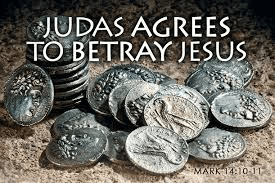
14 “Then one of the twelve, whose name was Judas Iscariot, went to the chief priests 15 and said, “What will you give me if I deliver him over to you?” And they paid him thirty pieces of silver. 16 And from that moment he sought an opportunity to betray him.” (Matthew 26:14–16 ESV)
10 “Then Judas Iscariot, who was one of the twelve, went to the chief priests in order to betray him to them. 11 And when they heard it, they were glad and promised to give him money. And he sought an opportunity to betray him.” (Mark 14:10–11 (ESV)
3 “Then Satan entered into Judas called Iscariot, who was of the number of the twelve. 4 He went away and conferred with the chief priests and officers how he might betray him to them. 5 And they were glad, and agreed to give him money. 6 So he consented and sought an opportunity to betray him to them in the absence of a crowd.” (Luke 22:3–6 ESV)
As the last week of the Lord Jesus Christ is studied, it is important to compare all four Gospels, their particular narratives and themes pertaining to the death, burial and resurrection of the Lord. Today’s focus concerns Judas Iscariot and his plans to betray Jesus into the hands of His enemies.
As Mary initiated her act of selfless devotion to the Lord in anointing Him, Judas initiated his contact with the chief priests in order to acquire money by betrayal. Luke reveals the actions by Judas were perpetrated by Satan’s internal influence upon the disciple. However, Judas willingly sought to betray the Lord.
What a comparison between Mary and Judas. Mary gave while Judas pursued every opportunity to get. Mary was public in her adoration of Jesus. Judas was private in his effort to betray Jesus. Mary’s object of worship was the Lord. Judas’ object of worship was money. Mary’s legacy is one of loving adoration. Judas’ legacy is heartless betrayal of the Master who loved him. Mary is famous. Judas is infamous.
“Commentators on Matthew 26 point out the contrast between Mary’s act of love in verses 6–13 (see John 12:1–8) and Judas’ evil in today’s passage. Judas is treacherously secretive, betraying the Lord behind His back (Matt. 26:14–15), but Mary publicly pours oil upon His head (vv. 6–13). Mary is selfless; she gives something up to bless her Savior (vv. 7, 10). Judas is selfish; he looks to profit by helping to bring the curse of death upon Jesus (v. 15). Finally, Judas sells out Jesus for a relatively small amount of money, but Mary honors Christ with a large amount of her resources — a year’s worth of wages (v. 9; John 12:5),” explains Dr. R. C. Sproul.
“Standing in sharp contrast to the love and devotion of Mary was the hatred and treachery of Judas. This disciple, who is understandably referred to last in the lists of the Twelve, was the son of Simon, who was also called “Iscariot.” The name “Iscariot” means “man of Kerioth,” which was a small town in Judea about 23 miles south of Jerusalem (cf. 3:19). Thus Judas was not a Galilean like the other disciples,” states Dr. John MacArthur.
“It is clear that Judas never had any spiritual interest in Jesus—he was attracted to him because he expected Jesus to become a powerful religious and political leader. He saw great potential for power, wealth, and prestige through his association with him. But Jesus knew what Judas was like from the start, and that is why he chose him as one of the Twelve. He was the one who would betray him so that the Scripture and God’s plan of salvation would be fulfilled (Ps. 41:9; 55:12–15, 20–21; Zech. 11:12–13; John 6:64, 70–71; 13:18; 17:12).”
Are you more like Mary or Judas? This is a provocative question but a necessary one. How we answer reveals our true nature and eternal destiny.
“Judas’ betrayal of the Savior is the most wicked deed ever committed. It warns us to be careful lest sin take hold of our hearts and make us turn our backs on Christ. Those who truly know Jesus will not finally betray Him, but it is possible even for Christians to become disenchanted with the way God works out His plan and fall into transgression. Let us take care to remember that we have no right to call the Lord’s way of doing things into question,” concludes Dr. Sproul.
Soli deo Gloria!
 His Word Today
my first thought about Judas is That he was doomed from the start cursed from the beginning destined to fall Kinda like how I felt of myself a loser a sinner hell bound no way out no matter how many times I read tracts like How to be saved the 4 spiritual laws. , Until God. In His mercy brought anew birth to me I was just like Judas
LikeLike