
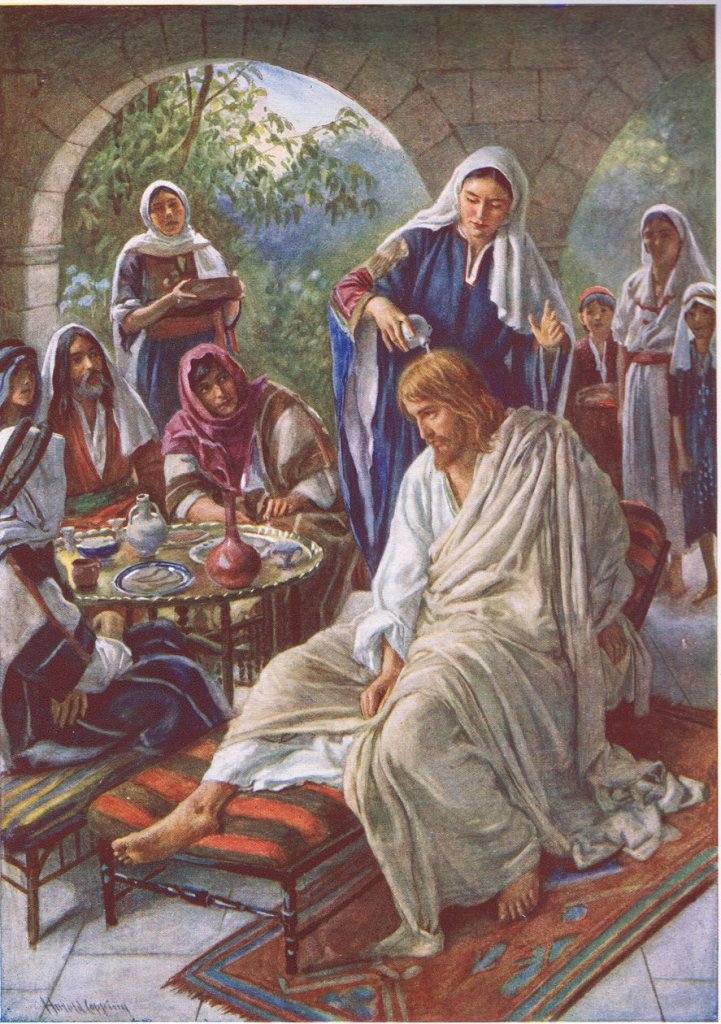
10 But Jesus, aware of this, said to them, “Why do you trouble the woman? For she has done a beautiful thing to me. 11 For you always have the poor with you, but you will not always have me. 12 In pouring this ointment on my body, she has done it to prepare me for burial. 13 Truly, I say to you, wherever this gospel is proclaimed in the whole world, what she has done will also be told in memory of her.” (Matthew 26:10–13 (ESV)
6 But Jesus said, “Leave her alone. Why do you trouble her? She has done a beautiful thing to me. 7 For you always have the poor with you, and whenever you want, you can do good for them. But you will not always have me. 8 She has done what she could; she has anointed my body beforehand for burial. 9 And truly, I say to you, wherever the gospel is proclaimed in the whole world, what she has done will be told in memory of her.” (Mark 14:6–9 (ESV)
7 Jesus said, “Leave her alone, so that she may keep it for the day of my burial. 8 For the poor you always have with you, but you do not always have me.” (John 12:7–8 (ESV)
One of the principles of proper biblical interpretation is Scripture interprets Scripture. This means the Bible is its own interpreter and never contradicts itself. An example of this interpretative principle is found in the story of Jesus’ anointing at Bethany. Jesus’ response to Mary, and the disciples’ response to her, are recorded not only in Matthew’s Gospel but also in Mark 14:6-9 and John 12:7-8.
Mary’s extravagant act of worship by anointing Jesus with expensive perfume (Matt. 26:6-7; Mark 14:3; John 12:1-3) was contrasted by the disciples’ indignant response against her act of worship and love for Jesus (Matt. 26:8-9; Mark 14:4-5; John 12:4-6). What then was Jesus’ response, not only to Mary but also to the disciples?
In all three text, Jesus firmly reprimands the disciples, and not Mary. In Matthew and Mark’s account, Jesus posed a rhetorical question to the men; ““Why do you trouble the woman” In Mark and John’s Gospel, He also issued a command; “Leave her alone.” He then commended Mary for what she had done calling it “a beautiful thing.”
He understood, even though the disciples did not, the significance of what Mary had done. She prepared Jesus for what would befall Him in the next several days: His substitutionary death, burial and subsequent resurrection.” He selfless acts pointed to the saving Gospel.
“It was not that the Master was unconcerned about the needs, both physical and spiritual, of those to whom help and mercy should be shown. Far from it, as the following passages indicate: Matt. 5:7; 6:2–4; 12:7; 19:21; Luke 6:20, 36–38; 21:1–4; John 13:29. On this subject, as well as on all others, his teaching was in line with the rest of special revelation (Exod. 23:10, 11; Lev. 19:10; Deut. 15:7–11—was he not in a sense quoting Deut. 15:11?—Ps. 41:1; Prov. 14:21b, 31; 19:17; Isa. 58:7; Jer. 22:16; Dan. 4:27; Amos 2:6, 7; and for the New Testament see 2 Cor. 8:1–9; Gal. 6:2, 9, 10; 2 Thess. 3:13; James 5:1–6),” explains Dr. William Hendriksen.
“But there would be many more opportunities to attend to the cause of Christian charity or benevolence. On the contrary, the opportunity to show love and honor to Jesus in the state of humiliation had almost vanished. Gethsemane, Gabbatha, and Golgotha were just around the corner. What Mary had done was therefore right, beautiful even, for it was prompted by thankfulness of heart. It was also unique in the thoughtfulness it revealed. Moreover, it was regal in its lavishness. Last but not least, it was marvelous in its timeliness.”
What may initially appear to be most important, often is the less important. The meeting of physical needs of the moment can never be equal with the eternal significance of the Gospel, and those who proclaim it. Mary’s act pointed the eternal love of God, displayed on the cross. While meeting the social, and material needs of the poor is a good and blessed thing to do, the heralding of the Gospel is far greater and lasts longer (John 4).
What legacy are you living and leaving? Is it the materialism of the moment, or the ministry of a lifetime?
Soli deo Gloria!
 His Word Today