
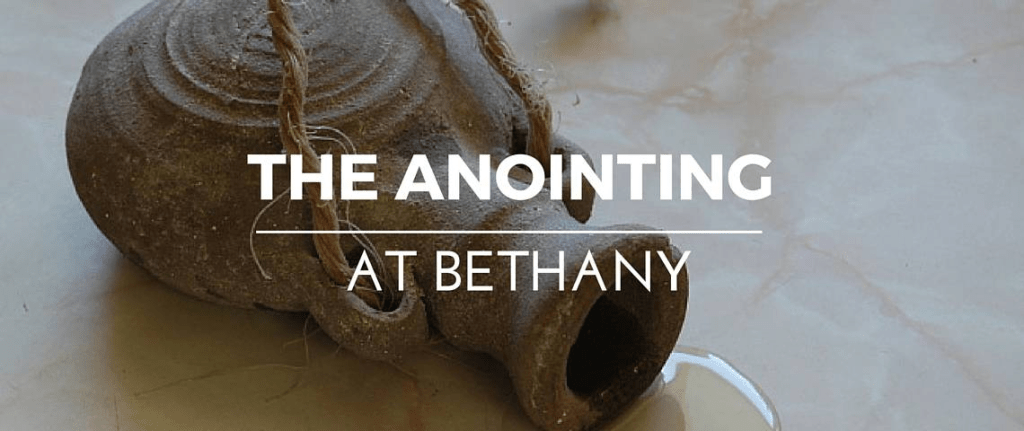
6 Now when Jesus was at Bethany in the house of Simon the leper, 7 a woman came up to him with an alabaster flask of very expensive ointment, and she poured it on his head as he reclined at table. Matthew 26:6–7 ESV)
3 And while he was at Bethany in the house of Simon the leper, as he was reclining at table, a woman came with an alabaster flask of ointment of pure nard, very costly, and she broke the flask and poured it over his head.” (Mark 14:3 ESV)
“Six days before the Passover, Jesus therefore came to Bethany, where Lazarus was, whom Jesus had raised from the dead. 2 So they gave a dinner for him there. Martha served, and Lazarus was one of those reclining with him at table. 3 Mary therefore took a pound of expensive ointment made from pure nard, and anointed the feet of Jesus and wiped his feet with her hair. The house was filled with the fragrance of the perfume.” (John 12:1–3 ESV)
One of the principles of proper biblical interpretation is Scripture interprets Scripture. This means the Bible is its own interpreter and never contradicts itself. An example of this interpretative principle is found in the story of Jesus’ anointing at Bethany. Mark 14:3 and John 12:1-8 are a parallel account of Matthew’s text. All three Gospels chronicle the event occurred in the village of Bethany (Matt. 26:6; Mark 14:3; John 12:1).
“There is no conflict between this account (Matt. 26:6) and John 12:1, “Now six days before the Passover Jesus came to Bethany.…” The time indication in Matt. 26:2, “after two days” does not apply to the anointing at Bethany (verses 6–13). At verse 6 Matthew begins to tell a new story. To do so he must go back a few days, to the preceding Saturday evening, when a supper was given at Bethany in honor of Jesus,” explains Dr. William Hendriksen.
“Each night during the last week of His life Jesus is staying in Bethany, a village about an hour’s walk from Jerusalem (Matt. 21:17), probably because the Holy City, filled to the brim with Passover pilgrims, has few vacancies,” explains Dr. R. C. Sproul.
Matthew and Mark record Jesus’ anointing took place at the home of Simon the Leper (Matt. 26:6; Mark 14:3), during a dinner (John 12:1). Mary, Martha and Lazarus were also in attendance (John 12:2-3). Some commentators speculate Simon may have been the father of the three siblings, but we cannot say for certain.
Martha served while Lazarus reclined at table, presumably as an honored guest (John 12:2-3). This was because the dinner was given in Jesus’ honor following the events of John 11 when Jesus raised Lazarus from the dead. John reveals the woman who anointed Jesus was none other than Mary (Matt. 26:7; John 12:3).
“Present at this supper were at least fifteen men: Jesus, The Twelve, Lazarus (John 12:2), and a certain Simon, mentioned only here (Matt. 26:6) and in Mark 14:3. The idea readily suggests itself that the supper (or “dinner” if one prefers) was prompted by love for the Lord, specifically by gratitude for the raising of Lazarus and for the healing of Simon, the man who had been a leper, is still called “Simon the leper,” but had presumably been healed by Jesus. It was at the home of this Simon that the dinner was given,” states Dr. Hendriksen. .
Matthew and Mark indicate Mary had an alabaster flask containing expensive ointment (Matthew 26:7a; Mark 14:3). The flask was perhaps made from pure gypsum. John says the ointment was made from pure nard and measured a pound. Mary was extravagant, not only when she broke the beautiful flask but also when she poured its contents on Jesus’ head (Matt.26:7; Mark 14:3). There was so much ointment remaining that she also anointed the feet of Jesus and wiped His feet with her hair (John 12:3).
Mary’s act was one of unbounded devotion for the Lord. It will be contrasted by the indignity of the disciples. May we choose to live in such a way that our actions, speech and attitudes reflect an utmost devotion for the Lord Jesus Christ.
Soli deo Gloria!
 His Word Today