
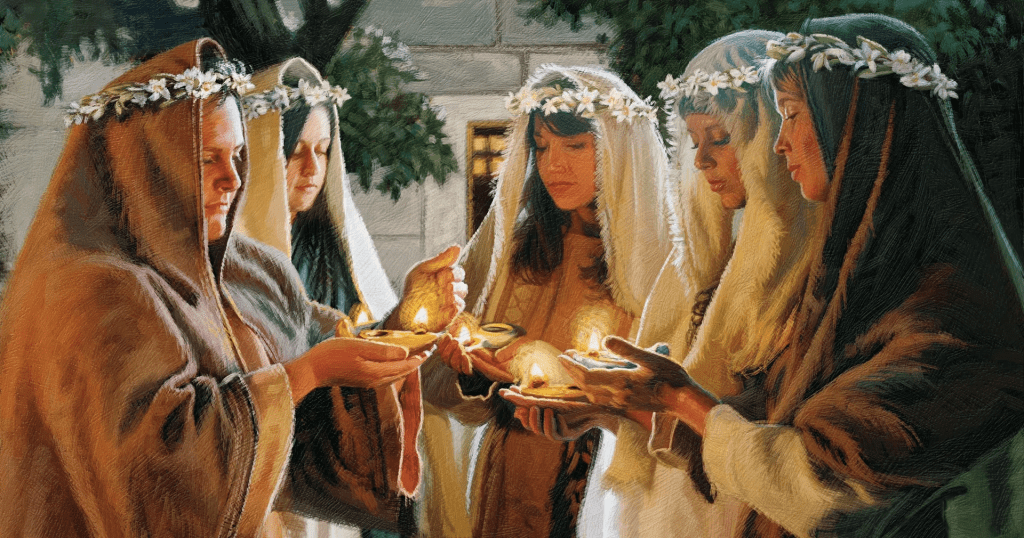
6 “But at midnight there was a cry, ‘Here is the bridegroom! Come out to meet him.’ 7 Then all those virgins rose and trimmed their lamps. 8 And the foolish said to the wise, ‘Give us some of your oil, for our lamps are going out.’ 9 But the wise answered, saying, ‘Since there will not be enough for us and for you, go rather to the dealers and buy for yourselves.’ 10 And while they were going to buy, the bridegroom came, and those who were ready went in with him to the marriage feast, and the door was shut. 11 Afterward the other virgins came also, saying, ‘Lord, lord, open to us.’ 12 But he answered, ‘Truly, I say to you, I do not know you.’ 13 Watch therefore, for you know neither the day nor the hour.” (Matthew 25:6–13 (ESV)
The bridegroom finally arrives. It is midnight. Jesus provides no explanation as to why the delay in the bridegroom’s arrival. The announcement of his coming awakens the ten sleeping maidens (Matt. 25:5). They are now to accompany the bridegroom to meet his bride.
The ten trimmed their lamps, or lit their torches. Five of the ten had a sufficient supply of oil to replenish their torches and keep them ablaze. The remaining five did not. They came unprepared, not expecting it would take such a long time for the bridegroom to arrive.
The unwise virgins asked the other five to give them some of their supply of oil. However, the wise virgins refused to do so because there would be not enough oil for them all. They told the unwise virgins to the dealers and buy some more oil. How this was to be done a midnight is not explained.
“Instead of finding fault with these girls because of their heartlessness, we must try to understand their situation. Wedding processions generally move slowly. Besides, this is midnight. Not only must the girls go out to meet the bridegroom; they must also escort him back to the house with their lamps still brightly burning all the time. Their reply is therefore not unreasonable. It is rather “in character,” showing forethought, a further manifestation of the same careful planning they had done when they had filled their lamps with oil,” comments Dr. William Hendriksen.
However, while the five unwise virgins went to buy some more oil, the bridegroom came. Those who were ready to accompany him to the wedding feast did so. Upon the entourage’s arrival to the place of the feast, the door to the building was shut.
“Certain passages of Scripture are filled with pathos, with a deep feeling of tragedy. Think, for example, of 2 Sam. 18:33, “O my son Absolom, my son, my son, Absolom.…” So also the “never again” at the close of the six lines of Rev. 18:21–23a. And so here also: when the bridegroom comes, those who are ready enter. The others never get in, for when they arrive they discover that the door is shut. (Luke 13:25),” states Dr. Hendriksen.
When the five unwise virgins arrived to the wedding feast, having presumably purchased more oil for their lamps, the master of the house refused them entry. He announced he did not know them.
“In Jesus’ parable, the bridegroom for whom the ten virgins are waiting is the Savior Himself (v. 1). Jesus is here implicitly claiming to be God incarnate; the Old Testament often pictures the Creator as a groom and His people as His bride (Isa. 54:4–8; Hos. 2:14–20). The bridegroom’s arrival is clearly taking longer than expected, for all ten ladies fall asleep (Matt. 25:2–5). This reveals that although we cannot know the exact time of His return, the fact that Jesus has tarried 2,000 years and counting is not unexpected,” states Dr. John MacArthur.
“The foolish virgins are unprepared for the bridegroom (vv. 8–13). They did not count the cost of being in the processional and did not ready themselves for its delay. Like many others, the foolish girls have not understood the price of discipleship; sacrifice and forethought are required to stand in the day of trial and to be assured that one’s faith is real (Eph. 6:10–20; 2 Tim. 3:16–17; 1 John 5:13). Only the spiritually prepared — the wise virgins — will enter the kingdom.”
Jesus’ concluding statement was a word or warning and preparation. “Watch therefore, for you know neither the day nor the hour.” True then, true now.
Soli deo Gloria!
 His Word Today