
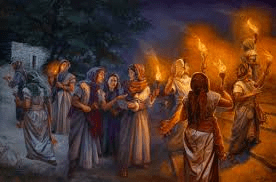
“Then the kingdom of heaven will be like ten virgins who took their lamps and went to meet the bridegroom. 2 Five of them were foolish, and five were wise. 3 For when the foolish took their lamps, they took no oil with them, 4 but the wise took flasks of oil with their lamps. 5 As the bridegroom was delayed, they all became drowsy and slept.” (Matthew 25:1–5 (ESV)
God the Father alone knows exactly when He has decreed God the Son, Jesus Christ, to return to earth in power, might and glory (Matt. 24:29-31, 36), With this in mind, believers in Christ are live in anticipation of the Son’s return. The Lord Jesus could return any day. Therefore, using illustrations and parables, the Lord explained how to prepare for His coming (24:37–25:30). Today, we begin to examine the Parable of the Ten Virgins.
Jesus introduced the parable with the phrase, “the kingdom of heaven will be like.” The kingdom of heaven is the Lord Jesus Christ’s rule and reign over His servants; believers in Christ. Matthew 8 contains several kingdom parables. Today’s text indirectly compares the kingdom of heaven to ten virgins and a wedding. Jesus used this analogy to prepare His disciples for a long delay for His return to earth in power, might and glory. He cautioned all followers to be ready.
The parable begins with ten virgins taking their lamps and meeting a bridegroom. Obviously, a wedding is about to take place. Presumably, it is a Jewish wedding. It is also taking place at night, which explains the need for lamps. The word lamps (λαμπάς; lampas) literally means torch. It most often refers an oil saturated wick contained is a bowl like vessel. However, lamps may also refers to Roman torches.
“Weddings were held toward evening and torches were used as part of the celebration, which focused on a procession leading the bride to the groom’s house,” explains commentator Craig Keener.
“It is unlikely that “lamps” refers to the small Herodian oil lamps, which could be carried in the hand; all the evidence points instead to torches, which were also used in Greek and Roman wedding ceremonies. These torches may have been sticks wrapped with oil-soaked rags. In many traditional Palestinian villages in more recent times, the wedding feast occurs at night after a day of dancing; the bridesmaids leave the bride, with whom they have been staying, and go out to meet the bridegroom with torches. They then escort him back to his bride, whom they all in turn escort to the groom’s home.”
Jesus made a distinction between the ten unmarried bridesmaids. He said five of these women were foolish and five of them were wise. In other words, there was a lack of understanding among half of the women which the other half possessed.
This wisdom, or lack thereof, directly related to the supply of oil required to keep the respective lamps lit and burning. The foolish women did not take extra oil with them. The wise women did. This was all the more necessary because the bridegroom was delayed in his arrival. Whereupon, all ten virgins became drowsy and slept.
“As is clear from a comparison of 25:13 with 24:42, 44, there is a close connection between this parable and the immediately preceding one. Both emphasize the need of being prepared at all times for the coming of the Bridegroom, Jesus Christ,” comments Dr. William Hendriksen.
“The ten are alike in ever so many respects. All intend to meet the bridegroom and to escort him to the place where the festivities are to be held. All have lamps. All are expecting the bridegroom to come before another day has arrived, but none of them knows at what hour he is coming. All are looking forward to taking part in the marriage feast. When the bridegroom lingers, all these ten girls fall asleep, a sleep from which all are suddenly aroused (verses 5 and 6).”
The significance of this sudden awakening, and the lack of knowledge of the bridegroom’s arrival, will concern us as we continue our study tomorrow. Are you prepared to meet the Lord?
Soli deo Gloria!
 His Word Today