
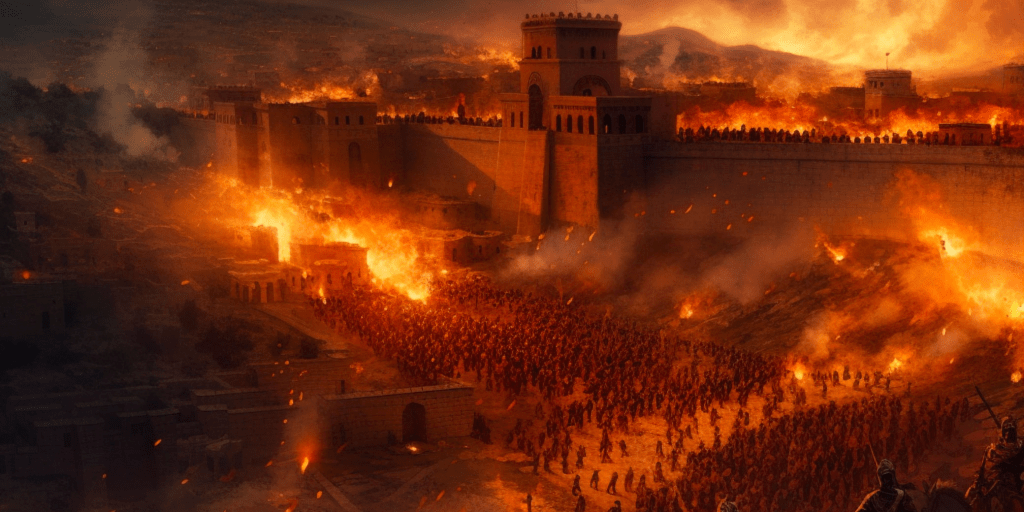
16… “then let those who are in Judea flee to the mountains. 17 Let the one who is on the housetop not go down to take what is in his house, 18 and let the one who is in the field not turn back to take his cloak. 19 And alas for women who are pregnant and for those who are nursing infants in those days! 20 Pray that your flight may not be in winter or on a Sabbath.” (Matthew 24:16–20 (ESV)
Within the immediate fulfillment of the abomination of desolation (Matt. 24:15), fulfilled with the destruction of Jerusalem and the temple in 70 A.D., Jesus proscribed the actions of those living during this time. While Christ’s words point to the immediate future in the first century, they also apply to the greater desolation occurring in the world immediately prior to the return of the Lord (Matt. 24:29-31).
First, Jesus commanded those living during this time in Judea to flee to the mountains. The mountains may refer to areas southeast of Jerusalem. This would be the area near the Dead Sea and would include the hills of Moab and Edom. It was there that David hid from Saul (I Sam. 23:29). It would be here believers in Christ would find refuge from Rome.
Second, fleeing to the hills for refuge would entail an immediate departure. There would be no time to collect personal possessions from home to take on the journey. Jesus commanded His listeners to flee with the clothes on their back and nothing more. Otherwise, they faced certain persecution and death from the Roman army.
Third, the individual in the field must also immediately flee. There would no time to even go back to collect one’s cloak. Even though such a garment would provide warmth and comfort at night, there would be no time to retrieve it. Jesus commanded no one go back for personal effects.
Fourthly, this time of destruction would be particularly difficult for pregnant women and those with nursing infants. Jesus cautioned people the living conditions while fleeing the Romans would prove challenging and difficult. He displayed special concern for women and children, who the male dominated society and culture dismissed and often rejected in the first century.
Finally, Jesus cautioned people that this devastation and time of flight from Rome could occur either on the Sabbath or during the winter. They needed to prayerfully prepare.
“Even in that climate the winter has its cold days. Moreover, it is the rainy season. Snow, especially in the hills to which Jesus had ordered his followers to flee and even lower down, could not be entirely ruled out,” explains Dr. William Hendriksen.
“Traveling on the Sabbath was difficult. To be sure, even the rabbis permitted flight on the Sabbath when a person was in danger of losing his life. And Christ’s own teaching on the subject of Sabbath observance (Matt. 12:11; Mark 2:27) was sufficiently generous to make allowance for escape on that day. But the many man-made rules and regulations by means of which the scribes and the Pharisees had created the impression that man was indeed made for the Sabbath would have resulted in refusals on the part of many a strict observer to help those in need. So the Lord urges his disciples to pray that they may not have to flee in winter or on the Sabbath.”
“This prophecy, this warning, speaks to the fall of Jerusalem, and only the fall of Jerusalem. Its prime commands cannot possible apply to Jesus’ return,” explains commentator Daniel M. Doriani. “When He (Jesus) comes, it will be utterly pointless to flee to the mountains. Indeed, Revelation says unbelievers will wish to be buried under mountains on that day (Revelation 6:16). Why would a believer want to flee anyway? How could it be worse for mothers at Christ’s return, or worse if He came on a cold winter day? But it is imperative to flee, at once, from a vengeful army, and cold and children do compound the trouble of flight.”
Regardless of whatever happens in life, God remains in control by His purposeful sovereignty. However, this does mean believers in Christ should be prepared for tribulation and suffering. Have a faithful day in the Lord.
Soli deo Gloria!
 His Word Today