
15 “Woe to you, scribes and Pharisees, hypocrites! For you travel across sea and land to make a single proselyte, and when he becomes a proselyte, you make him twice as much a child of hell as yourselves.” (Matthew 23:15 (ESV)
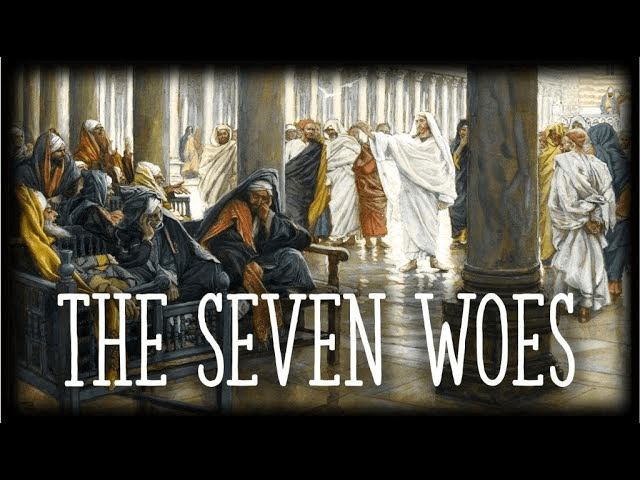
In the context of Matthew 23:13-36, Jesus heralded seven woes against the scribes and Pharisees. Luke 11:37-54 records an earlier lamentation of six woes. Rather than an oracle from a prophet of God, these woes are an oracle from the God of the prophets.
“A woe,” James M. Boice writes, “is a lament or wail concerning the final end for evil people.”
“Woes are an important part of the Old Testament prophetic books; in many places the prophets declared oracles of woe from God that promised judgment for Israel’s sins (for example, Isa. 5:8–23; Amos 6:1–7). With His oracles of woe, Jesus stands as the judge of men, warning the impenitent of the fate that awaits them,” states Dr. R. C. Sproul.
In this second woe, Jesus condemned the scribes and Pharisees’ efforts to convert Gentiles to Judaism. The Lord recognized their zeal in traveling long distances to make a single proselyte. A proselyte (προσήλυτον; proselyton) is a non-Jew who is circumcised and adopts the Jewish religion.
“The second woe faults the Pharisees’ missionary outreach (23:15). Making converts per se is not condemned, the problem is the “truth” to which they convert people. Pharisaic teaching tends to produce zealous advocates of legalism and proponents of humanity’s ability to earn God’s favor, not messengers of grace. Since man cannot earn his own righteousness (Rom. 3:23), most converts to Pharisaism become children of hell, preachers of a false gospel,” explains Dr. Sproul.
Jesus’ condemnation was not in the religious leaders attempts to lead people to the One, True God of the Jews. This was a noble effort to bring pagans to biblical truth. However, the scribes and Pharisees efforts resulted in recent converts becoming twice as much a child of hell as these religious leaders.
“There were two kinds of proselytes in the synagogues. One was called ‘a proselyte of the gate.’ This was a Gentile who only attended the services. He now worshipped the true God, but he had not committed himself to full ritualistic and legalistic Judaism. Such proselytes are referred to in the Book of Acts as a person who was devout (Acts 10:2, 7; 13:20), as God-fearing (10:2, 22, 35; 17:4, 17), or as a worshiper of God (16:14; 18:7),” states Dr. John MacArthur.
“The other kind of proselyte was referred to as ‘a proselyte of righteousness’ so called because he became as religiously Jewish as a Gentile could become. They participated in all the ceremonies, rituals, and feasts. They observed all the cleansing and other rites, both biblical and traditional. Those converts were even given Jewish names in order to separate them as much as possible from their pagan past. Contrary to their popular appellation, however, they became anything but righteous. Like the scribes and Pharisees who instructed them, they became paragons of self-righteousness.”
Are you a spiritual soul-winner who leads people to Christ but also to Pharisaic legalism? Resolve to renounce any legalistic tendency you, and others, may possess.
Soli deo Gloria!
 His Word Today