
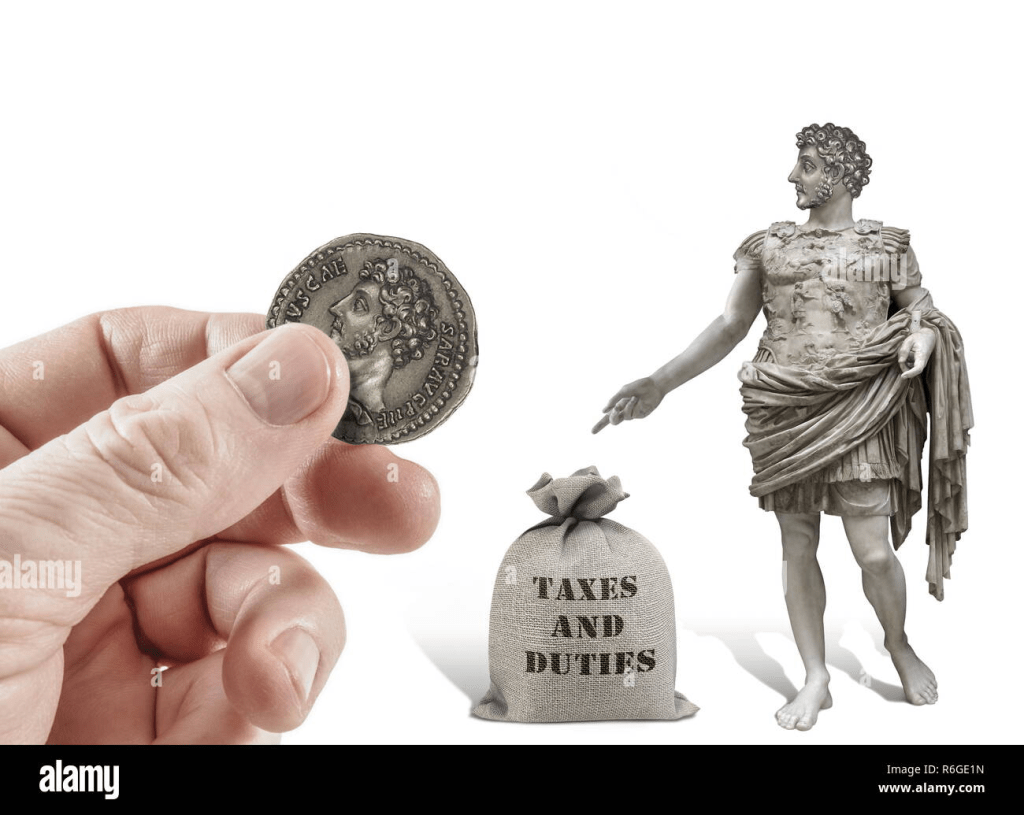
18 “But Jesus, aware of their malice, said, “Why put me to the test, you hypocrites? 19 Show me the coin for the tax.” And they brought him a denarius. 20 And Jesus said to them, “Whose likeness and inscription is this?” 21 They said, “Caesar’s.” Then he said to them, “Therefore render to Caesar the things that are Caesar’s, and to God the things that are God’s.” 22 When they heard it, they marveled. And they left him and went away.” (Matthew 22:18–22 ESV)
A common idiom, or turn of phrase, is there are two things certain in life: death and taxes. It was made famous by one of America’s Founding Fathers; Benjamin Franklin.
“Our new Constitution is now established, and has an appearance that promises permanency; but in this world nothing can be said to be certain, except death and taxes.” — Franklin, in a letter to Jean-Baptiste Le Roy, 1789
As long as there has been government, there have been taxes (Deut. 18:14-17; Acts 23:1-5; Rom. 13:1-7; I Peter 2:17). “Because the task of government is divinely ordained and requires financial support, the Christian must pay taxes with a distinctive motive and understanding, as an element of obedience and devotions to God (Matt. 17:24-27; 22:15-21),” explains Dr. R. C. Sproul.
As God Incarnate, Jesus acknowledged and affirmed this biblical truth as today’s text reveals. At the same time, He also recognized the motives of the Pharisees. They were people of malice and hypocrisy. “But Jesus, aware of their malice, said, ‘Why put me to the test, you hypocrites’?”
Malice (πονηρίαν; ponerian) means wickedness. It refers to not only wicked behavior but also a wicked and evil nature. A hypocrite (ὑποκριταί; hypocritai) is pretending to something, or someone, you are not. In the Greek culture, a hypocrite was an actor in the theater pretending to be someone else. Jesus used both terms to describe and judge the ungodly Pharisees.
“As in past episodes (21:23–27), Jesus is in a no-win situation. The Jewish populace will hate Him if He affirms the propriety of the poll tax. Yet if He declares it unlawful, He can be charged with treason. Jesus, of course, sees through the ruse. He asks for the coin used to pay the tax, which for pious Jews should be a special copper coin minted with Rome’s approval, not the silver denarius, which is seen as idolatrous because it depicts the Caesar’s image and his title divus et pontifex maximus, Latin for “divine and high priest.” Jesus’ enemies are revealed as hypocrites when they produce the denarius (22:18–21). Those who hate idolatrous coinage are carrying unclean money themselves,” explains Dr. R. C. Sproul.
Matthew then recorded the following object lesson by the Lord. 19 “Show me the coin for the tax.” And they brought him a denarius. 20 And Jesus said to them, “Whose likeness and inscription is this?” 21 They said, “Caesar’s.” Then he said to them, “Therefore render to Caesar the things that are Caesar’s, and to God the things that are God’s.” 22 When they heard it, they marveled. And they left him and went away.”
The Pharisees marveled at Jesus’ teaching and wisdom. The word marveled (ἐθαύμασαν; ethaumasan) means to wonder and be amazed. They did not expect such an answer. They were filled with awe, but they remained unconverted as they left Him and went away.
“He (Jesus) was not evading the issue, but was clearly saying, “Yes, pay the tax.” Honoring God does not mean dishonoring the emperor by refusing to pay for the privileges—a relatively orderly society, police protection, good roads, courts, etc., etc.—one enjoys. Cf. 1 Tim. 2:2; 1 Peter 2:17. Thus, no truthful charge of sedition could be made against Jesus,” states Dr. William Hendriksen.
“Our Lord’s teaching is a useful principle for understanding when it is lawful to obey the state. As long as it does not claim for itself the rights that appropriately belong to God, Christians must obey the ruling authorities. This means we obey even when we do not agree with their tax rates, speed limits, or regulation of other parts of our lives. Do you obey the government when no biblical principle is violated even if you do not like the laws of the land,” concludes Dr. Sproul.
Soli deo Gloria!
 His Word Today