
11 “But when the king came in to look at the guests, he saw there a man who had no wedding garment. 12 And he said to him, ‘Friend, how did you get in here without a wedding garment?’ And he was speechless. 13 Then the king said to the attendants, ‘Bind him hand and foot and cast him into the outer darkness. In that place there will be weeping and gnashing of teeth.’ 14 For many are called, but few are chosen.” (Matthew 22:11–14 (ESV)
As today’s text reveals, Jesus was not quite done with The Parable of the Wedding Feast. There remained an epilogue. An epilogue is a conclusion or a postscript. In other words, Jesus had more to say in His object lesson to the Jewish religious leaders (Matt. 21:23).
After the wedding hall was filled with invited guests (Matt. 22:10), the king came to look at the guests. Remember, these people were not the ones originally invited and who refused to attend (22:1-8). Rather, they were strangers who the king’s servants found on the roads and invited at the monarch’s request. Some were bad and some were good.
When the king arrived, he saw a man who had no wedding garment. He asked the individual, “‘Friend, how did you get in here without a wedding garment?’ The man in question remained speechless. What was the significance of wedding guests wearing wedding garments?
“When the first invitees turn down their summons to the king’s feast, others, bad and good, come to the table (Matt. 22:10). Does this mean that God’s banquet will include the profoundly wicked who finally trusted Christ as well as those who, though upright by human standards, saw their lack of perfection and served Jesus? Or, are the “bad” guests those who profess faith falsely, the poor fish who in Matthew 13:47–50 dwell among the good until the end,” asks Dr. R. C. Sproul?
“The first interpretation is certainly biblical, but the concluding verses of the parable of the tenants (22:11–14) favor the latter option. Ancient kings often provided the proper attire to the guests at their feasts,” as Dr. John MacArthur notes. “This second group of invitees has need of appropriate clothing, for they are found on the street unprepared to attend a wedding banquet. Therefore, the ejected man’s “lack of a proper garment indicates that he has purposely rejected the king’s own gracious provision.”
Jesus then stated what the king decided to do. ‘Bind him hand and foot and cast him into the outer darkness. In that place there will be weeping and gnashing of teeth.’ 14 For many are called, but few are chosen.”
“The call spoken of here is sometimes referred to as the “general call” (or the “external” call)—a summons to repentance and faith that is inherent in the gospel message. This call extends to all who hear the gospel. “Many” hear it; “few” respond (see the many-few comparison in 7:13–14).,” explains Dr. MacArthur.
“Those who respond are the “chosen,” the elect. In the Pauline writings, the word “call” usually refers to God’s irresistible calling extended to the elect alone (Rom. 8:30)—known as the “effectual call” (or the “internal” call). The effectual call is the supernatural drawing of God that Jesus speaks of in John 6:44. Here a general call is in view, and this call extends to all who hear the gospel—this call is the great “whoever will” of the gospel (cf. Rev. 22:17). Here, then, is the proper balance between human responsibility and divine sovereignty: the “called” who reject the invitation do so willingly, and therefore their exclusion from the kingdom is perfectly just. The “chosen” enter the kingdom only because of the grace of God in choosing and drawing them.”
“
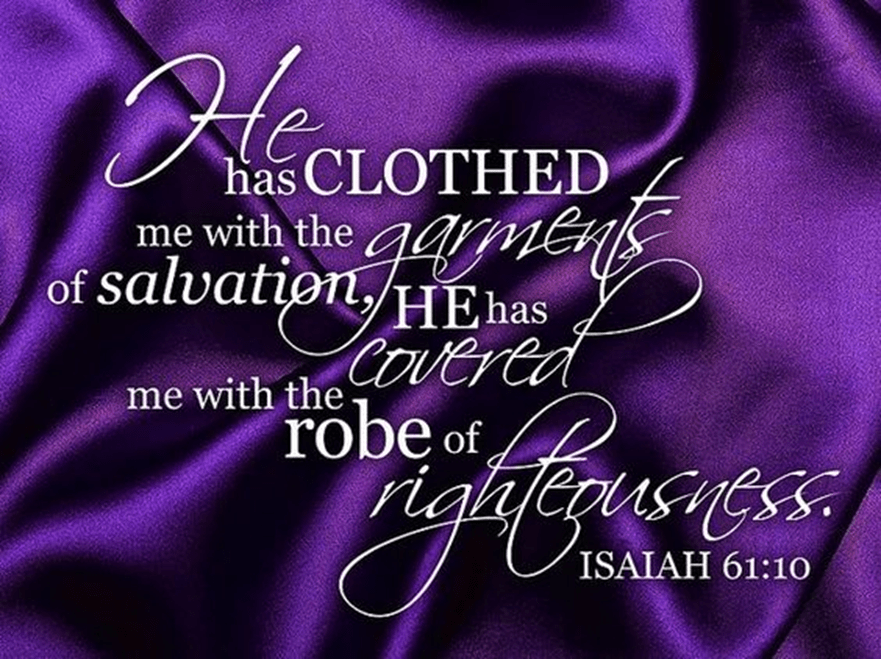
“This parable teaches us about justification — God’s crediting of His Son’s perfect righteousness to our record through faith alone (Rom. 3:21–26). Yet justifying faith is active, demonstrating itself in good deeds (James 2:14–26; WCF, 11.2). We must distinguish justification, the only way we can stand before the Creator, from sanctification — our working out of salvation by serving others and becoming more like Jesus (Phil. 2:12–13). Still, justification and sanctification are inseparable, and we cannot have one without the other,” states Dr. Sproul. See Zachariah 3:1-5; 2 Cor. 5:21.
Have you received the imputed righteousness of Christ (Romans 3:21-26; 4:1-25)? Are you dressed in His righteousness alone, faultless to stand before the throne? Are you evidencing this righteousness by a holy life?
My hope is built on nothing less
Than Jesus’ blood and righteousness
I dare not trust the sweetest frame
But wholly lean on Jesus’ Name.
On Christ the solid Rock I stand
All other ground is sinking sand
All other ground is sinking sand.
When darkness seems to hide His face
I rest on His unchanging grace
In every high and stormy gale
My anchor holds within the veil.
On Christ the solid Rock I stand
All other ground is sinking sand
All other ground is sinking sand.
His oath, His covenant, His blood
Support me in the whelming flood
When all around my soul gives way
He then is all my Hope and Stay.
On Christ the solid Rock I stand
All other ground is sinking sand
All other ground is sinking sand.
When He shall come with trumpet sound
Oh may I then in Him be found
Dressed in His righteousness alone
Faultless to stand before the throne.
On Christ the solid Rock I stand
All other ground is sinking sand
All other ground is sinking sand.
Soli deo Gloria!
 His Word Today
I want to develop my skills using your post? If you have any ideas how I should ask our Father to help me in perspective of writing to captivating the Christian communities in the United States and other countries?
LikeLike